
Confraternity of Our Father Jesus the Fallen and Our Lady of Health


Popular Name:
Fallen and Health
Founded:
Canonical Seat:
Imagery:
- Our Father Jesus the Fallen (Granada School – 17th century) – Throne of 24 santeros
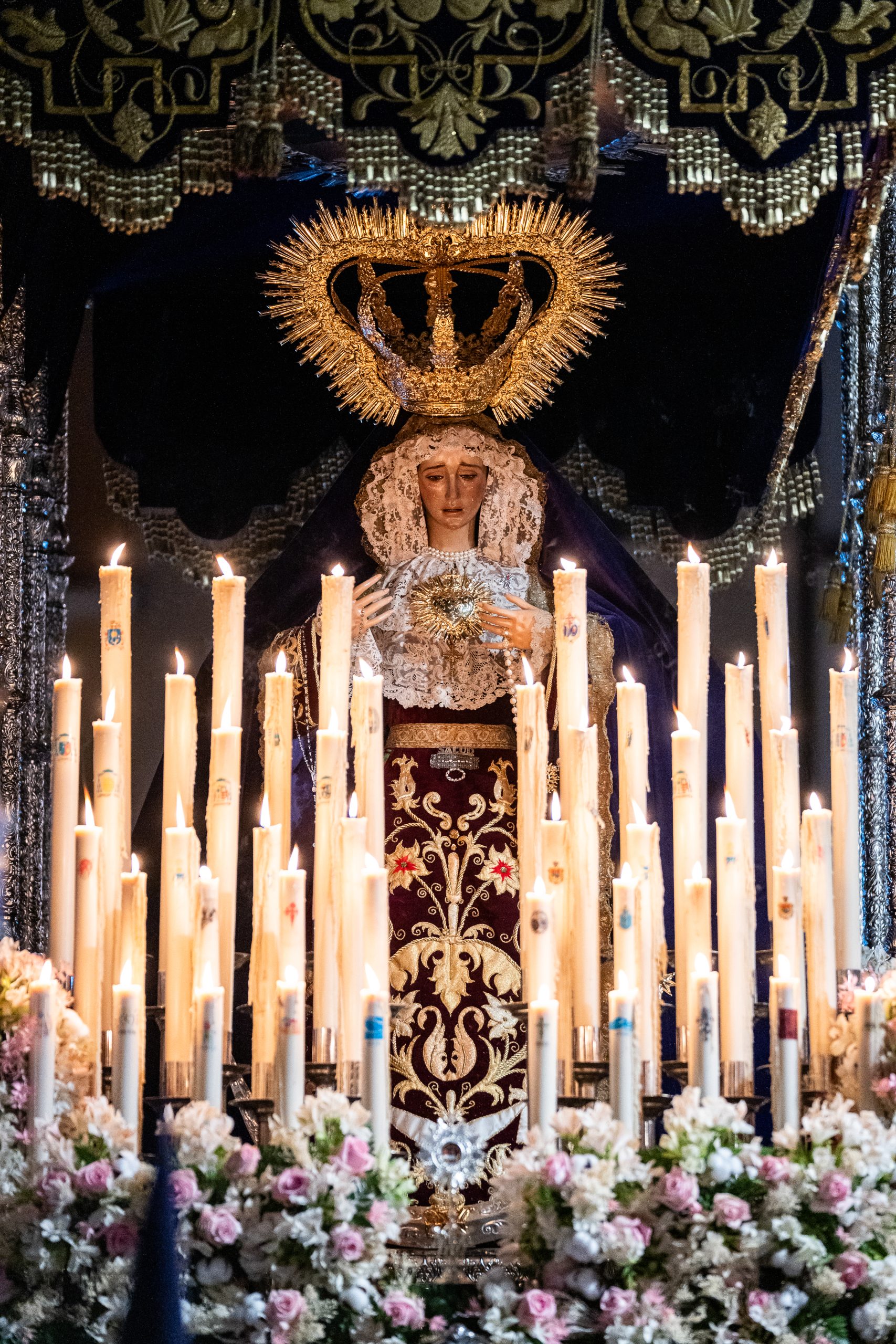
- Our Lady of Health (Daniel Henares Paredes – 2010) – Throne of 26 santeros
Hermano Mayor:
Francisco Manuel Luque López
Procession Departure:
Holy Thursday – 8:15 pm
Number of Brothers:
110
Tunic of the Brothers:
Purple tunic and hood, the latter embroidered with the cross of Saint James, and a rope cincture.
Tunic of the Santeros:
Purple tunic and capirote with a white cord.
To trace the current history of the Confraternity, we must go back — as with so many other Lucena institutions — to the founding of the Venerable Confraternity of Our Lady of Peace and Congregation of the Holy True Cross, Prayer and Good Death in the 16th century. With its own chapel, several Passion brotherhoods were formed within it that processed together on the afternoon of Holy Thursday, closed by the joyful image of Our Lady of Peace. The Confraternity of the True Cross and that of Our Lady of Peace were governed by separate governing boards until the approval of the statutes in 1832.
The image in question, that of Jesus the Fallen, was acquired, according to a surviving account book, in 1702 in Granada, for the sum of 1,152 reales. In 1719 the cross covered in silver sheet with sgraffito decoration, with which it still processes today, was made.
The various images that formed part of the procession were assigned to different cuadrilleros (lay patrons responsible for their upkeep) as a way of addressing the financial difficulties experienced by the brotherhood during the 19th century. Because the chapel was so small, some cuadrilleros moved the images to their private homes in the early 20th century, a situation which, together with the poor state of repair of the building, had already forced the procession to set out from Llanete de Santiago, and which would eventually lead to the sale and demolition of the chapel in the 1940s.
From that point on, the second historical stage of these images began, with the formation of independent confraternities around the various devotions that had split off from the old corporation — a development that allowed this important devotional and artistic heritage to be preserved.
During this period, the image of Jesus the Fallen was placed by the Blanes family — who held the cuadrillería (patronage) of the image — in the oratory of the Álvarez de Sotomayor family, making its penitential procession on Holy Thursday from the Parish Church of San Mateo until, in 1964, the collapse of the vaults of San Pedro Mártir destroyed the throne in which it was kept.
It was not until 1972 that the present-day Confraternity was established and its canonical seat changed, being moved to the Parish Church of Santiago, after its first Hermano Mayor contacted the Marquis of Blanes to request the transfer of the image. The first penitential procession took place in 1975 from the church of Las Filipenses, since the parish church was undergoing works and the image had to return to the home of the Countess of Valdecañas after the procession ended. This arrangement continued until 1979, when its cuadrillero definitively handed the image over to the Confraternity. It was in 1976 that the image left from the church of Santiago for the first time, and in 1982 its first besamanos (hand-kissing ceremony) took place.
The image of Our Lady of Peace once again accompanied Jesus the Fallen from 1987 under the title of Our Lady of Health, after a section of the Governing Board was set up to promote a Marian titular image. The brotherhood’s heritage continued to grow, and in 2010 the Board considered replacing the image with another that would more fully embody the character of a Sorrowful Mother; the current image, the work of José Daniel Henares, was blessed on 6 March 2010. In 2022 the fiftieth anniversary of its founding was celebrated, an occasion marked by the restoration of the Christ figure and the liturgical coronation of the Blessed Virgin.
Our Father Jesus the Fallen is a dressed image of the Granada school by an anonymous author, dated to the last decade of the 18th century. It depicts Jesus during one of his falls, carrying the cross, with one knee on the ground and his hand resting on a rock. It was a titular image of the now-defunct Confraternity of the True Cross and, in the early 20th century, was placed by the Marquises of Blanes, its cuadrilleros, in the oratory of the Álvarez de Sotomayor Valdecañas family.
The image was restored in 2022 by the Lucena-based firm CECORE. Of particular note is the cross covered in silver sheet with sgraffito decoration from 1719 with which it processes.
Our Lady of Health is a candelero image (built on an inner wooden framework beneath the robes) made in 2010 by José Daniel Henares and blessed on 6 March of that year. It replaced the older Our Lady of Peace, which had processed under this title after being altered to give it the character of a Sorrowful Mother. Notable features include the crown in the Antequera style and the canopy valances embroidered in fine gold thread, in a nineteenth-century pre-Juanmanuelino design, by the Huelva-born artist Cristobalina Muñoz Álvarez, blessed in March 2019.
Our Lady of Peace, as recorded in the accounts of the True Cross brotherhood for 1592, appears in connection with an expense of 11,817 maravedís for wax, the polychroming of a full-figure image of Our Lady, and the renewal of a figure of Christ, from which it may be inferred that it was made around that time. The image came into the Confraternity’s hands after being converted into a Sorrowful Mother by the Confraternity of Our Father Jesus Bound to the Column, and was handed over to this brotherhood by the parish priest in 1986. It is currently withdrawn from worship and undergoing a restoration process so that it can be returned to veneration.
The throne of Our Father Jesus the Fallen was made in 2000 in the Angulo workshops. It follows a Baroque style of scrollwork and depicts various episodes from the life of Christ on its cartouches. The lanterns were likewise made by the same workshop in 1982, in silver-plated metal.
The base structure and pedestal of the throne of Our Lady of Health were made in 2001 by the Angulo workshops, with the canopy poles and cresting made the following year in chased, silver-plated metal, forming an ensemble likewise in the Baroque scrollwork style. The current vases were unveiled in 2022, while the embroidered canopy valances, made by Cristobalina Muñoz Álvarez, were unveiled in 2019.

*Documentary Source: Notas para la historia de las cofradías lucentinas (Francisco López Salamanca – 2022), Official Programme of the Semana Santa de Lucena 2026, and documentation provided by the confraternity itself.
*Photographs: Jesús Ruiz Jiménez ‘Gitanito’ and Jesús Cañete Fernández.

