Holy Week
Identity and Distinctiveness
Holy Week in Lucena: A Celebration with Its Own Identity
Holy Week in Lucena is one of the most distinctive expressions of Andalusian popular religiosity. Its distinctive character, shaped over the centuries, transcends the strictly processional sphere to become a collective expression of identity, heritage, and living tradition. The ‘santería’, recognised as an Asset of Cultural Interest (Bien de Interés Cultural), together with a wide range of tangible and intangible heritage elements —sounds, vocabulary, rituals, craftmanship, popular participation, and intergenerational transmission— shape a unique celebration that is lived intensely throughout all 365 days of the year, distinguishing Lucena within the Andalusian and Spanish confraternity landscape.
Living Tangible and Intagible Heritage throughout the Year
Holy Week in Lucena is sustained by a broad range of tangible and intangible heritage assets that together form a distinctive and fully living cultural ecosystem. Alongside the uniqueness of the ‘santería’, the town preserves a network of artisan workshops —including silversmithing, bronze casting, embroidery, sculpture and sacred imagery, woodcarving, restoration, and sound craftsmanship— that maintain centuries-old techniques with a contemporary outlook, carrying out their work throughout the year. Added to this are the confraternity tailoring workshops, responsable for the attire of ‘santeros’, ‘nazarenos’, and ‘mantillas’, which play a fundamental role in shaping the distinctive aesthetic identity of the celebration. This heritage is complemented by an outstanding reliigious legacy, comprising churches, convents, chapels, hermitages, and a sanctuary open for worship, as well as a rich sound heritage that remains active throughout the twelve months of the year ―drums, the ‘torralbo’, ‘saetas’, and procesional marches. It also includes spaces such as the Brotherhood Houses, where confraternity life and activities continue from January to December. Nor should we overlook the town’s rich sculptural heritage , which preserves works by renowed sculptors such as Pedro Roldán, Blas Molner, Diego de Mora, and Castillo Lastrucci.
At the same time, the intangible dimension is reflected in the vibrant live of Lent, during wich a multitude of events and tourist itinerariesare organised, in the passing down of traditions from one generation to the next through the Children’s Holy Week and the Youth Committees, in the traditional cuisine and pastries associated with this liturgical season, and in a distinctive vocabulary that captures the uniqueness of the ‘santería’ and the traditions of Lucena. All of these elements together form a cohesive cultural system that transcends the celebration itself and stands as a defining expression of the community’s collective identity.
- Artisan workshops: silversmithing, bronze casting, embroidery, sculpture and sacred imagery, woodcarving, restoration, and sound craftsmanship. Local master craftsmen with an international reputation keep centuries-old techniques alive.
- Confraternity tailoring workshops: they create the attire of ‘santeros’, ‘nazarenos’, and ‘mantillas’, carefully attending to every detail in accordance with tradition. Their work preserves the aesthetic and heritage identity of Holy Week in Lucena.
- Religious heritage: fifteen places of worship, including five parish churches, two convents (the Franciscans and the Agustinins Recollets), three churches, two hermitages, two chapels, and one sanctuary
- Sound heritage: traditional drum and ‘torralbo’ rhythms, local ‘saetas’ (such as the Alcantarillaand the Perrilleja), and processional marches composed by musicians from Lucena.
- Brotherhood Houses: centres for the preservation of heritage, fellowship, and cultural activity throughout the year.
- Lent 40 days of intense activity featuring religious worships, proclamations, concerts, exhibitions, and guided tours.
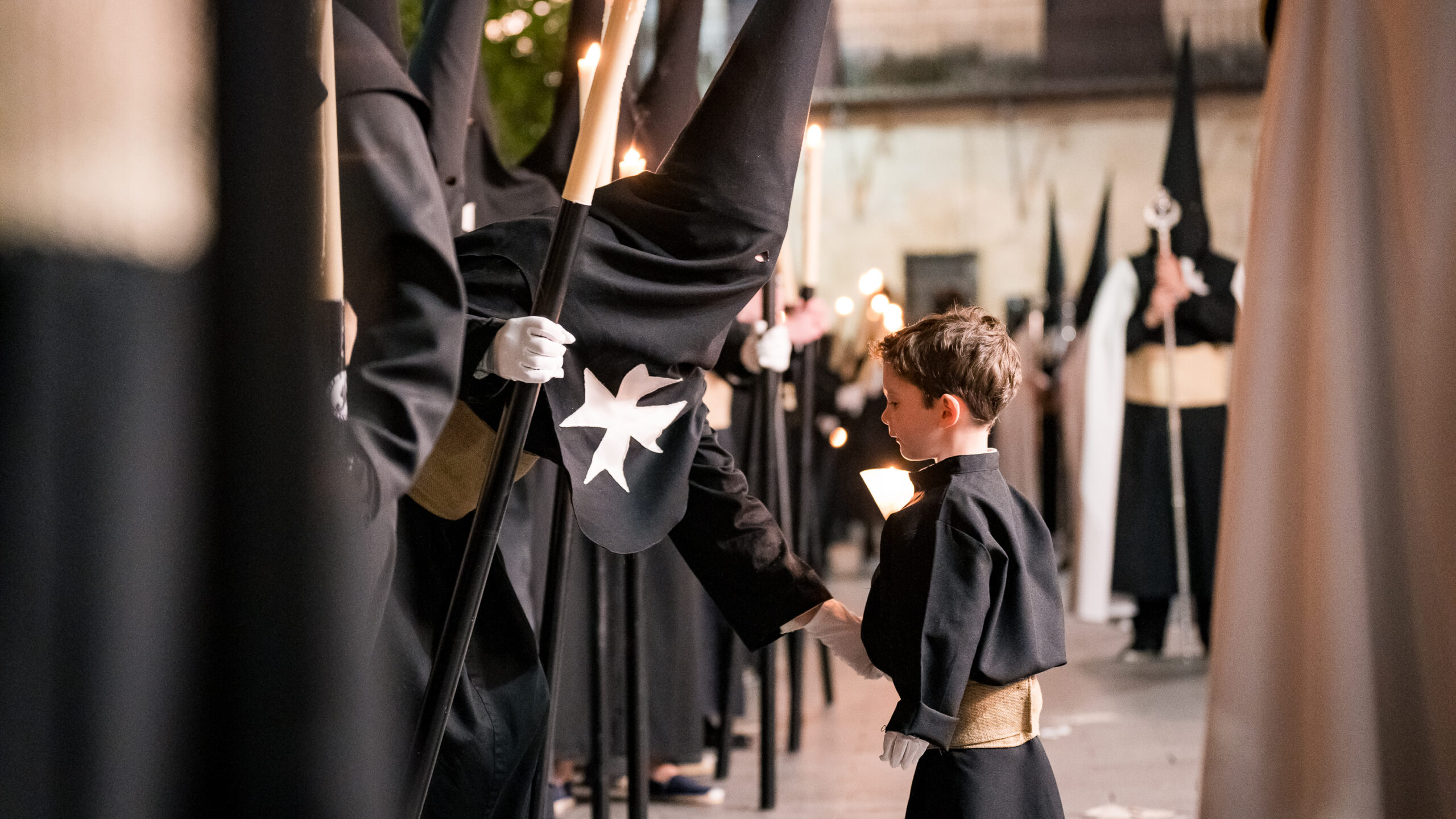
- Children’s Holy Week: more than one hundred children’s crews parade with small thrones, passing the tradition on to new generations.
- Gastronomy and Confectionery: traditional dishes and sweets associated with Lent and Holy Week, featuring recipes passed down from generation to generation that form an integral part of Lucena’s cultural and gastronomic identity.
- Distinctive vocabulary: Holy Week in Lucena possesses its own unique vocabulary, born from the ‘santería’ and the town’s confraternity tradition. It includes expressions passed down orally from generation to generation, forming an essential part of its intangible heritage.
Holy Week today: vitality and distinctiveness
Today, more than fifty images of Christ, the Virgin Mary, and secondary figures are carried in processions during Holy Week, with a total of 17 Passion brotherhoods and confraternities which, as part of the Agrupación de Cofradías of Lucena, work throughout the year to make this celebration possible. Holy Week in Lucena maintain a balance between tradition and renewal, with a programme of events running from Palm Sunday to Easter Sunday and involving the whole town. As a distinctive feature, Lucena does not have an official procession route (‘carrera oficial’). Instead, all brotherhoods and confraternities share a common section of their itineraries, converging at the Parish Church of Saint Matthew the Apostle.
The ‘santería’ is its backbone: temporary crews, led by the ‘manijero’, carry the processional ‘pasos’ in perfect coordination, creating an unique visual and rhythmic language. Visitors are drawn into a symbolic world where every gesture and every sound has a meaning. Holy Week in Lucena is, above all, a celebration deeply rooted in the social fabric of the town, in which the entire community participates actively and continuously.
It is not only the brotherhoods and confraternities —the organising backbone of the celebration—, but also ‘santeros’, ‘manijeros’, musicians, artisans, security services, volunteers, public institutions, and the local business community contribute to making it possible, reflecting a collective commitment that trascends the religious sphere to become a shared cultural and social expression. This level of involvement is sustained throughout the year, with religious worships, activities and preparations that engage different generations and professional sectors, consolidating Holy Week as a shared element of identity and a living heritage that is naturally passed down within the community.
Holy Week in Lucena take place in a particularly well-preserved urban and monumental setting, where the town’s religious heritage is harmoniously integrated into the course of the processions. The planning of processional routes, the adaptation of public spaces, and the organisational measures put in place ensure the protection and conservation of both the architectural heritage and the urban landscape, balancing visitor attendance with respect for the surrounding environment. This commitment extends to the involvement of public authorities, brotherhoods and confraternities, and operational services, which work in coordination to preserve the town’s heritage value throughout the celebration.
Lucena is a founding member of Caminos de Pasión and of the European Network of Holy Week and Easter Celebrations, placing the town within an international framework of cultural exchange and tourism promotion.. Its model of religious and heritage tourism is based onauthenticity and first-hand experience.
The role of women: an essential part of Holy Week in Lucena
Women play an essential and deeply rooted role in Holy Week in Lucena, participating actively in the preservation, organisation, transmission, and promotion of a tradition that forms part of the town’s collective identity. Their presence is essential in the day-to-day life of the brotherhoods and confraternities, where they hold positions of responsibility on governing boards and carry out tasks related to the preparation of religious worships, the internal administration of the corporations, the organisation of educational and charitable activities, as well as the preservation of their artistic, documentary and devotional heritage.
Women’s contribution has been equally decisive in areas linked to the artisan and cultural heritage of Holy Week in Lucena. Embroiderers, seamstresses, ‘camareras’ (images caretakers), dressers of sacred images, florists, photographers, communicators, and professionals involved in a wide range of confraternity-related crafts contribute daily to keeping alive a tradition that extends far beyond the processional sphere. This is complemented by an increasingly prominent role in the cultural and literary dimension of Holy Week, with women taking part as proclamation speakers (‘pregoneras’), exaltation speakers (‘exaltadoras’), presenters and organisers of initiatives dedicated to the dissemination and promotion of Lucena’s confraternity heritage.
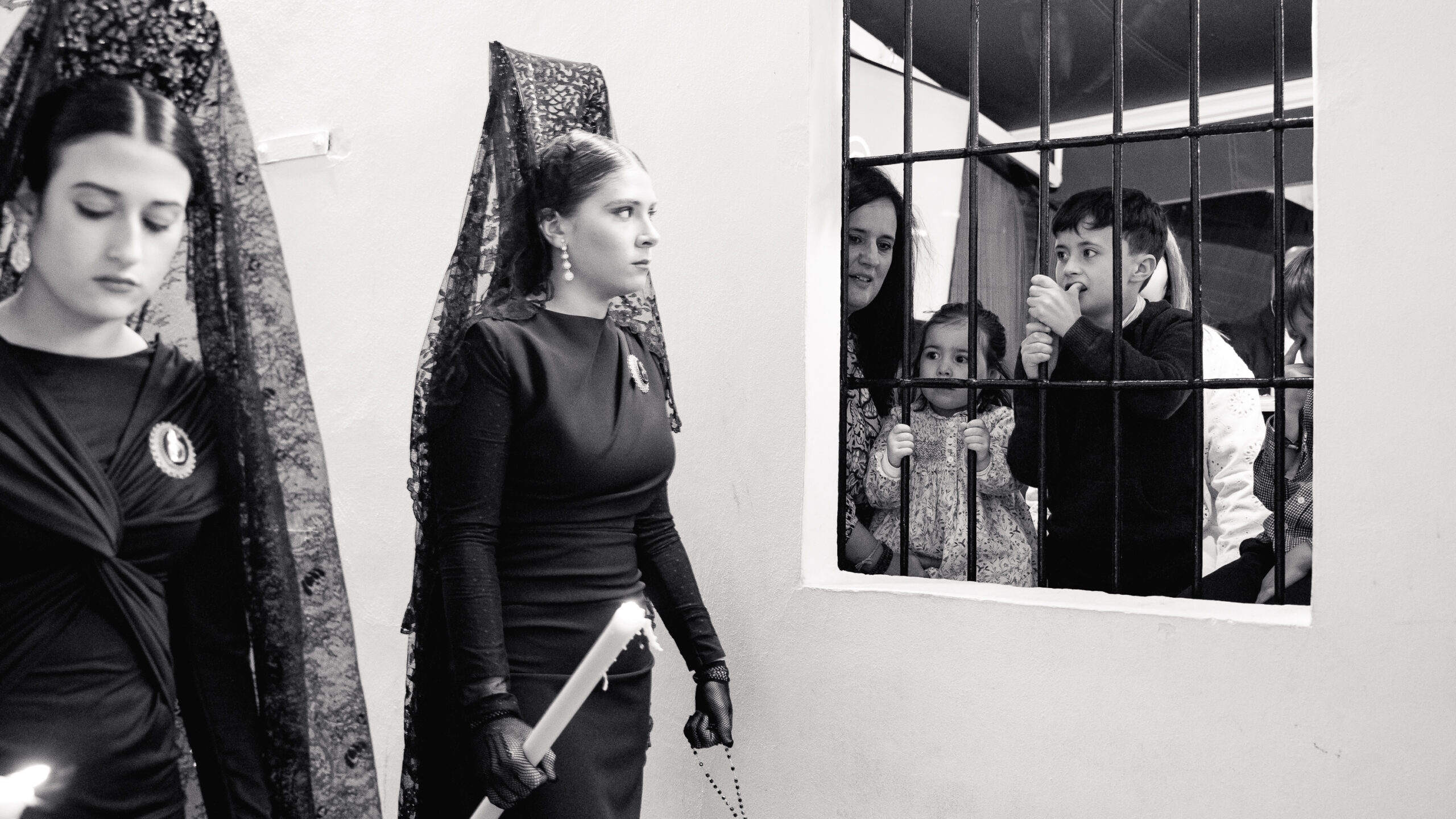
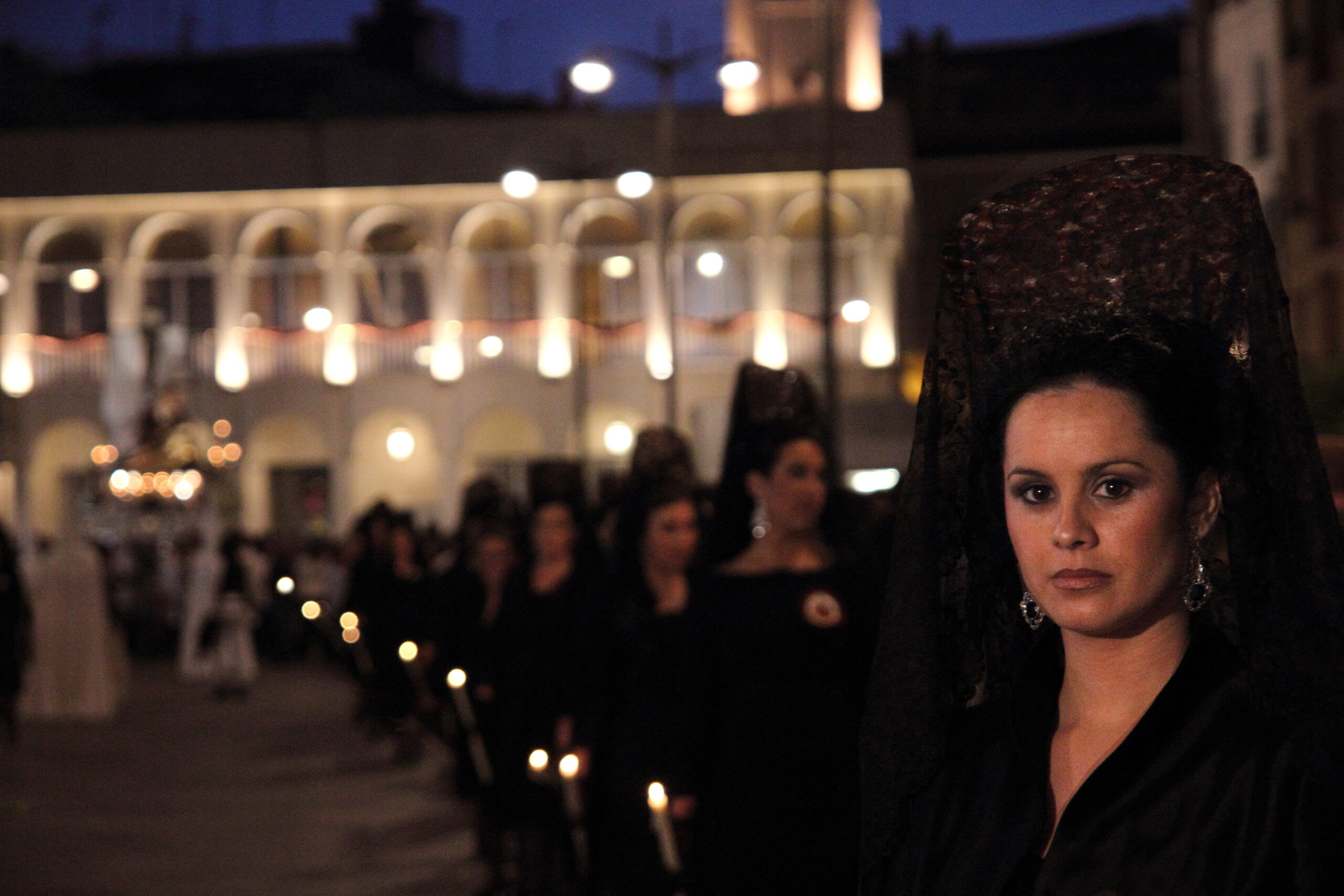
Within the world of ‘santería’ itself, women also occupy a position of great importance, serving as a vital human and emotional pillar of this tradition. The figures of the mother, wife, sister, and the mantilla-handler (‘manijera de mantillas’) have historically been closely linked to the support and preparation of the crews, forming an integral part of the rituals that precede the processions and of the oral transmission of the customs, traditions, and values associated with the penitential procession. Likewise, the ’mantilla’ corteges have taken on considerable significance in recent decades as part of the processions, becoming one of the most elegant and iconic images of Holy Week in Lucena.
The growing participation of women in youth committees, governing boards, working gropus, and cultural activities also reflects the natural evolution of a deeply vibrant and participatory celebration, capable of embracing new perspectives preserving its essence or its historical identity. This sustained involvement of generations of women has played a decisive role in strengthening the social, family and community roots of Holy Week in Lucena.
To speak about the role of women in Lucena’s Holy Week is, in short, to speak about commitment, dedication and the transmission of traditions from one generation to the next. Their contribution ―often discreet, but indispensable in every respect― forms an inseparable part of a celebration that continues to be shaped day by day through the collective involvement of the entire town.
Processions: a living expression of Lucena’s religious devotion
Processions of Holy Week in Lucena constitute a deeply symbolic expression of the town’s popular piety, in which each element fulfils a specific role within the whole, thereby becoming a public catechesis in which faith, tradition, identity and Lucena’s own intangible heritage merge.
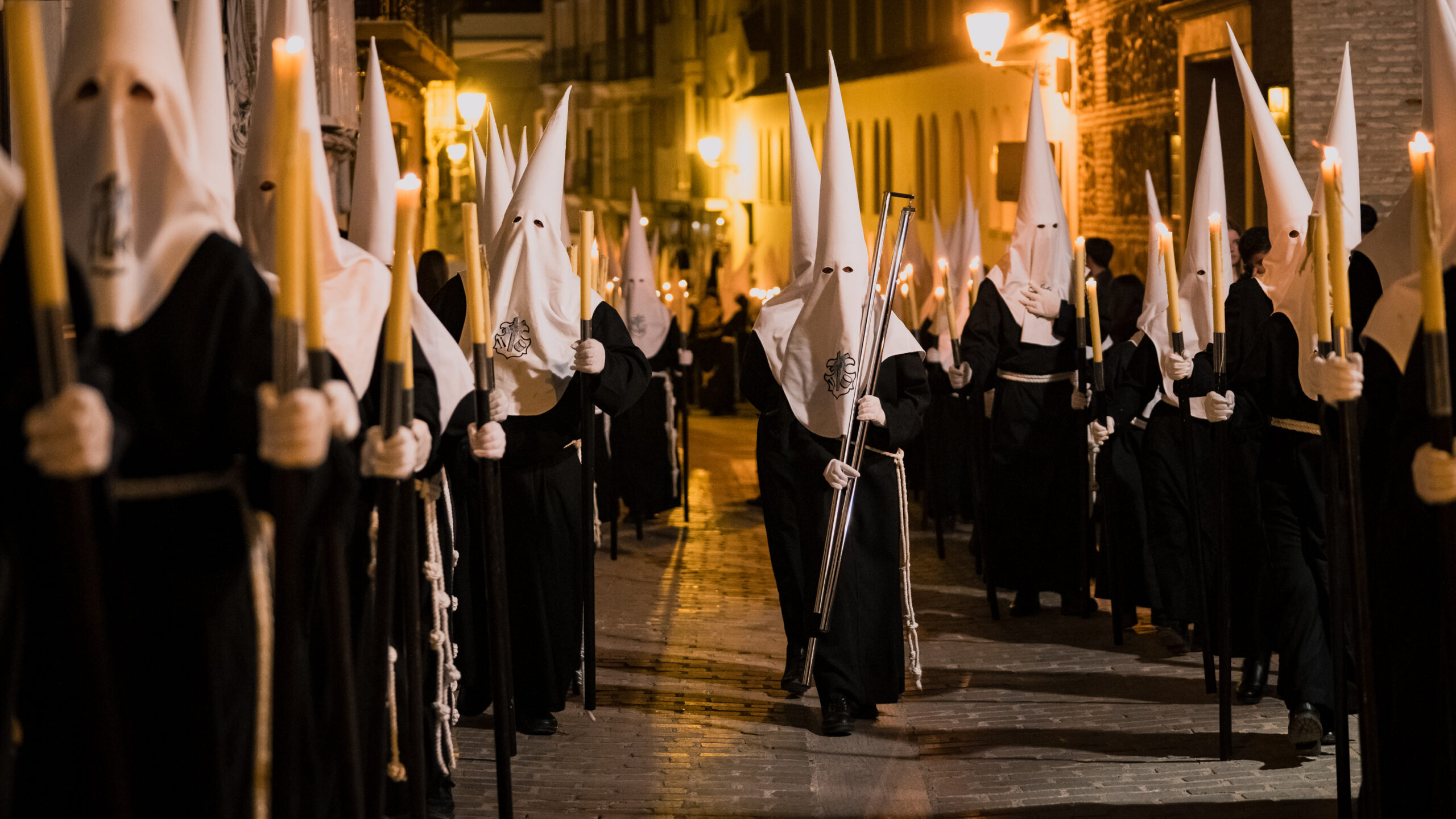
The procession is led by the ‘insignias’ and corporate representations of the brotherhoods and confraternities, followed by a ‘banda de cornetas y tambores’ (brass and drum band). They are followed by sections of candle-bearing confraternity members and ‘mantillas’ (accompanying the ‘pasos’ of Virgin Mary), members of the Govering Boards of the brotherhoods and confraternities, acolytes, ‘pertigueros’, the ‘torralbo’ (where applicable), and, beneath the processional throne carried on the shoulders of the ‘santeros’, the distinctive accompaniment of the drum. In some cases, particularly behind the processional thrones of the Virgin Mary, the cortege is brought to a close by a marching band. It should also be noted that some brotherhoods are accompanied by a chapel music ensemble.
Holy Week in Lucena is experienced in a particularly close and participatory manner, with a lively and vibrant atmosphere that forms an essential part of its distinctive character. Unlike other processional traditions, the streets are not cordoned off, and the public shares the space with the passing corteges. Spectators interact respectfully with the ‘santeros’, asking after their wellbeing, offering them water, and following with admiration the effort and coordination of each crew. This closeness creates a direct relationship between those taking part in the procession and those watching it, reinforcing the communal and human character of a celebration that is experienced from within, in constant contact with the people.
The early hours and morning of Good Friday have a distinctive and instantly recognisable character in Lucena, with a procession that stands apart from the rest of Holy Week due to its massive scale and powerful symbolic significance. Around the image of Our Father Jesus the Nazarene (Nuestro Padre Jesús Nazareno), the streets are transformed into a true sea of purple, formed by thousands of confraternity members who surround and accompany the Lord in an atmosphere of collective fervour,, restrained emotion, and deep popular devotion. More than an orderly procession, the cortege becomes a single living body moving forward in unison, reflecting a shared faith that trascends formal expression and is experienced as a collective act of devotion among all its devotees.
On the other hand, in the early hours of Holy Thursday reach one of their most moving moments in Lucena with the procession of the Cofradía del Silencio (Brotherhood of Silence), when the town is immersed in an atmosphere of absolute contemplation. The mourning drums set a solemn and restrained rhythm as the procession advances in an atmosphere of profound reverence, broken only by the stark beat of the drum and the sounding of the ‘toque de silencio’, which announces the arrival of the ‘paso’. There is no clamour, no speech: only silence, the darkness of the night, and the gentle glow carried by the confraternity members, creating a scene of profound spiritual intensity that transforms the early hours of the morning into a shared prayer and a testimony of faith expressed through the utmost simplicity.
The Lucena Throne: A Bearer of Faith and Tradition
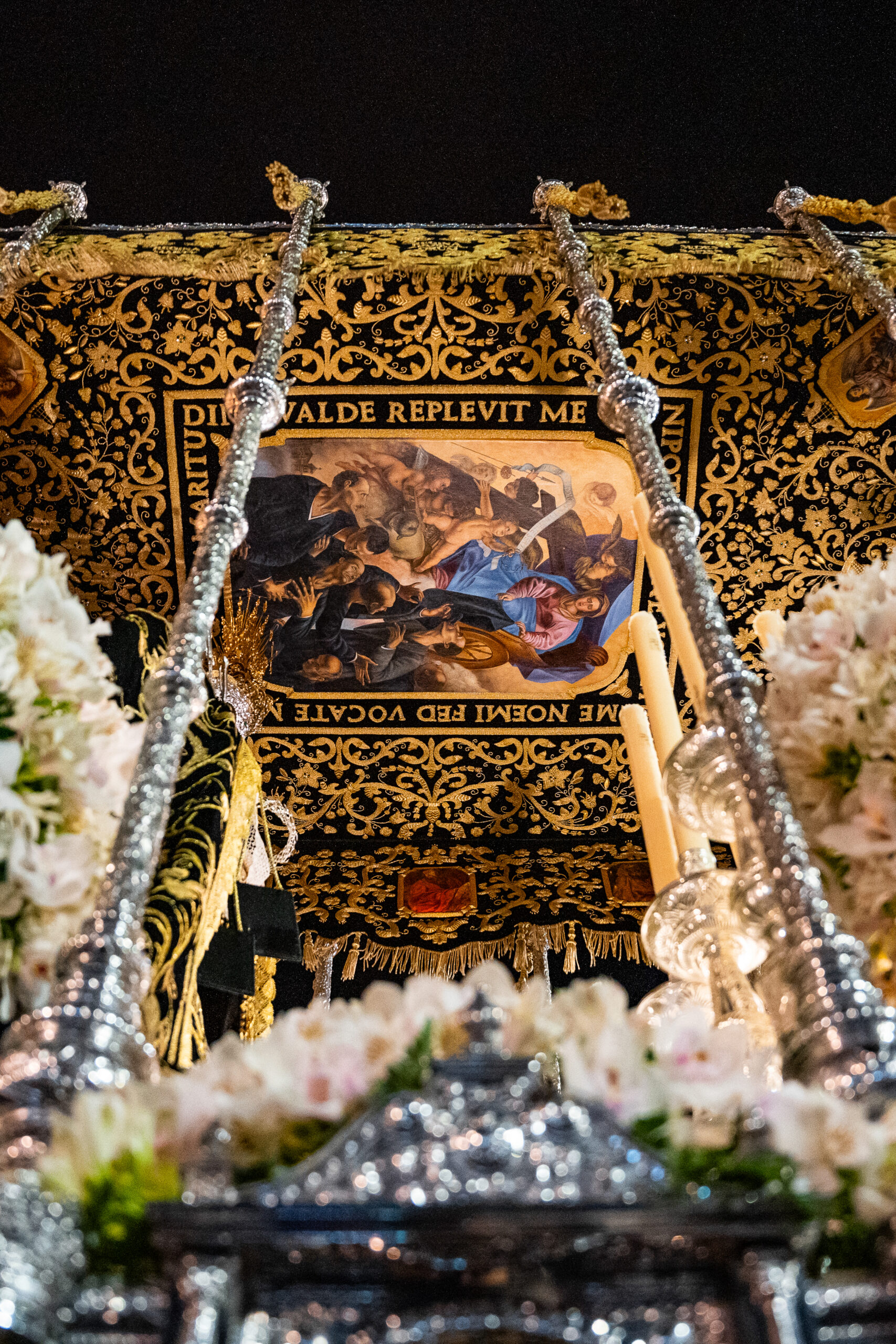
The Lucena throne is a structure specifically designed for the ‘santería’ tradition and for the continuous carrying of sacred images without relife bearers or changes of crews. Its base is the ‘parihuela’ or ‘parigolón’,, which forms the complete framework of the throne and serves as the structural base upon which the entire ensemble is built. Forming part of this structure are the ‘varales’ (poles), arranged longitudinally and in parallel, which rest directly on the shoulders of the ‘santeros’. On these ‘varales’, topped with ornate metal finials (‘casquetes’), concentrate the physical effort and balance of the throne, making them the essential point of contact between the structure and the crew of ‘santeros’. Above the ‘parihuela’ stands the ‘canastilla’, adorned with rich fabrics or decorated with gilded and embossed metalwork. It is within this structure that the sacred image is placed upon a pedestal (‘peana’), enhancing its prominence and visibility.
To make it easier to raise and lower the throne —particularly when entering or leaving the church—, the ‘parihuela’ incorporates the ‘asones’, U-shaped metal fittings positioned along the ‘varales’. Alongside them, the bell (positioned at the manijero’s corner of the throne) serves as an essential means of communication between the ‘manijero’ and the crew, signalling commands —such as stops and starts—. Meanwhile, the individual wooden wedges (‘cuñas’) , placed beneath the ‘varales’ for each ‘santero’, ensure that all members of the crew are aligned at the same height. The carrying system is completed by the use of ‘almohadillas’ (pads), placed on top ot the wedges. While they do not remove the weight, they help to cushion and distribute it during the continuous progress of the procession.
In the canopied thrones (‘pasos de palio’), the ‘candelería’ (arrangement of candles) takes on a particularly prominent role, not only as an ornamental features but also as an essential element of the throne’s visual language. Its arrangement and the rhythm of its light accompany the measured progress of the procession, enveloping the Marian image and reinforcing the atmosphere of recollection and solemnity that characterises Holy Week in Lucena. The same applies to the ‘palio’ (canopy), which is supported by a series of slender poles —known as ‘barras de palio’— that uphold the entire structure.
Beyond its technical construction, the Lucena throne is a living element, in which every component fulfils a specific function within a system that has been passed down orally from generation to generation. All of this makes the Lucena throne far more than a mere physical structure: it is the space in which collective sacrifice, share discipline, and a unique way of understanding faith and tradition are expressed, values that are deeply rooted in the identity of Lucena.
The Lucena Mantilla: Elegance and Living Tradition
In recent years, the figure of the ‘mantilla’ has experienced a remarkable resurgence in Holy Week in Lucena, becoming one of the most distinctive and recognisable features of its processional parades. Far from being regarded merely as an aesthetic element, the ‘mantilla’ is part of a well-established protocol and a particular way of accompanying the principal sacred images, especially the sorrowful Virgins (‘Dolorosas), bringing solemnity, reverence, and elegance to the procession.
This growth has been accompanied by the strong involvement of women from different generations, who find in the ‘mantilla’ a meaningful way of taking an active role in confraternity life. An increasing number of young women are joining the processional corteges, learning the traditions of dress and conduct that are passed down through families and oral tradition, thereby helping to preserve a custom deeply rooted in Lucena’s identity.
In Lucena, the figure of the‘manijera de mantillas’ plays a fundamental role in the organisation and coordination of each brotherhood or confraternity’s female procession. Appointed by the ‘manijero’, she is responsible for preparing and overseeing (‘aviar’) her group of ‘mantillas’, conveying the required protocol, and ensuring uniformity, order, and the proper conduct of the accompaniment throughout the penitential procession. Her role, beyond its organisational responsabilities, also carries an important symbolic and human dimension, making her a point of reference and a unifying link among the women taking part in the procession.
The attire of the ‘mantilla lucentina’ follows a carefully observed traditional protocol, lending uniformity and solemnity to the procession. It consists of the traditional Spanish black mantilla, a mother-of-peral comb (‘peina’), hair worn up, a black long-sleeved dress with a modest neckline and a hem below the knee, sheer black stockings, black mesh gloves, long earrings ―traditionally avoiding pearls― a rosary, and the identifying sash of the corresponding brotherhood or confraternity. This attire is further complemented with black mid-heeled shoes, maintaining at all times an appearance of sobriety and elegance.
The presence of the ‘mantillas’ has also become one of the most distinctive visual features of Holy Week in Lucena, particularly at certain key points along the processional routes. Their carefully observed attier, the silence that accompanies their procession, and the uniformity of the corteges create scenes of remarkable visual and symbolic power, reinforcing the heritage, cultural , and emotional significance of a celebration that continues to evolve without losing its essence. In some cases, these processional corteges can include more than one hundred women.
Much More Than a Religious Celebration: An Economic Driver Throughout the Year
Holy Week in Lucena is one of the town’s principal cultural, social, and economic driving forces , generating continuous activity throughout all 365 days of the year. Beyond the penitential processions themselves, the preparation or religious worships, new commissions, restoration projects, rehearsals, educational activities, and events organised by the brotherhoods and confraternities sustains a broad human and professional network that actively contributes to the preservation, transmission, and promotion of this shared heritage.
Around Holy Week in Lucena revolves a significant artisanal and economic network , involving workshops and specialised professionals in silver or goldsmithing, embrodery, sacred sculpture (‘imaginería’), woodcarving, carpentry, artistic metal casting, restoration, textile craftsmanship, and floral decoration, among many other trades. Many of these professions are rooted in family traditions passed down from one generation to the next. This is complemented by the work of image dressers (‘vestidores’), seamstresses, musicians, photographers, audiovisual creators, and media professionals, who document and promote a celebration with growing external visibility and a remarkable capacity for cultural and tourism outreach.
The organisational and social dimension of Holy Week also mobilises thousands of people directly connected to the brotherhoods and confraternities: ‘santeros’, confraternities and brotherhoods members, ‘mantillas’, governing boards, youth committees, and volunteers, all of whom take an active part in the preparation and staging of the processions and the wider programme of confraternity activities. Equally essential is the coordination with municipal assembly, maintenance, and cleaning services, as well as with security forces and medical services, all of which help ensure the smooth running of a celebration that attracts large numbers of participants and visitors.
This impact also extend across the wider local business community. The hospitality sector, accommodation providers, local retailers , and numerous tourism-related businesses experience significant growth and activity during Lent and Holy Week, encouraging visitor arrivals and strengthening Lucena’s position as a leading cultural and tourism destination.
Holy Week in Lucena is not only a religious, cultural and heritage expression of extraordinary value, but also a strategic asset for local development, capable of generating economic activity, employment, social cohesion, and external promotion. Its ability to engage broad sectors of the population and activate a wide range of professional and business activities makes this celebration a genuine expression of living heritage, with a direct, far-reaching, and sustained impact on the life of the town.

