Agrupación de Cofradías of Lucena
History
The Agrupación de Cofradías of Lucena Eight Decades at the Service of the Brotherhoods and Confraternities of Lucena
Background and early initiatives
The history of the Association of Brotherhoods of Lucena cannot be understood without referring to the city’s deep-rooted confraternal tradition. Since the 16th century, Lucena has developed a strong network of Passion and Glory brotherhoods which, through their processions, religious workships, and charitable works, became the main expression of popular religiosity. Over the centuries, however, social crises, epidemics, wars, and the 19th-century confiscation processes affected many of these corporations, weakening their organization..
By the first decades of the 20th century, Holy Week in Lucena was already showing signs of decline. Several brotherhoods had ceased their processions, while others maintained their activities with great difficulty. Even so, popular devotion remained alive, and initiatives for coordination were beginning to emerge. In 1931, the Cofradía de la Entrada en Jerusalén (Brotherhood of the Entry into Jersusalem) published . the first printed Holy Week programme, a clear sign of the need to unify efforts.
Even before its official establishment, decisive steps had already been taken: draft statutes existed, meetings were held among members of the brotherhoods, and there was the explicit approval of Bishop Adolfo Pérez Muñoz It was understood that Lucena needed an institution capable of bringing together all its brotherhoods, defending their interests, and coordinating the organization of Holy Week.
The Official Foundation in 1944
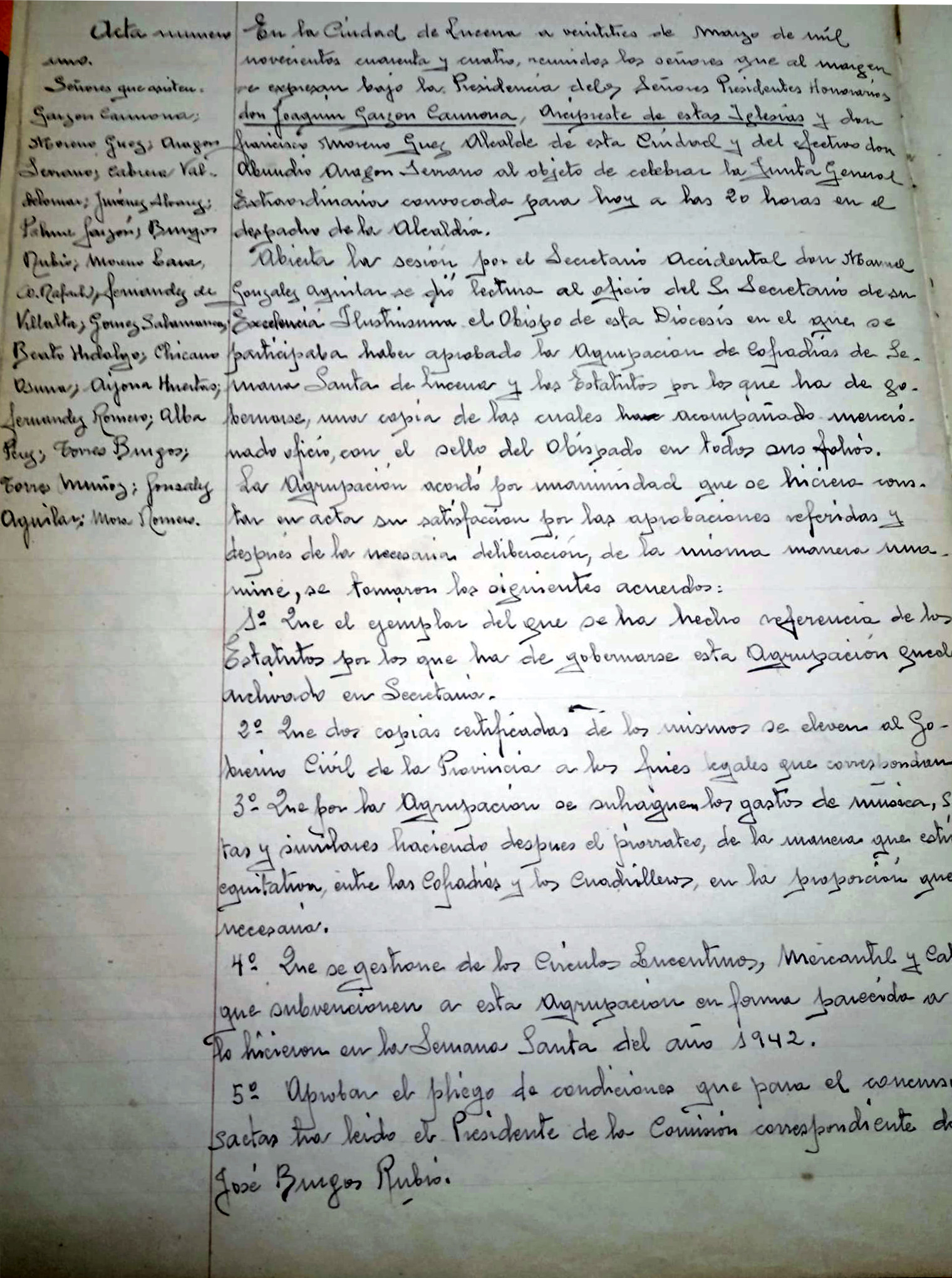
The founding date of the Agrupación de Cofradías of Lucena is March 23, 1944. On that day, the articles of incorporatin were signed at the town hall and under the honoray presidency of the parish priest of St. Matthew, Joaquín Garzón Carmona, and the mayor, Francisco Moreno Güez. The first acting president was Abundio Aragón Serrano, acommpanied by a large group of brotherhood members and cuadrilleros who took on the responsibility of beginning a new era.
The first minutes record fundamental agreements: the filing of statutes, the distribution of expenses for music and saetas, arrangements for subsidies with the city’s cultural associations, the appointment of stewarding committees for each procession, and even instructions to cuadrilleros regarding the proper way to carry the ‘pasos’ (floats). From the very beginning, the mission of the Agrupación was clear: to ensure organization, preserve the santera tradition, and uphold the dignity of Holy Week in Lucena.
In 1953, the first Holy Week proclamation was established, delivered by the writer Pedro Palop Fuentes, inaugurating a tradition that would eventually become one of the central events of Lent in Lucena, although it did not become an annual event until 1978 and, from 1983 onward, has taken place at the Major Parish Church of St. Matthew.
Early decades (1940s-1960s): challenges and consolidation
Thefirst years of the Agrupación de Cofradías of Lucena were not easy. The postwar period brought economic restrictions, and the city’s social life itself did not always make it easy for everyone to get involved. The memoranda from the 1950s reflect the poor attendance of brotherhoods presidents at meetings, the absence of processions on certain days, and the need to sanction reluctant cuadrilleros.
Even so, the Association achieved significant milestones: it organized saeta competitions, established official timetables and routes, and ensured that the tradition was kept alive even during the most difficult times. In the 1960s, under the presidency of Antonio Zurita Botí, the indifference shown by some brotherhoods was dealt with firmly, to extend that the bishopric’s intervention was even considered in order to ensure the processions could continue.
This was also the period in which the idea of confraternal unity began to take shape as an indispensable condition for the future. Lucena’s Holy Week, with its distinctive santería traditions and artistic heritage, needed a strong institution to represent it before the civil, ecclesiastical and social authorities.
Renewal and resurgence (1970s-1990s)
The renewal came in the late 1960s with the election of Antonio Villa Álvarez de Sotomayor as president in 1969. The proclamation was revitalised, striking expressionist posters were produced, and an award for the best cuadrilla was established, recognising the central role of santería. Under the leadership of Fernando Moreno Cantero (1972-1974), Masses for santeros were introduced during Lent, and the institution’s educational role was significantly strengthened.
In 1973, the Agrupación organised the Children’s Procession for the first time, serving as a breeding ground for future generations of brotherhood members and santeros. This initiative became one of the institution’s greatest contributions, and it continues today as a festive and educational expression of the tradition.
It should also be noted that, apart from a poster drawn by Atienza which in 1953 served as the cover of the local periodical Producción, and another by Mariano Tenllado on linoleum and printed in his own workshops in 1943 –which shared its Passion-themed motif with the Araceli festivities– no specific poster for Holy Week in Lucena was published until 1970.
In the 1980s, under presidents such as Juan Antonio Parejo Pineda and Luisfernando Palma Robles, the Agrupación underwent a modernisation: the magazine Torralbo was launched (1982), the ‘Manolo Ramírez’ Award was established (1982), new statutes were adopted, and the proclamation in the Iglesia Mayor Parroquial de San Mateo Apóstol (Main Parish Church of St. Matthew the Apostle) was established as an annual event. In 1985, awards were introduced for the best-behaved cuadrillas, and corporate attendance at events such as besamanos (kissing of the hand) ceremonies and viacrucis (Stations of the Cross) was made a regular feature.
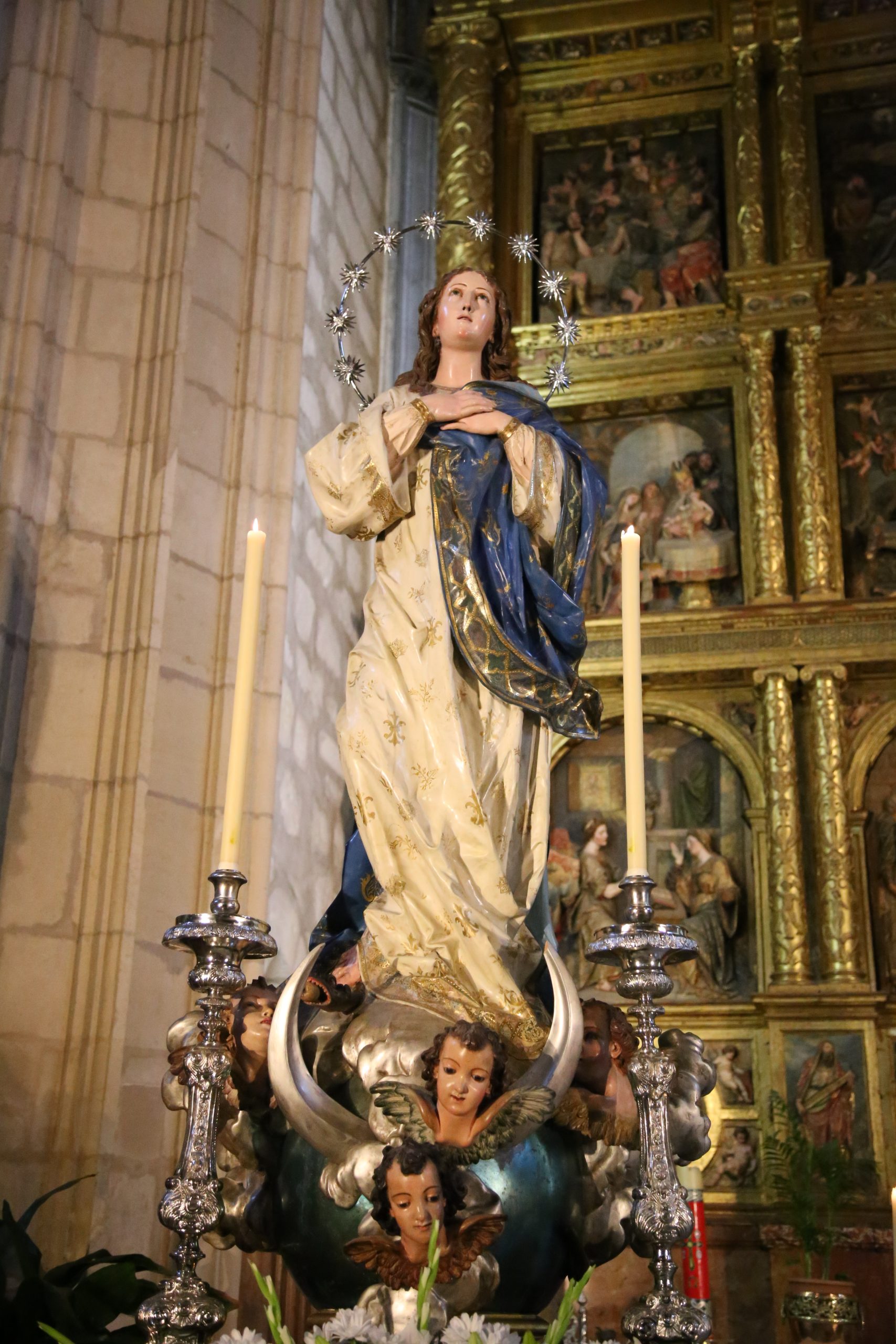
Gaspar Villa Fernández (1987–1991) transferred the organisation of the children’s processions to the Peña El Santero, while Ángel Huertas Villa (1991–1994) restructured the Agrupación into delegations and adapted the statutes to the diocesan framework. It was also during his period that the Inmaculada Concepción (Immaculate Conception) was established as the Patroness of the institution and the municipal grant was reinstated.
The fiftieth anniversary and the great confraternal revival (1994-1995)
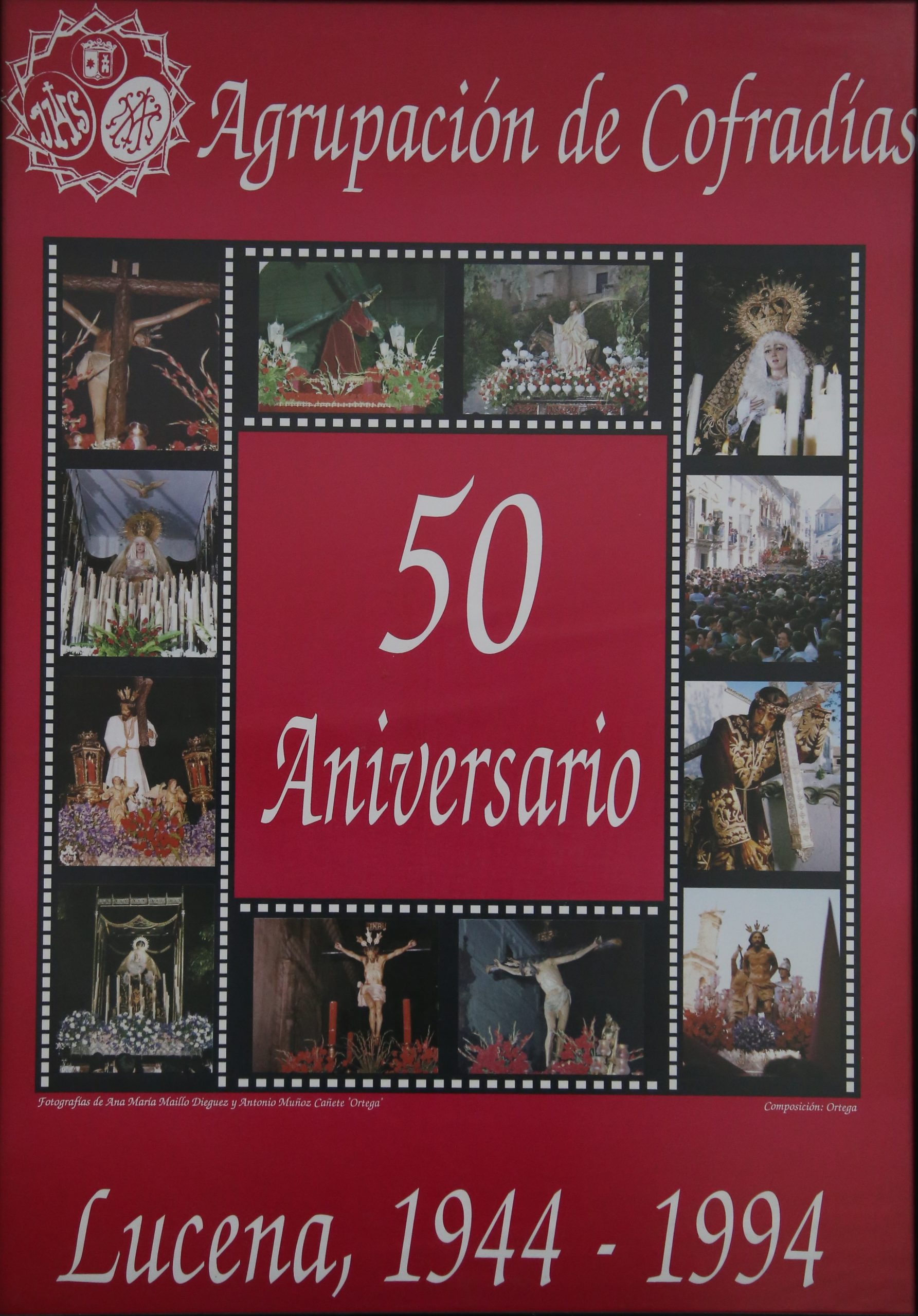
The fiftieth anniversary of the foundation (1994–1995) marked a turning point. Under the presidency of Francisco Salazar Roldán, the Agrupación organised a wide-ranging programme of events: lectures, concerts, exhibitions of sacred art and television broadcasts of the processions on TVE, which brought Lucena to the attention of audiences throughout Spain and Latin America
The living presidents were honoured, the City’s Gold Medal was awarded to the institution, and the Exaltation of the Saeta was celebrated with performances by renowned artists. That commemoration strengthened the pride of Lucena’s brotherhoods and marked the beginning of a new era of splendor.
At the same time, the Agrupación intensified its work of fraternisation with other associations, such as that of Archidona, and reinforced its image as a guardian of the heritage of the brotherhoods and a driving force in the cultural sphere.
Towards the 21st century: modernisation, communication and international renown
Since the late 1990s and throughout the 21st century, the Agrupación has undergone a profound transformation. The focus was on education, with la series of lectures and the publication of pregones (proclamations); communication was strengthened through posters, programmes and the magazine Torralbo; and the organisation’s external profile was boosted by integrating Lucena into networks such as Caminos de Pasión and the European Network of Holy Week and Easter Celebrations, of which it was a founding member.
The Agrupación’s work was decisive for the designation of Lucena’s Holy Week as a Fiesta de Interés Turístico de Andalucía (Festival of Tourist Interest in Andalusia) in 2003, and it currently continues to lead the way towards its national recognition.
The institution has successfully combined tradition with modernity: it maintains respect for Santería rituals, while at the same time promoting the professionalisation of the organization, cooperation with public authorities, and dissemination through the media and social networks.
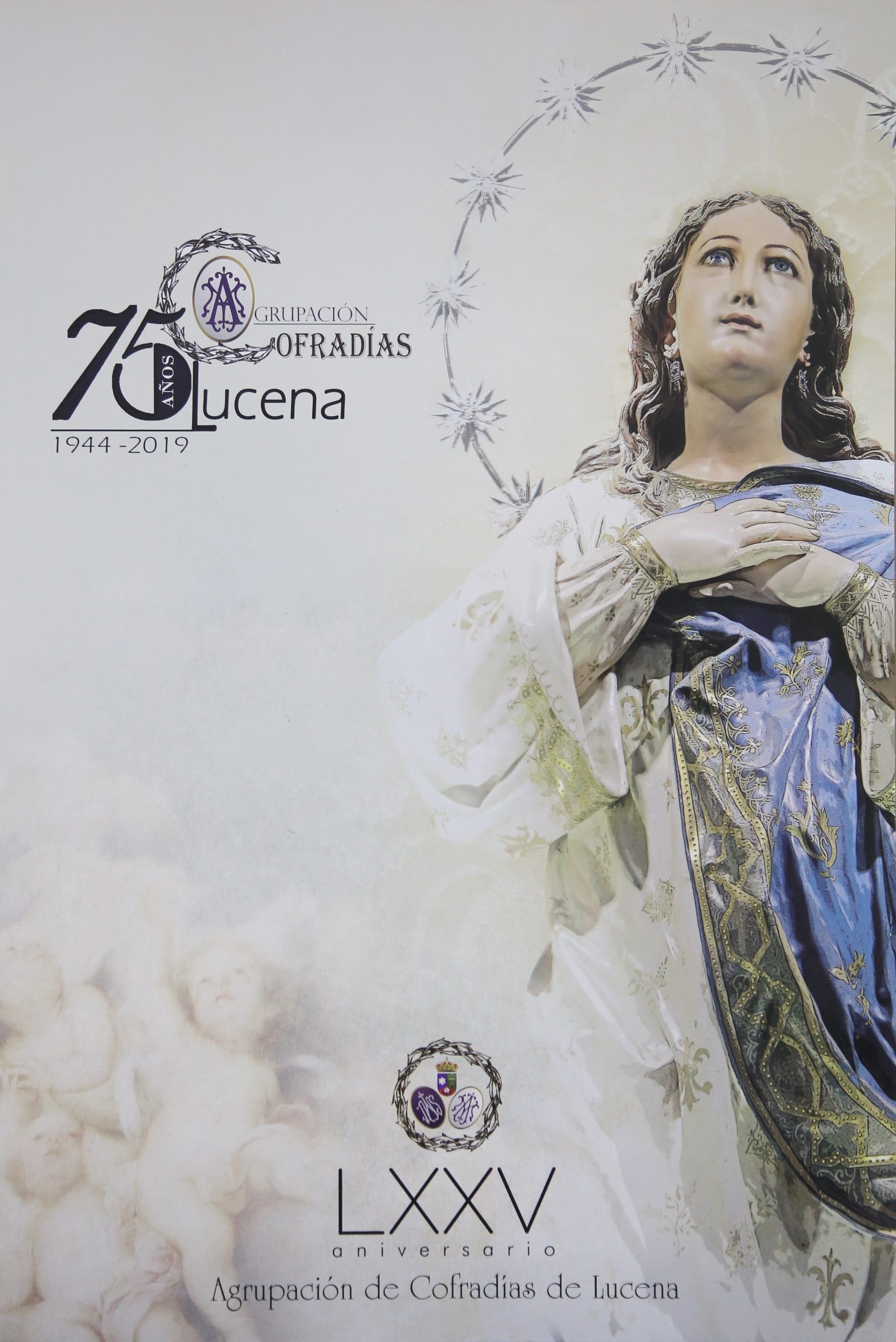
In 2019, the Agrupación de Cofradías celebrated the 75th anniversary of its foundation with an wide-ranging programme of cultural and religious eventes, including exhibitions of ceremonial goods, concerts, poetic and musical performances, and a solemn pontifical mass presided over by the bishop at St. Mathew, during which former presidents and commemorative brotherhoods were publicly honoured.
Later, between October and December 2021, the Jornadas de Cultura Cofrade (Cofrade Culture Days) took place, thanks to an important grant from the Junta de Andalucía. They offered concerts, lectures, panel discussions, exhibitions, recitals and educational activities that highlighted the artistic, musical and ethnographic heritage of Lucena’s Holy Week, thereby reinforcing its role as a cultural and devotional reference point.
The Agrupación today: guardian of tradition and driving force in the cultural sphere
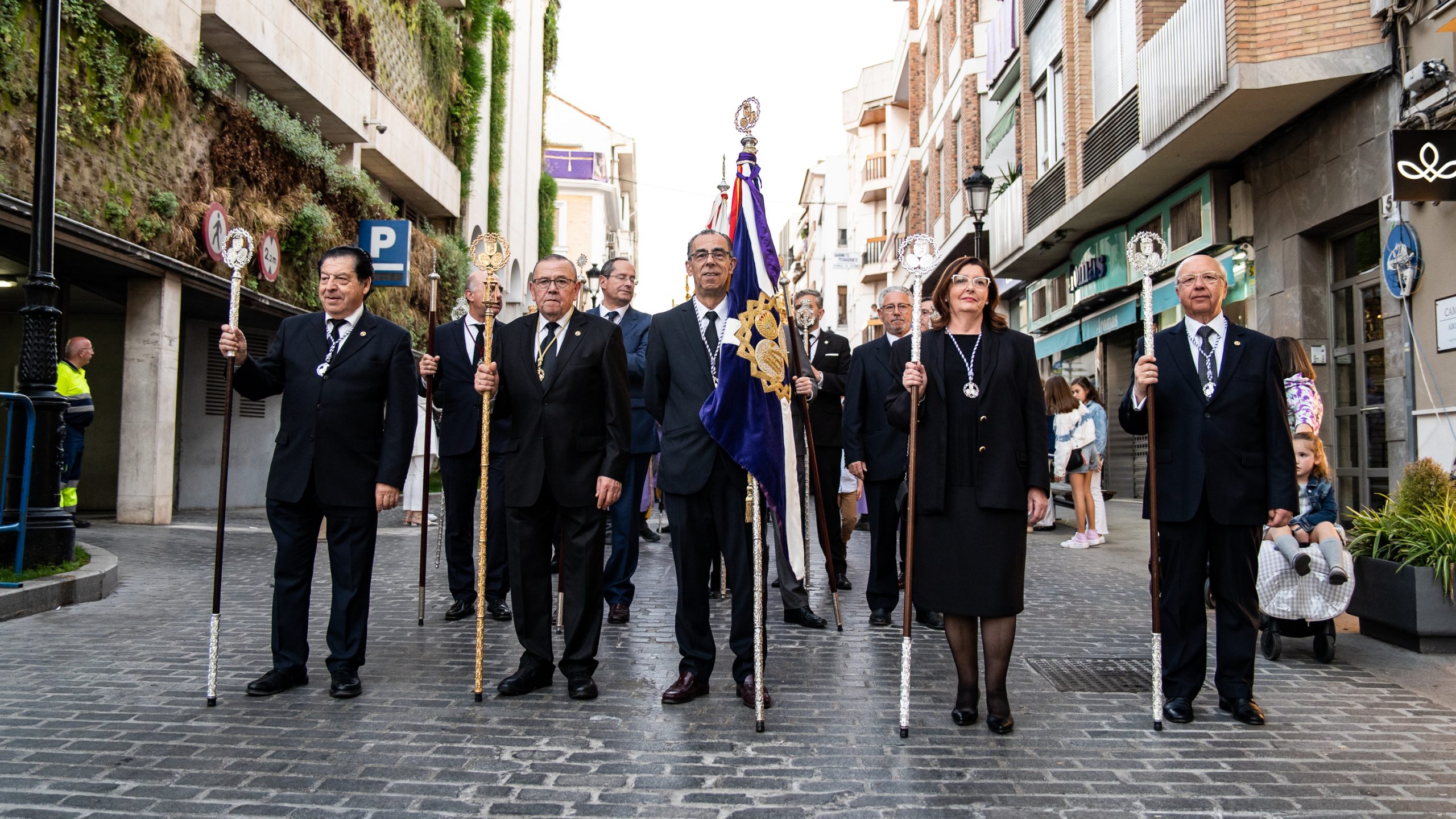
Today, the Agrupación de Cofradías of Lucena is much more than just a coordinating body. It is the institutional heart of Lucena’s Holy Week, the place where consensus is forged, values are passed on and collective identity is built. From its headquarters on Huertas Street, it coordinates the brotherhood’s activities throughout the year by organizing religious worships, training, cultural activities and charitable events.
Under its auspices, Lent, the pregón (proclamation), Children’s Holy Week and, in 2025, the Procesión Magna Pasionista (Great Passionist Procession) ‘Lucena Vive la Pasión’ are held. This milestone projects to the world the uniqueness of the Santería tradition, recently recognised as an Asset of Cultural Interest..
The Agrupación safeguards an intangible and material heritage of enormous value, encourages young people to get involved, supports the work of brotherhood houses and artisans, and contributes to the cultural, social and economic development of the city.
In short, the history of the Agrupación de Cofradías of Lucena is the history of a people who, through confraternal unity, have managed to keep their Holy Week alive, transforming it into an universal heritage. Eight decades after its foundation, the institution continues to be the pillar of tradition and the driving force propelling Lucena’s brotherhoods into the future.
Retrieved from: Notas para la historia de las cofradías lucentinas. Book by Francisco López Salamanca, Lucena’s oficial chronicler (2022)