Parish Group of Our Lady of Anguish and Most Holy Christ of the Good End


Popular Name:
Las Angustias
Foundation:
Canonical Seat:
Imagery:
Our Lady of Anguish and Most Holy Christ of the Good End (Anonymous 17th-century carving) – Throne of 22 santeros
President:
Raúl Pineda Delgado
Procession:
Passion Thursday – 21:00
Santeros' Tunic:
Black, with a capirote of the same colour
Today’s Parish Group of Our Lady of Anguish was formed within the parish of Santo Domingo de Guzmán with the aim of restoring worship and devotion to one of the Marian images of greatest historical and artistic value linked to popular religious tradition in Lucena.
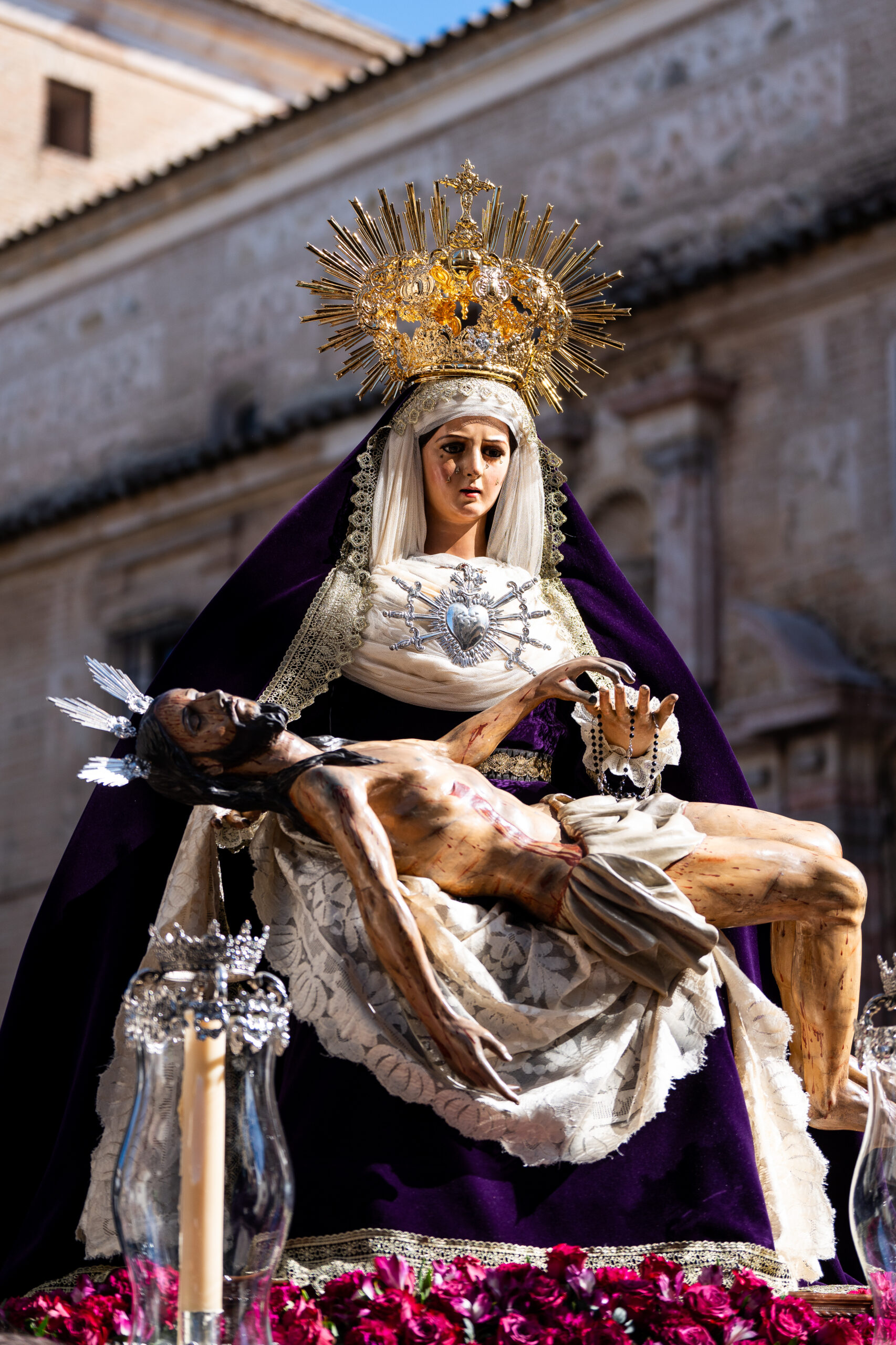
The image of Our Lady of Anguish, a full-carved Dolorosa holding the dead Christ in her lap, expresses in her face the Mother’s deep sorrow at the loss of her Son. It is an anonymous 17th-century work stylistically linked to the Sevillian school and attributed to the artistic circle of Pedro Roldán, retaining notable elements of great technical and artistic quality.
The carving was donated in 1682 by Catalina Antonia de Cardona, Marchioness of Comares, to the now-vanished hermitage of San Francisco de Paula, located next to Santo Domingo, where it was venerated under the title of Our Lady of Solitude. After the disappearance of that church, the image was moved to one of the side aisles of the Dominican church.
In 1973, a confraternity was founded to render public worship to the Virgin together with an image of Jesus of Humility, currently venerated in Jauja. The brotherhood held a penitential procession for several years on Holy Wednesday, travelling especially through the area around the Corazón de Jesús neighbourhood and the city centre, with borrowed thrones and processional items. The corporation had only one Hermano Mayor, Agustín Carrasco Jiménez, and remained active until the 1990s. During that period, owing to the delicate state of conservation of the sculptural group, the images underwent occasional restoration work by the Sevillian sculptor Luis Álvarez Duarte.
The corporation was re-founded in September 2023, restoring the worship and public presence of the images in Lucena’s confraternity life. Since then, the Parish Group has held various annual events and acts of worship, including a besamanos, the transfer of the images to the Ermita de Nuestra Señora de la Aurora, and the Passion Thursday procession, which has already become one of the most notable dates in Lucena’s Lenten calendar.
One of the most distinctive aspects of this procession is the prominent role of the young crews, made up of Lucena teenagers who find in this procession a transitional space between the traditional children’s processions and their future joining of the santero crews of the Semana Santa de Lucena, thereby contributing to the generational transmission of Lucena’s santería tradition.
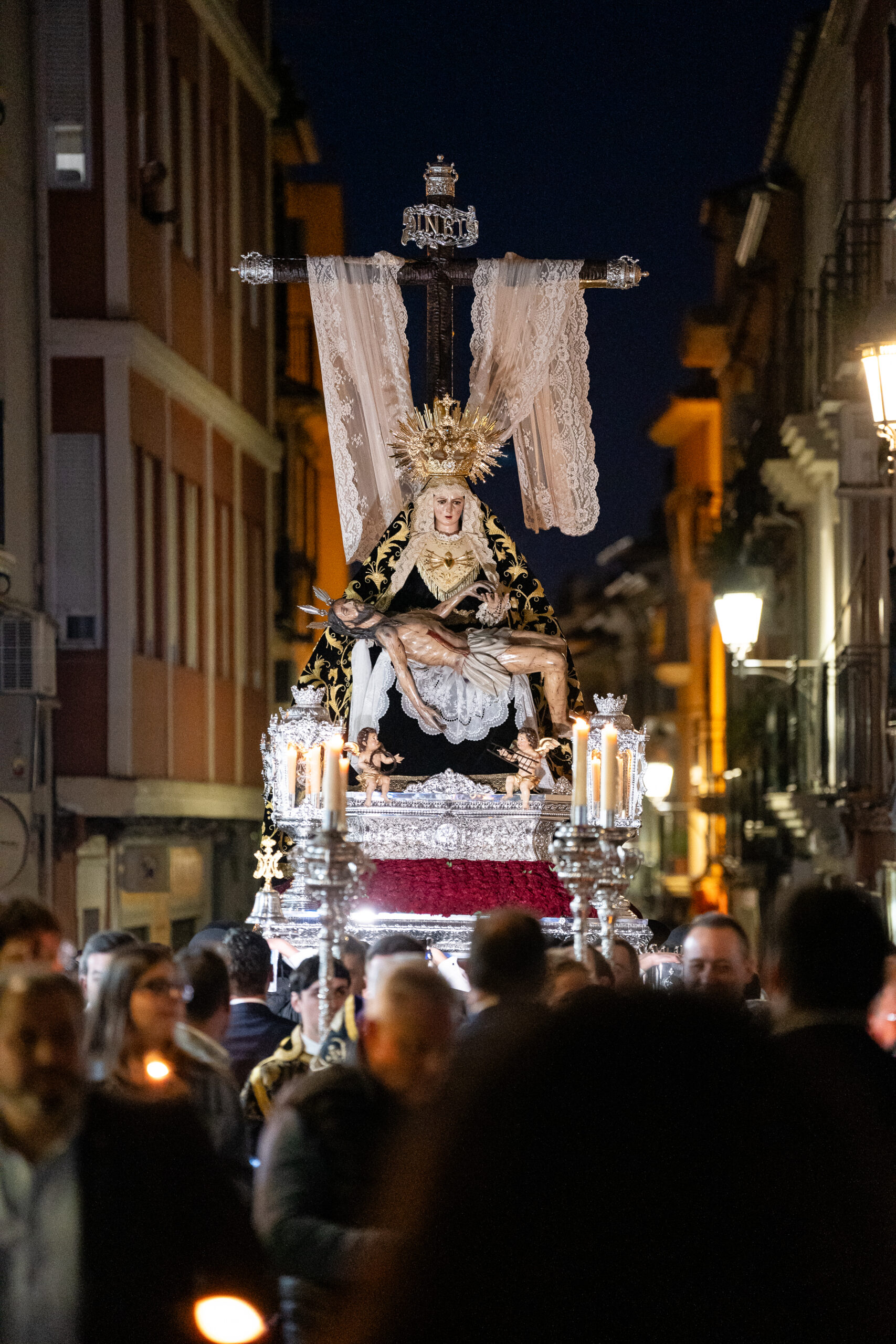
The throne of Our Lady of Anguish, unveiled in 2024 and made by the Lucena-based firm Paula Orfebres, was designed specifically for these young crews, built on a frame adapted to 22 santeros and their physical characteristics.
The ensemble is built around an elegant Baroque aesthetic, with a straight-lined moulding and cartouches ornamented with foliage scrollwork, on which stands a five-sided base made of hand-repoussé and chased silverwork, plated in sterling silver.
The scene is watched over by four classical-style lanterns, also made by Paula Orfebres, entirely handcrafted and enriched with meticulous chased and silver-plated work. The pieces have a circular base, ornamented shafts and octagonal bodies topped with crowns, evoking the formal language of 18th-century Baroque. The ensemble is completed by a newly made cross by Daniel García Berlanga in pine wood, designed to resemble a natural tree through the carving of bark and knots, partly enriched with gold leaf.
The Parish Group also continues to expand its artistic heritage. The Lucena-based firm Orfebres Gradit has produced the new crown of Our Lady of Anguish, donated by several devotees. The crown, in an 18th-century Baroque style, incorporates plant motifs, imperial elements, floral garlands and a radiant halo with rays, all made of metal plated in sterling silver.
At the beginning of 2026, both Our Lady of Anguish and the Most Holy Christ of the Good End underwent a major restoration process carried out by restorers Manuel Espejo Mármol and Miguel Ángel Sánchez Jiménez, an action funded through the Grant Programme for the Conservation, Restoration and Rehabilitation of Historical-Artistic Heritage.
The intervention made it possible to recover numerous historical, technical and aesthetic values of both images, while also reinforcing the artistic attribution of the Virgin to the circle of Pedro Roldán and ensuring the future conservation of a sculptural group of enormous importance within Lucena’s devotional heritage.