
Author: Manuel Guerrero Cabrera, professor and writer
(Article published in www.lucenahoy.com during Lent 2024)
We return once again to an article from the newspaper archive. On this occasion, it is an article entitled «Lucena Notes», published in the Córdoba newspaper ‘La Voz’ on 20th April 1924, in which we find information not only about the religious and processional aspects of our Holy Week, but also about its leisure activities. One particularly valuable detail is that the correspondent tell us he wrote the article on the morning of Holy Wednesday. As a result, he describes what was expected to take place, provided that the weather, which was unsettled that year, did not prevent it.
Let us begin with the religious aspect, which opens with some disappointing news: the processional throne of the Entry into Jerusalem, or ‘La Pollinita’, did not take part in procession. This was 1924, so there was no need to make such a distinction, since for many centuries ‘La Pollinita’ in Lucena had been that of the Archconfraternity of Mount Carmel. The correspondent describes the processional throne as «striking» and, with a touch of sarcasm, expresses his disagreement that there was no good reason for it not to take part in procession: «keeping it for a better occasion, like the vineyard owner in the story». That evening however, on Holy Wednesday, the ‘Miserere’ would be sung. When the correspondent turns to Holy Thursday, he describes all the processional thrones as belonging to the Archconfraternity of Peace, which we know is not the case:
The procession of Peace (La Paz) will take place, comprising the following beautiful and valuable devotional images. Saint Faith (Santa Fe), Jesus Fallen (Jesús Caído), Jesus Bound to the Column (Jesús atado a la Columna), the Washing of the Feet (Lavatorio), the Lord of the Blood (Señor de la Sangre), and the Stone Virgin (Virgen de Piedra); that is, provided the weather improves.
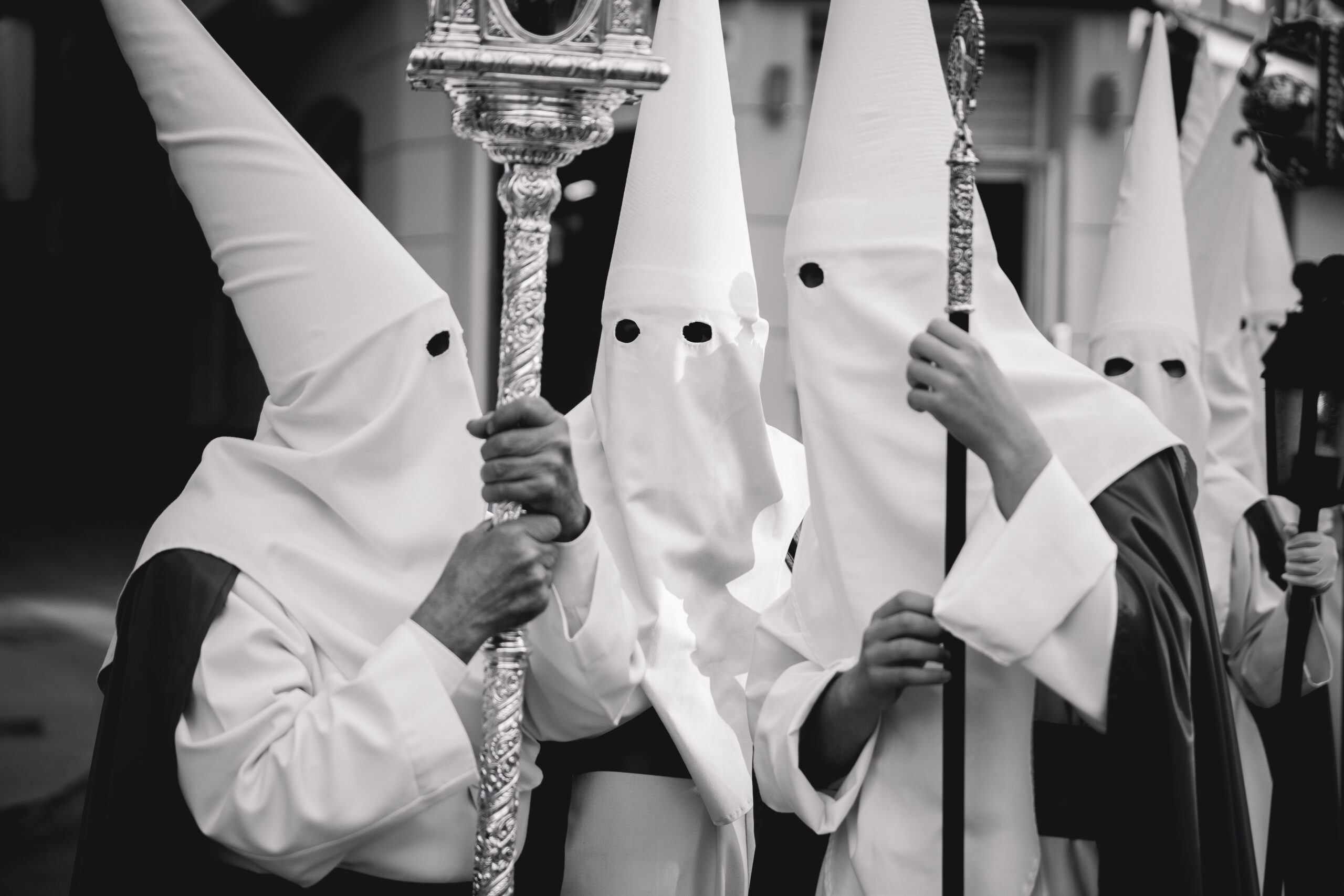
As for Good Friday, we find a particularly interesting detail: Francisco Serrano Rivera (1), the ‘cuadrillero’ (2), paid for a company of Roman soldiers and another of trumpeters to accompany the Lord from the moment of the processional departure. That afternoon, the Holy Burial, together with Mary Magdalene, Saint John, and Our Lady of Solitude (3), would bring the Holy Week processional departures to a close. The correspondent tells us which groups formed the processional cortège of the afternoon Penitential Procession of Jesus the Nazarene:
Accompanying the procession were the Most Excellent Town Council with its mace-bearers and kettledrummers, representatives of the Army, the Foro, the Red Cross, The Augustininan and Franciscan Fathers, the Society of Saint Vincent de Paul, the Marist Brothers, the Catholic Circle, the Home for Orphan Girls and the Elderly, industry, commerce, the farming community, the banking sector, the entire venerable clergy, together with young children dressed as angels, archangels and sibyls.
As might be expected, he not only referred to Lucena’s principal institutions, but also noted the curious presence of boys and girls dressed as angels, archangels, and sibyls.
Once the processions had conclude, the «Berber» spectacle of firing gunpowder, traditionally held on Holy Saturdahy, was discontinued. It consisted of Moorish horsemen firing their ‘espingardas’ while riding. Instead, there were fireworks and the ringing of church bells, together with «fine ‘solera’ wine and what follows it into vinegar».
The highlight, however, was Easter Sunday, with bullfights, theatre performances, cinema screenings, cockfighting, and other entertainments. At the bullring, Parejito and Gordillo fought six young bulls from the Natera ranch. At the Salón Alhambra, the theatre company of Don Rafael Cabanes performed, accompanied by Maestro Varo and his sexet. The ‘Círculo Lucentino’ and Círculo Católico’ held society balls, while at the town’s principal theatre the amateur dramatic company gave one or two performances as part of the festivities in honour of Our Lady of Araceli.
Yet this fascinating article tells us something else: that 73 «well-to-do young men» had formed the new Brotherhood of the Column, whom it also refers to as «’columnarios’». It is said of them that other wealthy citizens might follow their example, together with that of the already mentioned Francisco Serrano Rivera, so that our Holy Week would have nothing to envy in that of other towns. Closeley linked to this hope was the expectation of admiring the «magnificent Meneses silver throne». Without doubt, that was the fist time ―the moment that began the excitement of seeing Our Father Jesus Bound to the Column carried on one of the processional thrones most cherished in the ‘santería’ tradition.
NOTES:
(1) Francisco Serrano was the person who, in 1923, provided a canopy of Our Lady of Succour, the processional throne for which he served as ‘cuadrillero’. In 1924, as a member of the Jesus brotherhood, he donated bread, together with a voucher, to every member of the brotherhood carrying a wax candle. See LÓPEZ SALAMANCA, Francisco (2000): La Archicofradía de Nuestro Padre Jesús Nazareno: cuatrocientos años de historia. (The Archconfraternity of Our Father Jesus the Nazarene: four hundred years of history) Venerable Archicofradía de Nuestro Padre Jesús Nazareno, pp. 363-4.
(2) The newsparper note states that he was responsible for taking the Nazarene out in procession, a duty which at that time fell to the ‘cuadrillero’.
(3) This would, in fact, refer to Our Lady of Succour.
Photograph of the article: Jesús Cañete Fernández

