Author: Manuel Guerrero Cabrera, professor and writer
(Article published on www.lucenahoy.com in 2014)
In this text, I aim to establish a timeline relating to the history of the Brotherhood of Our Lady of the Valley in Lucena. There are, of course, many gaps, but I believe this may provide a useful starting point for gaining a better understanding of the brotherhood and its links with both the fair and the hermitage of the same name.
16th century: The Hermitage of Our Lady of the Valley was built through the devotion of the gentleman Fernando Alonso del Valle, «in fulfilment of a vow he made to the Sovereign Queen of the Angels when he faced a most grave danger at that place, from which he was suddenly delivered» (1).
1537: The earliest known reference to the Hermitage of Our Lady of the Valley appears in the municipal council minutes dated 29th January 1537, held in the Lucena Municipal Historical Archive.
«The chief mayor asked Brother Juan de Talavera to show him the licence granted by the Marquis authorising him, as he intended, to enclose and plant with vines a plot of common land near Our Lady of the Valley» (2)
1548: Juan Bocanegra sends alms to the priest serving at Our Lady of the Valley.
1575: On 6th February, the Brotherhood of Our Lady of the Valley was founded, according to Ramírez de Luque (3).
1583: Work to extend the hermitage was already under way, as stated in the will of Don Juan Álvarez, who bequeathed ten reales towards the work.
1593: A reference in the municipal council minutes held in the Municipal Historical Archive reads: «A petition submitted by the brothers of Our Lady of the Valley to Her Ladyship the Countess was considered, requesting a corner of land behind the chapel so that they might enclose it, together with Her Ladyship’s decision on the matter» (4).
1599: The Discalced Carmelite brothers intended to establish a convent at the hermitage, with the support of the Countess of Prades, Doña Ana Enríquez de Cabrera y Mendoza. However, they did not do so, as they eventually settled at the Church of Our Lady of Mount Carmel.
1602: Reference to the hermitage well in the municipal council minutes: «Whereas a petition was submitted to this council by the brothers of Our Lady of the Valley, requesting permission to enclose the well situated behind the house».
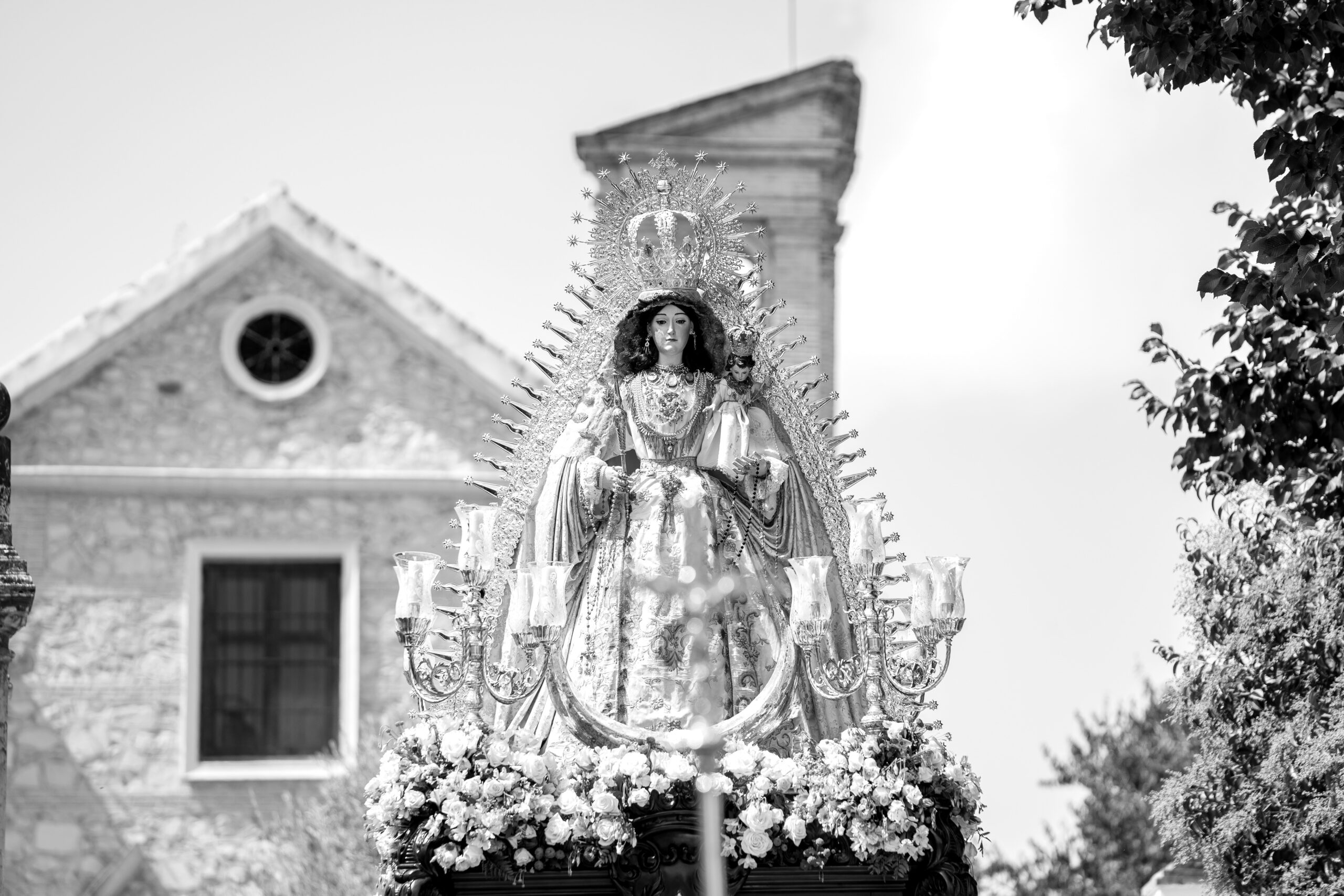
First third of the 17th century: The image of Our Lady of the Valley was acquired (5).
1652: Reference to the brotherhood’s Senior Brother and to a well belonging to the hermitage in the municipal council minutes: «At this council meeting, Don Francisco del Valle Navarro, a resident of this town and Head of the Brotherhood of Our Lady of the Valley, submitted a petition in which he stated that the said hermitage has, and has long had, a well behind it, on a plot of land belonging to the town council, which supplied the necessary water. In the course of time, the wellhead collapsed and some boys filled in the said well» (6).
1685: The silver crescent moon, with a silver-gilt cherub at its centre, was acquired. The date appears in the inscription.
1690: The shrine chamber of the Virgin was under construction. Juan Martín Márquez undertook to quarry the stone needed for its construction (7).
1693: The stonemasons Juan Navajas and Toribio de Bada undertook to make and install the jasper frontal for the high altar, as well as to produce tables and a basin for the sacristy and two holy-water stoups.
1713: The Alcantarine Franciscans founded a convent, or «hospice», adjoining the hermitage, following an agreement with the brotherhood. The Franciscan community attempted to move within the town walls, to Ancha Street, but difficulties with another religious order, together with financial problems, led them to return to the hermitage.
18th century: The image of the Child was acquired, together with the halo in the form of a sun, with straight and wavy rays, star points and branches of flowering lilies.
1760-1763: The high-altarpiece was made by Juan Abundio de Burgos.
1776: The entrance of the hermitage is enlarged.
1800: The brotherhood’s member included official notaries and royal notaries, as well as legal representatives (8)
1816: The notaries petitioned Lucena Town Council for the triumphal carriage designed for the Blessed Virgin of Araceli on 3rd September, so that the brotherhood might «make full use of it and devote it to the worship of the aforementioned Sovereign Image» (9).
1835: The secularizacion and confiscation of ecclesiastical property resulted in the convent and its garden passing into state ownership, while the church and its ancillary buildings passed to the diocese. During these years, the brotherhood began to decline. Around this decade, the image of Saint Martha must have been transferred to the Hermitage of Our Lady of the Valley following the demolition of her hermitage in Santa Marta Alta Street (10)
1873: Don José de la Torre y Lara acquires the convent with the intention of converting it into a home for orphaned girls.
1908: Don Francisco de Paula Cortés y Curado founded a Home for the Elderly under the care of the Sisters of the Helpless Brothers.
1977: The community of Sisters departed, and the convent was subsequently converted into a residential home run by the Pious Union of Workers of the Abandoned Jesus, under the direction of Don Prudencio Uzar.
1980: A group of friends, led by Don Vicente Espejo Prieto, decided to re-establish the brotherhood, with the assistance of Don Prudencio Uzar and Don Juan Parejo. That same year, the image was carried in procession during the September fair. New tunics were worn by the ‘santeros’, while the Virgin wore a newly acquired mantle, skirt, cuffs, bodice and sleeves from Ceuta, together with a matching garment for the Child. The first bell was donated by Don Prudencio Uzar (11).
Mid-1980s: The processional throne is acquired.
2003: A group of young people took charge of the brotherhood, with Don José Antonio Parejo as its Head of the Brotherhood.
2005: Saint Martha was incorporated as a co-titular image of the brotherhood. Saint Martha was carried in procession for the first time on the shoulders of the brotherhood’s female bearers (12).
2006: Don Prudencio Uzar died. The Hermitage of Our Lady of the Valley was restored.
2010: On 24th October, Don José Félix García took office as the first parish priest of the Sagrada Familia, following the consecration of the hermitage as a parish church.
2016: Restoration of the image of Saint Martha, carried out by CECORE. Our Lady of the Valley was carried in procession for the first time wearing silver ‘ráfagas’, lent by the Brotherhood of Our Lady of Araceli from Seville.
2019-2020: Restoration of Our Lady of the Valley, carried out by CECORE.
2020-2021: The COVID-19 pandemic prevented the image from being carried in procession.
2022: The brotherhood acquired its own silver ‘ráfagas’, chased by Don José Ismael Moya Bos and inspired by the 18th-century sunburst or halo owned by the brotherhood.
BIBLIOGRAPHY
ARCOS, Francisco J., and CALZADO, Julián (2005): «25 años de historia». Madre del Valle 2, pp. 44-48.
COFRADÍA DE NTRA. SRA DEL VALLE (2005): «Editorial». Madre del Valle 2, pp. 2-3.
PALMA ROBLES, Luisfernando (2005): «Algunos aniversarios y la feria del Valle de 1816». Madre del Valle 2, pp. 19-23.
PALMA ROBLES, Luisfernando (2006): «Algunas noticias sobre la ermita lucentina de Nuestra Señora del Valle en el siglo XVI». Madre del Valle 3, pp. 7-11.
RAMÍREZ DE LUQUE, Fernando (1998): Tardes divertidas y bien empleadas por dos amigos en tratar de la verdadera historia de su patria Lucena. Ayto. de Lucena.
Photograph of the article: Jesús Cañete Fernández

