Author: Francisco López Salamanca, official chronicler of Lucena
(Article published in the 1983 edition of Torralbo magazine)
The early history of Lucena’s brotherhoods remains, in many cases, to be uncovered. Their documentary records—membership registers, statutes, inventories and minutes of meetings—do not appear to have attracted the attention of researchers. Those that have not been lost through the vicissitudes of time lie undisturbed in parish or private archives, awaiting the eyes and pens of those willing to bring to the present day a previously unknown view of Lucena’s penitential life. The Parish Church of Our Lady of Mount Carmel, formerly the Convent of Saint Joseph of the Discalced Carmelite friars, preserves an important collection of documents relating to the now-dissapeared Brotherhood of Our Lady of Mount Carmel, once one of the most prominent brotherhoods of Lucena’s Holy Week, which held its penitential procession on Holy Tuesday. These texts bring us into contact with the religious expressions of a very different and distant age. Approaching the Christian experiences of Lucena’s inhabitants in former times with an understanding attitude requires us to set aside the present-day concept of ‘santería’ and to reassess the importance of brotherhood devotion. Life in the 17th century —the period to which these historical notes will broadly be confined— was undoubtedly perceived very clearly as something transient, as a brief journey towards another existence. It was therefore essential to secure, by every possible means, future glory while still in this world, as well as a dignified burial following a funeral appropriate to one’s social standing, and the necessary Masses to incline the Supreme Judge towards greater mercy. We thus find the following words, repeatedly recorded in the brotherhoods’ minutes and statutes, as a defining feature of confraternal life during this period: «When any brother dies, his funeral shall be attended with ten wax torches and the standard, and twelve Masses shall be said for him; and if the wives of the brothers die, ten torches shall be carried and eight Masses said.»
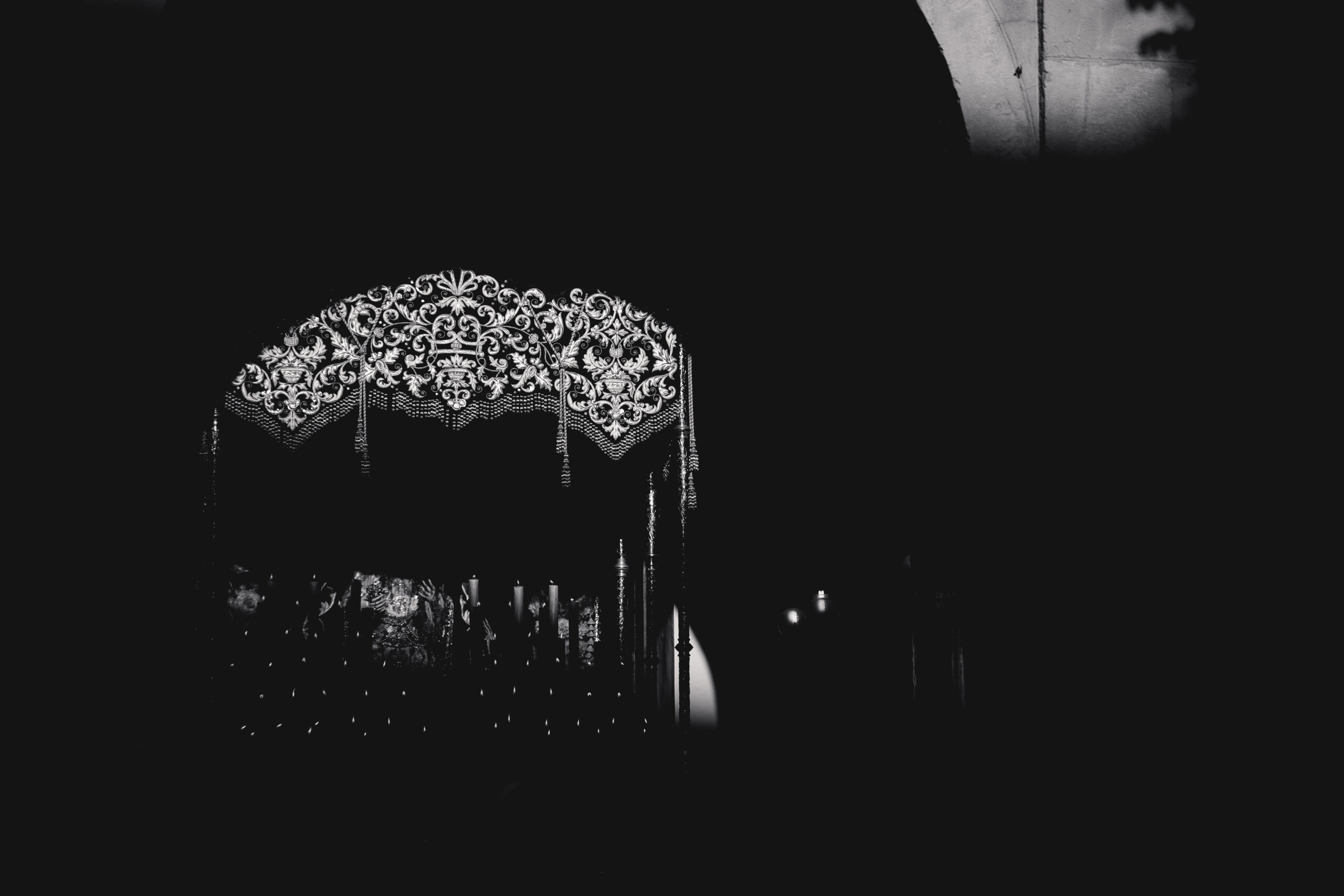
«Established as a brotherhood in 1606 at the request of it first Head of the Brotherhood, His Excellency Don Luis Fernández de Córdova y Aragón». Duke of Cardona[1] and approved on the same date by the Most Illustrious and Most Reverend Brother Diego de Mardones, Bishop of the Diocese», as recorded in the second book of meetings. This Brotherhood of Our Lady of Mount Carmel reached its highest levels of participation between 1650 and 1720, a period that coincided with a far-reaching spiritual movement which, in its final decades and supported by renewed economic growth, made possible the extraordinary flowering of the Baroque in Lucena. The penitential Brotherhood of Our Lady of Mount Carmel, reorganised, like so many others, at the beginning of the 18th century, had six processional thrones, four of them beneath canopies which, unusually from the perspective of Holy Week today, did not carry four different images of the Virgin. The exceptionally beautiful image of Our Lady of Sorrows, which still survives, was the only representation of the Virgin in the group. It was carried in procession beneath a canopy «of black plush with silver lace», supported by iron poles. The image of Jesus of Humility, also still preserved today in the Parish Church of Our Lady of Mount Carmel, likewise made its penitential procession beneath a plush canopy, but one «with white and black lace and a bier with gilded railings».
Another processional throne carried beneath a canopy, «of purple satin with silver lace, and with a bier with black railings», was that of Jesus of the Crowning with Thorns, now lost: an Ecce Homo being crowned with thorns by a Jewish figure. An image of Jesus under Arrest, beneath a canopy similar to the preceding one, was carried in procession with his hands bound and two long cords attached to them. The ends of the cords were each held by a man dressed as a Hebrew, walking in front. ‘La Pollinita’, identified in the brotherhood’s minutes books and inventories as «Jesus at His Entry into Jerusalem», had, however, no canopy. Its processional throne consisted simply of a plain bier fitted with six iron rings, to which two carrying poles could be attached. Depending on the circumstances, it was carried either on the shoulders or ‘a correón’, using leather straps, by six penitents dressed in coarse canvas tunics. The series of processional thrones concluded with the «symbol» of the Sacraments, consisting of «a cross with a painted canvas depicting the pelican, from which emerge seven ribbons representing the Sacrament», arranged like the arms of a fountain. At their ends, these ribbons bore different sacramental emblems, such as «a mitre and papal tiara» representing Holy Orders, or «a sackloth tunic» to evoke the sacrament of Penance.
Nevertheless, what was truly remarkable about this brotherhood was the live dramatisation that accompanied the processional thrones during the procession. A procession of characters —prophets, apostles, personifications of the sins, Romans, angels and penitents— formed an exact reflection of the religious outlook of Lucena’s society at that time.
The entries in the aforementioned inventory book are remarkably detailed: «fifteen wooden tablets bearing the names of the Prophets; one cedar tree, a crown and the ‘harp’ belonging to the Prophet David; fifteen masks representing those Prophets; and twelve tunics of coloured taffeta: iridescent, green, blue, amber, gold and pale green; two small tunics belonging to the angels who carry the bells».
The apostles, for their part, were provided for their portrayal with «twelve garments with cloaks of different colours; twelve masks with their haloes; twelve wigs; and twelve sandals of cordovan leather».
A clear distinction is made between Saint John, «with a face and hair», and Judas, whose garments were «of sulphur-coloured taffeta with a green cloak», and who also had a face and a rope.
The sins are not described in such detail. The seven deadly sins were depicted on «seven painted cards» carried by seven individuals dressed in tunics.
The brotherhood’s procession was brought to a close by a large panel depicting the Mystical Lamb and the white standard, which preceded the Roman captain, wearing a «hat and plume», followed by twelve soldiers with helmets and a drum. According to the inventory, these items were kept in the care of Sister Ana, the Blessed. The brotherhood also provided the necessary items for taking part in the procession as a penitent.
The penitents were required to wear coarse tunics, with their faces and hair covered in esparto grass or pointed hoods (‘capirotes’), and to choose from among the «instruments» of penance: fetters, shackles, crosses, stones to carry, whips and «crosses for those who processed with their arms outstretched». If we add to this procession the very large group of brothers who, dressed in doublets of «crea leona» or «bocadillo cloth», carried wax torches to illuminate the processional thrones —around eighty for each throne in the brotherhood’s most prosperous years, according to the inventories and minutes— the procession of this brotherhood on the afternoon of Holy Tuesday must have been an impressive spectacle, imbued with a powerful spirit of asceticism.
This form of Holy Week, of which nothing has survived in our town, was not always observed with the seriousness and religious devotion that might have been expected. Several decrees were issued by the bishops in an attempt to put an end to the scandals and excesses caused by the wearing of «masks» in the processions, as well as by «horns and drums», which turned «so holy and sorrowful a season into a carnival». The edict issued by Cardinal-Bishop Don Pedro Salazar on 1st April 1740 must have dealt the final blow to this former form of Holy Week in Lucena. It described the situation in the following terms: «We hereby renew all the former decrees and ecclesiastical censures concerning this matter, and order that our Vicar and parish priests, who continually preach and teach Christian doctrine, exhort the people not to cover their faces with disguises, ridiculous masks or extravagant costumes.
We order that the Heads of the Brothehood be notified that they must not allow anyone to take part in the processions under their charge with their face covered, even if they are carrying a drum or horn, for it is in this that the greatest scandal lies, with so many trumpets being added to conceal their abominations. And who would believe that such audacity had gone so far that even priests have come to wear the shameful disguise of masks
We command, by virtue of the obedience owed to us and under pain of major excommunication (latae sententiae), that no person in the said town shall take part in the Holy Week processions with their face covered, whether collecting alms, carrying a light or an image, or playing a trumpet or drum. We further order our Vicar and parish priests to ensure compliance with the utmost vigilance. Should anyone act in this manner, they shall be publicly declared excommunicate and their name posted on the notice board; and if they persist in their defiance, they shall be arrested. Once we have been informed, we shall in turn report the matter to the higher authorities, who will take even stronger measures to eradicate these abominable practices…» Thus, through such drastic measures imposed by Cardinal-Bishop Pedro Salazar, came to an end a tradition that seemed to combine features of the present-day Holy Week celebrations of Puente Genil and Baena. Perhaps it was this that gave rise to ‘santería’ in Lucena, a tradition that imbues the carrying of Lucena’s sacred images through its streets and squares with a dignity and artistry never attained in earlier centuries.
[1] In fact, the founder was Ana Enríquez de Cabrera y Mendoza, eldest daughter of the Duke of Medina de Rioseco and, by then, the widow of the aforementioned Duke of Cardona, Luis Fernández de Córdova y Aragón, heir to the lordship of Lucena, who had died prematurely then yerars earlier, in 1596, at the age of 38.
Photograph of the article: Jesús Cañete Fernández

