Author: Francisco López Salamanca, official chronicler of Lucena
(Article published in the 1984 edition of Torralbo magazine)
Don Fernando Ramírez de Luque writes in his ‘Tardes Divertidas’ that «the Brotherhood of Our Lady of Solitude was established in the year 1564» at the Church of Saint James, then a subsidiary parish church. Its statutes were approved, in the name of Bishop Francisco Reinoso, by the episcopal visitor Gómez Meléndez on 14th May 1601.
The archive of its church, where the brotherhood is based, preserves a minutes book, several deeds and other documents relating to the brotherhood, while the archive of the Major Parish Church of Saint Matthew the Apostle contains various bundles of its financial accounts.
Most of this material covers a period of just under a century, from 1719 to 1800. The study of these years reveals a period of flourishing for the oldest brotherhood of Holy Week, following an earlier phase of decline.
As already noted, this Brotherhood of «la Soberana Emperatriz de Zielos y tierra María Santísima de la Soledad i Angustia (the Sovereign Empress of Heaven and Earth, Mary Most Holy of Solitude and Anguish)», was established at the Church of Saint James, where the devotional image was placed in the chapel it still occupies today, at the head of the Gospel aisle. Its penitential observances consisted of a ‘novena’, usually attended by the choir of the Church of Saint Matthew and by a preacher, almost always from the Order of Preachers. During the final three days of the ‘novena’, a Forty Hours’ Jubilee was held, culminating on Good Friday, the day of the procession. This took place after the procession of the Holy Burial organised by the Brotherhood of Our Father Jesus the Nazarene. The devotional image of Our Lady of Sorrows titular image of the Servite Congregation, traditionally took part in that procession, although, when it ceased to do so owing to financial hardship, it was replaced by the image of Our Lady of Succour from the Chapel of Our Father Jesus the Nazarene.
Neverless, the Brotherhood of Solitude held its processional cortège entirely independently of that of the Brotherhood of Jesus the Nazarene, despite the fact that the figures carried on the thrones were the same. The procession began with the «silver-plated» ‘guion’, followed by a representation of the Holy Burial. Behind it came the empty Cross, «gilded, with nails, inscription and cloth», followed by the titular image of the Virgin, and then the image of Saint John and Saint Mary Magdalene. Behind them walked the ‘disciplinantes’ (flagellants), led by the ‘cuadrillero de azote’ and dressed in white tunics, sustained in their harsh penance by sips of wine provided by the brotherhood itself. The processional cortège was brought to close by the ‘blandoneros’ brothers, wearing their ‘capirotes’.
The celebrations concluded with a solemn Easter Sunday service accompanied by music. Afterwards, fireworks were set off and a meal was provided for the «pobres de boz» ―poor alms collectors who begged on behalf of the brotherhood during Lent.
The surviving documents reveal both the considerable financial resources of this brotherhood and the interest shown by Lucena’s oligarchy in holding positions within it. This situation continued in the late 18th and 19th centuries in the Archconfraternity of Jesus.
Its possesions, first recorded in an inventory in 1720 and subsequently enlarged, included a long list of silver jewellery. These comprised not only the numerous and costly items belonging to the sacred images, but also sacred vessels, silver lamps, liturgical ornaments and jewellery belonging to the titular image of the Virgin.
The first inventory mentions «an image of Christ in the Sepulchre, with its sheets and pillows», as well as «the gilded bier for the said Holy Christ»
Particularly noteworthy is the fact that, in none of the documents I have consulted, are this brotherhood’s procession described as a being carried ‘a correón’, using leather straps fastened around the bearer’s bodies to support the weight of the images. These straps are never mentioned in the inventoires, which, by contrast, explicity refer to the biers and their carrying poles. They must have been magnificent, judging both their maker, Pedro de Mena y Gutiérrez, and by their description: «A gilded and carved bier with eight angels and the four Evangelists, with its lower valance trimmed with white silk braid, six carrying poles, ornamental finials, crowning pieces, ten angels and eight carrying ‘horquillas’ with their pads». The absence of ‘correones’ raises an issue that should be considered by local scholars of ‘santería’, who may have been too quick to generalise a method of carrying processional thrones that perhaps only occasional or adopted in exceptional circumstances.
The ‘correón’ appears to have been used almost exclusively for certain images and, I believe, only when carrying them into and out of churches. However, in the particular case of Jesus the Nazarene, this practice became so excessive that the ‘correón’ was prohibited in perpetuity at a meeting of its governing board on 21th March 1839, «because of the scandal caused by its use».
I shall add a series of details concerning the Brotherhood of Our Lady of Solitude, based on the terms of office of its successive head brothers during the period in question.
Diego Pedro de Medina Carranza (1719-1726)
Together with the brotherhood’s treasurer, Francisca Ramírez, he began to work on the chapel chamber of Our Lady, whose painted decoration was entrusted to Francisco Muñoz.
Chandeliers were also made by the silversmith José Fernández, and a silver lamp by José Basurto del Acha, both of whom were from Lucena.
Martín Cortés Hurtado (1726-1730)
He completed the work begun by his predecessor.
Juan José Toledano (1730-1744)
He enclosed the chapel with a gilded grille «for its adornment, protection and safekeeping». A velvet mantle was also acquired for the Virgin. In 1731, the brotherhood acquired a plot of arable land in the Pradillo Quintero district, which was later planted with vines, «for the benefit of the acts of worship held in honour of Our Lady». On 5th April 1740, a letter was received fron the Bishop of Córdoba, Cardinal Salazar, threatening the members of the brotherhood with excommunication if the disturbances during the procession continued, as the brothers attended them wearing masks.
Juan Álvarez de Sotomayor (1744-1755)
In 1745, a house was purchased «which was for sale in the Llano de Santiago, adjoining the tower of the said church[1] in which to store the valuables and other belongings owned by the brotherhood». A bier was also made for the image of Mary Magdalene, purchased from Pedro de Mena for 390 reales in 1745, as well as a silver-gilt sun to adorn the Virgin’s mantle. In 1746, with the prior authorisation of the Duke of Medinaceli, Luis Fernández de Córdoba, the chapel was extended to include the space between the two adjacent arches in the Gospel nave. The image of Saint John and Mary Magdalene were placed opposite each of them, behind grilles made in 1747 by the blacksmith Juan de Gálvez. (The aforementioned grilles now enclose the Chapel of Our Lady of Solitude and the Chapel of Christ at the Column).
Martín Cortés Rico de Rueda (1755-1758)
A silver halo and perfume jar were made for Mary Madgalene.
Ambrosio Pedro Valenzuela y Curado (1758-1761)
In 1759, the brotherhood’s customary services were suspended «because of the major building work carried out in the said church, as its tower, roofs and structure were in danger of collapse. These were rebuilt, and new brick flooring was laid throughout all three naves».
José Barolomé Romero Toledano (1761-1768)
In 1763, the brotherhood purchased from Pedro de Atencia four and a half ‘aranzadas’ of young olive grove (‘estacada’) and poplar plantation in the Granadilla district, with a view to using the rental income to provide for future years of hardship. Eighteen radiant ornament, forty stars and sixteen silver points were also purchased from the Córdoba silversmith Cristóbal Sánchez Soto to adorn the Virgin’s mantle.
In 1763, the image of Our Lady of Solitude was carried in procession beneath a canopy for the first time. The canopy was black and supported by four poles.
Francisco Romero Toledano (1768-1799)
The brotherhood agreed to build a house on a plot it owned in Mires Street, intending to let it and use the rental income to cover the expenses of worship.
During his long term of office, the brotherhood’s chapels were considerably enriched, and the furnishings of their altars were improved with a large number of paintings, gilt-framed mirrors, altar frontals, images, lamps and other objects, which remained in place until the closing years of the 19th century.
[1] Like that of the Church of San Mateo, the tower of the Church of Santiago originally formed part of the church façade, until it had to be demolished because of the damage caused to it by the Lisbon earthquake of November 1955.
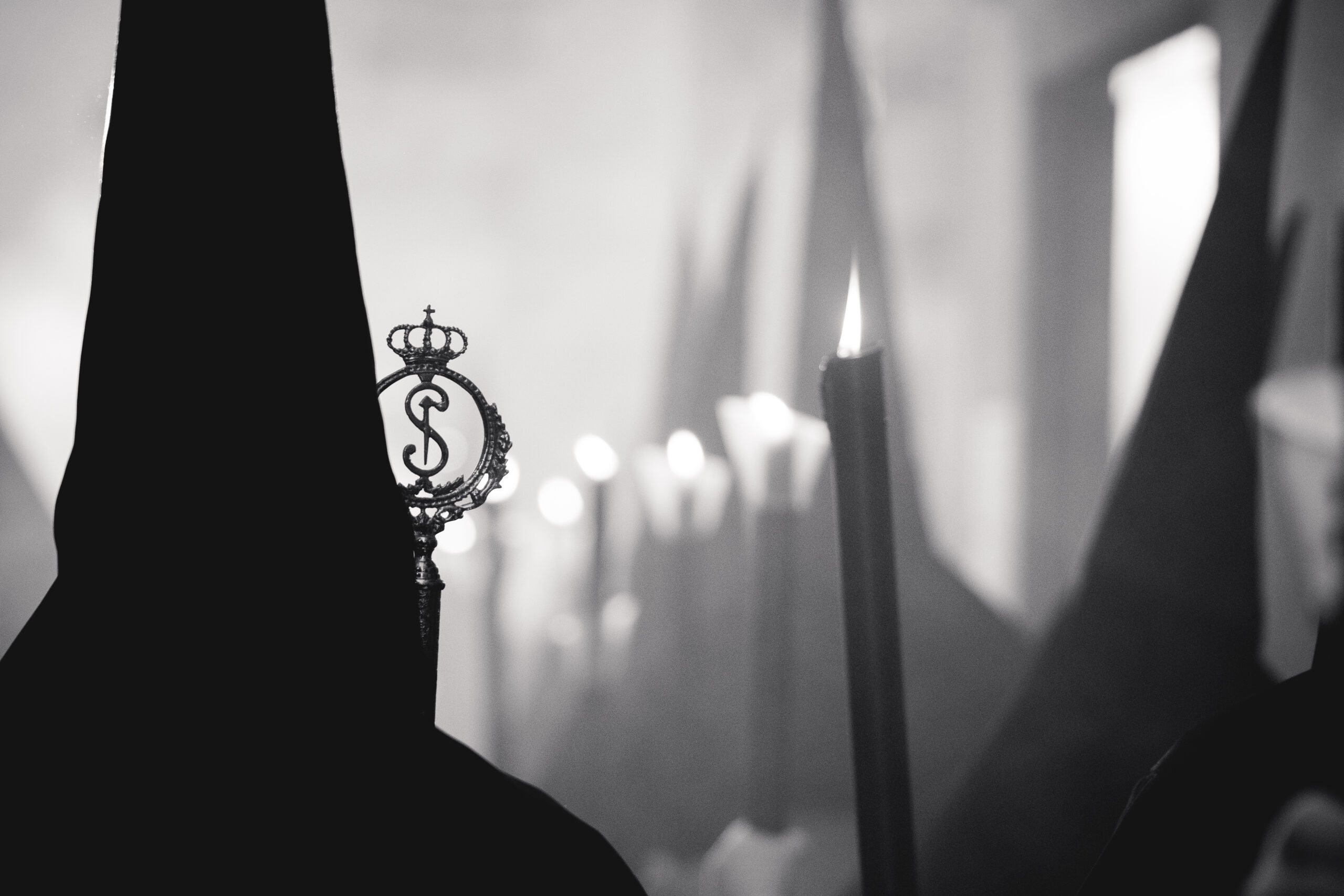
Photograph of the article: Jesús Cañete Fernández

