
Author: Francisco López Salamanca, official chronicler of Lucena
(Article published in the 1985 edition of Torralbo magazine)
The establishment of the Agrupación de Cofradías fulfilled a pressing need within our town. The large number of processional thrones making their way through the streets of Lucena under the auspices of its brotherhoods called for element capable of uniting so many dispersed efforts ―a catalyst for ideas and initiatives that would transform Holy Week in Lucena into a harmonious whole in which, while preserving the brotherhoods, there would beat a spirit of fraternity worthy of this Christian and Catholic expression of faith.
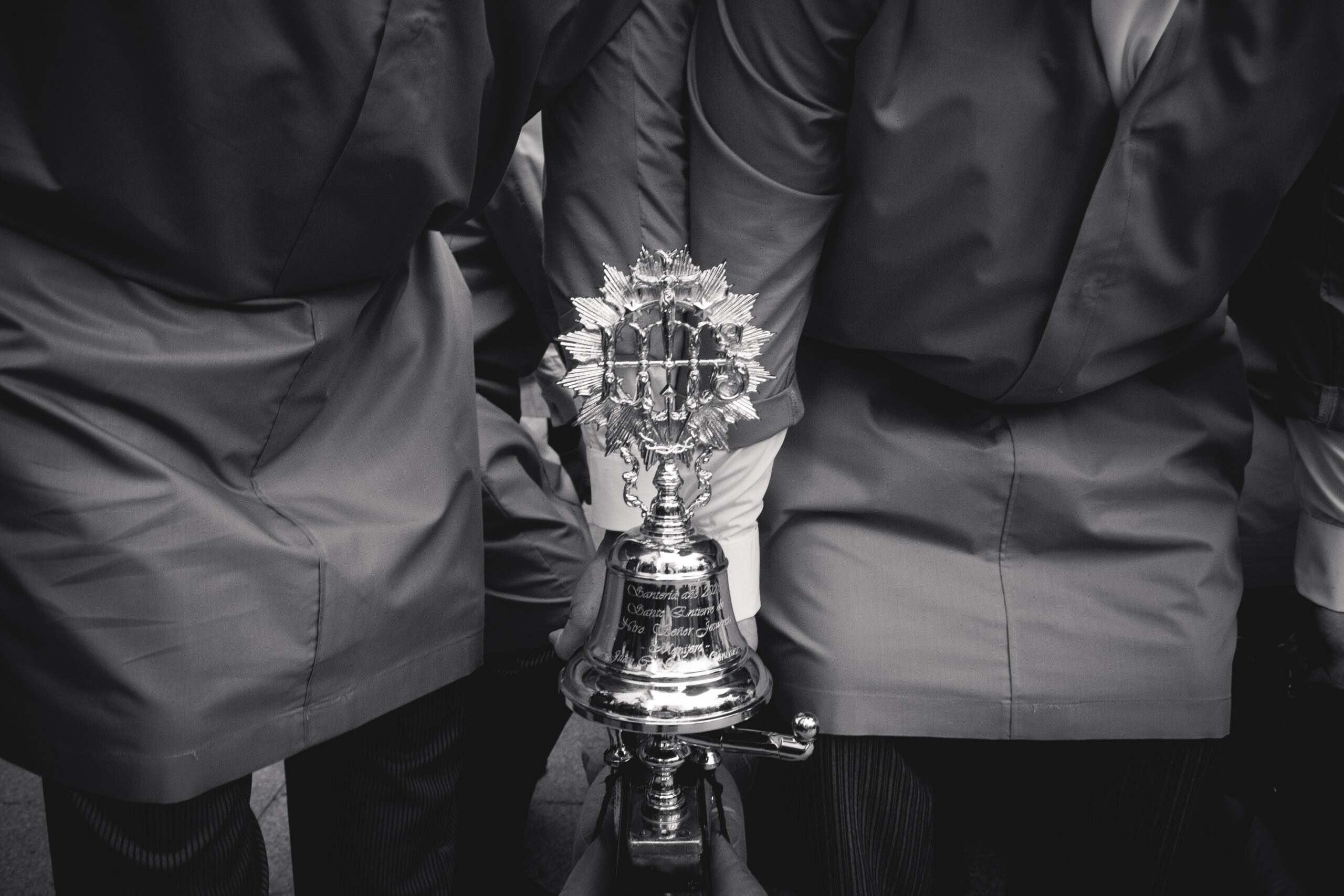
Whereas in other parts of Andalusia, and formerly also in Lucena, the brotherhood has served as the focal point around which the religious life of many believers revolves throughout the year ―with the processional cortèges representing but one, albeit significant, means of professing and strengthening the Catholic faith― in our town the tradition of ‘santería’ has, until comparatively recently, fundamentally altered this concept. Becoming an end in itself, ‘santería’ has acquired, on the positive side, an aesthetic richness that is by no means negligible and a distinctive character that sets it apart from Holy Week traditions elsewhere. On the negative side, however, it has diminished ―or at the very least greatly reduced― the role of the brotherhoods, which, with a few honourable exceptions, have traditionally confined, and in many cases continue to confine, their activity to the period immediately preceding Holy Week, limiting their function to little more than the adornment of the processional thrones. In this respect, they have been deeply influenced by the immense popular force of ‘santería’, which has permeated many of their governing boards.
In this way, Holy Week in Lucena has come to constitute a bipolar reality ―’santería’ and the brotherhoods― whose respective efforts at times neutralise one another, but which more often exist in opposition, with the balance generally tipping to the detriment of the brotherhoods.
It is therefore necessary ―and I believe this in the direction in which the leaders of the ‘Agrupación de Cofradías’ intend to proceed― to enhance the activities that define the statutes of each brotherhood, restoring each element to its proper place. One of its responsibilities must undoubtedly be to foster the next generation of ‘santeros’, whose numbers and enthusiasm are so striking in the children’s processional cortèges. At the same time, however ―and here the ecclesiastical hierarchy also has its part to play― it should endeavour to ensure that they understand that bearing an image of Christ or the Virgin upon their shoulders for public veneration is something far more profound than a form of sport or, at times, a rather unconvincing imitation of what their elders do.
The brotherhoods must recognise that, in order to serve as a ‘santero’ carrying one of the processional thrones of their titular devotion images, physical ability alone is not sufficient. It is easy to find ‘santeros’ whose only apparent connection with the brotherhoods consists of carrying the «holy images» out of the church and returning them afterwards, forgetting that the true protagonists of the procession are, first and foremost, the devotional image, then the brotherhood, and only finally the ‘santero’ himself. Unfortunately, this order of priorities appears, in general, to have been reversed.
I have spoken of carrying the holy images out of the churches and returning them afterwards, but it should not be forgotten that what accompanies these occasions is generally not a reflection upon the religious significance of the act, but rather a succession of gatherings of a wholly non-religious character, culminating in an expense usually borne by the ‘manijero’, often excessive and, at times, even scandalous in its scale. In this respect, these gatherings have become virtually obligatory, with the result that many ‘manijerías’ remain beyond the reach of worthy ‘santeros’, whose financial means simply do not allow them to aspire to such appointments. Leaving aside all this costly paraphernalia, intended to promote fellowship as a way of bringing people together in a common effort, the brotherhoods generally lead a rather languid existence: their membership continues to decline, their role in the processional cortèges in increasingly limited, and they face constant financial difficulties, made even more acute whenever restoration work or improvements become necessary.
Brotherhoods, onfraternities and ‘santería’ exist largely independent of one another; their paths cross only when it is time to bring the «holy images» out into the streets. Indeed, in our town, the ‘santero’ and the brotherhood member seem to represent two distinct ways of being and of understanding life. There are few occasions when a ‘santero’ is also a brotherhood member in the fullest sense of both terms. Promoting the figure of the brotherhood member-santero is likewise one of the responsibilities of the Agrupación de Cofradías. The brotherhoods should recognise and reward the commitment of their own members by entrusting them with the ‘santería’ of their processional thrones ―those who work for the good of their respective brotherhoods. These should not be regarded as isolated worlds, with no points of contact, detached from one another or even in conflict with one another, but rather as parts of a unified whole, joined in the commemoration of the Passion and Death of Our Lord.
Perhaps, without turning what follows into a nostalgic reflection based on the belief that the past was always better, looking back may help us understand this Christian spirit of fellowship among the brotherhoods. On 25th March 1771, the Heads of the Brotherhoods of the Passion then existing in Lucena met under the chairmanship of Juan Martínez de Gálvez, Vicar, Rector and Parish Priest of the Church of Saint Matthew: José Antonio de Cárdenas Nieto, representing the Brotherhood of Mount Carmel; Antonio Rafael de Mora Saavedra, representing the Brotherhood of Jesus the Nazarene; Francisco Romero Toledano, representing the Brotherhood of Our Lady of Peace and the Vera Cruz; and Pedro Julián de Luque, representing the Brotherhood of the Passion, based at the Franciscan Convent.
Thus, the representatives of those brotherhoods ―the protagonists of Holy Week in Lucena at that time― were gathered together in what was, in effect, a genuine ‘Agrupación de Cofradías’. The purpose of that assembly was «to enhance divine worship in the processions held in commemoration of the Passion and Death of Our Redeemer Jesus Christ». To that end, it was agreed «that the five aforementioned brotherhoods should attend one another’s annual processions, each accompanied by its banner and twenty members carrying twenty torches or candles, every brotherhood taking its proper place in each procession according to its seniority».
I shall leave other historical details and interesting aspects of the document for another occasion, and instead focus on the attitude shown by those Heads of the Brotherhoods, in accepting an arrangement whereby the generosity of each brotherhood would be repaid fivefold. In this way, the splendour of every processional throne in that bygone Holy Week was enhanced, at a time when ‘santeros’ were also brotherhood members and carried the thrones ―perhaps with less concern for aesthetics than today, but always giving the true Protagonist the place that was rightfully His.
Photograph of the article: Jesús Cañete Fernández

