Author: Francisco López Salamanca, official chronicler of Lucena
(Article published in the 1985 edition of Torralbo magazine)
At the invitation of the current Head of the Brotherhood of Our Lady of Sorrows of the Servite Brotherhood, I offer these pages a series of brief historical notes on that Congregation and Third Order which, established in various churches throughout Lucena, promoted devotion to Our Lady of Sorrows. The space constraints imposed by the inclusion of other distinguished contributions in this magazine have prevented me from dealing in greater detail with many of the more interesting aspects of the subject. Accordingly, I have confined this study to the eighteenth century, a turbulent period for the Congregation, yet one that was also marked by many significant achievements.
The earliest documented reference to the Congregation of the Servants of Mary, or Servites, appears in a minutes book of the Brotherhood of Our Lady of the O. It records that, on 12th March 1724, «the brethren intending to establish the Congregation of the Slavery» requested permission for their gatherings of prayer and spiritual exercises to be held in that hermitage every Friday throughout the year.
A few months later, on 16th August, at a subsequent meeting, the Congregation was allocated an altar on which to place its devotional image of Our Lady of Sorrows. As was customary among Servite congregations in different towns, the Lucena Congregation soon sought confraternity with the Congregation of Córdoba, so that they might share in one another’s spiritual benefits and prayers, as took place in 1734.
The Congregation was formally approved on 3rd October 1736 under the Rule of the Congregation established at the Church of Saint Marcellus in Rome, by decree signed by the Prior General of the Servita Order, Brother José Antonio Rossi.
However, as the Hermitage of Our Lady of the O lacked «sufficient space to erect a fitting altar, separate from those already existing in the hermitage, on which to honour its Sovereign Patroness», the Congregation resolved, at a meeting held on 3rd June 1760, to transfer its headquarters to the Hermitage of the Holy Christ of the Valley in Corralas Street. This decision followed the granting of permission by the Vicar General of the Diocese, countersigned by Francisco Vicente de Vargas, Senior Criminal Officer of the diocesan curia. To this end, formal agreement was signed with Jerónimo de Cuenca Gallardo, patron of the aforementioned hermitage, by which he granted the Congregation a site on which to erect its own altar. However, the devotional image of Our Lady of Sorrows could not be installed there, as José Ramírez Ávila, Head of the Brotherhood of Our Lady of the O, refused to hand it over, «there being no document to prove that it was the property of this Congregation».
Determined to acquire a new devotional image, the Congregation collected alms from its members and, on 27th March 1761, purchased a devotional image of Our Lady of Sorrows from the sculptor Victoria Chacón for the sum of seventeen pesos.
The Congregation’s establishment in the Hermitage of the Holy Christ of the Valley marked the beginning of a golden age, reflected both in the growing number of members who took part in its rigorous spiritual exercises and in the many congregations from across Spain that sought confraternity with it. This stood in marked contrast to the preceding years, which had been regarded as comparatively unproductive, «owing to the small number of brethren of which it was composed and the troubled times that befell it».
Following the establishment of the Servite Congregation and Third Order in its new location, at the monthly general meeting held on 12th February 1773, the then Head of the Brotherhood, Fernando Ramírez de Luque, proposed the commissioning of a new devotional image, since, as the records state, «there was at that time a great master sculptor in Córdoba […] and that, should he retire, the opportunity would be lost.» A month later, at a meeting of the brotherhood, several ‘borrones’ (preliminary sketches or designs) submitted by the religious sculptor were presented so that those in attendance might select the one they preferred. A letter from the sculptor was also read, stating that the cost of the devotional image would amount to 1500 ‘reales de vellón’. It was agreed that payment would be met through 600 ‘reales’ donated by the brotherhood deputies, together with the proceeds from the sale of the former devotional image and of certain mantles and items of jewellery.
By the middle of 1775, Brother Antonio Rafael de Mora informed the governing board that he had received word from the religious sculptor advising that the devotional image of the Virgin could be collected from Jaén. It was thereupon resolved that Brother Alonso Benítez should travel to that city «with one or two strong men to deal with any mishap» that might arise during the transport of the devotional image.
Once the devotional image of Our Lady of Sorrows had arrived in Lucena[1], it was placed in the home of the aforementioned Antonio Rafael de Mora until a suitable location could be found for it. Mora had paid the full cost of the sculpture, amounting to 1500 ‘reales de vellon’, explaining that he had done so in fulfilment of a vow made in Madrid during an illness.
When the governing board of the congregation met with its benefactor, he sought to impose upon the Servites, as a condition for handing over the new devotional image of the Virgin, a series of demands which they considered unacceptable. As a result, the long-awaited devotional image remained in the possession of Don Antonio Rafael, while the former image of Our Lady of Sorrows continued to receive veneration in the Hermitage of the Holy Christ of the Valley.
In 1776, it was resolved that «the Virgin’s eye and eyelash should be repaired». After consulting a sculptor regarding the repair, he concluded that it could not be carried out because the head was made of clay. Faced with this impossibility, the brethren resolved «that the said sculptor should make a new image of Our Lady at the least possible expense to this Venerable Congregation, and that it should indeed be completed by the aforementioned sculptor[2], on the most favourable terms that could be desired, since he had already remitted almost half the cost as a charitable donation to the said Venerable Congregation.»
A few days later, at another monthly meeting, it was resolved, following a proposal put forward by several brethren, that the Feast of the Virgin should be celebrated in the Major Parish Church of Saint Matthew the Apostle, owing to the limited space available in the Hermitage of the Holy Christ of the Valley. Thus, in response to the wishes of the large number of brethren and members of the Third Order, the congregation began its gradual association with the Major Parish Church of Saint Matthew the Apostle. On 14th June 1787, the Servite brethren were confronted with the dilemma of either surrendering the new devotional image of the Virgin ―known today― to the patron of their hermitage, or seeking another church in which to establish themselves. Several proposals were put forward during that troubled meeting, and it was ultimately resolved to petition the Vicar General of the diocese for permission «to establish the congregation in the College of Orphan Girls (Purísima), until such time as a means might be found to build a church to which Our Mother of Sorrows could be transferred». The response, however, proved far more unfavourable. On 1st October, the congregation received formal notice requiring it to vacate the hermitage within six days, without any reference whatsoever to the petition that had been submitted. Consequently, urgent negotiations were undertaken with the community of the Convent of Our Lady of Victory of the Order of Minims, through a member of the Chamizo family, a member of the Third Order who held a side altar in the Church of Saint Francis of Paola. After an agreement had been signed with the Father Corrector (Prior) of the convent, it appears that its terms were subsequently altered unilaterally by the friars. As a result, on 12th February 1788, the congregation resolved to leave that church.
In these circumstances, the only viable course of action, in agreement with the Vicar, José Feliciano Téllez, was to petition the Duke of Medinaceli for permission to establish the congregation in the Major Parish Church of Saint Matthew the Apostle.
Thus, under the protection of the patron of the town’s churches, they were granted a place within the church, in the very location they occupy today. While the niche-shrine and the altarpiece were being constructed, the devotional image of the Virgin remained in a display case within the sanctuary.
Supported by the Duke, the congregation attained the stability it had lacked for many years, together with the space that its growing prosperity required. Thus, during the final fifteen years of the 18th century, having definitively abandoned the idea of building their own church, the Servites undertook the construction of the altarpiece, together with the rooms required to house their possessions, extending into part of La Villa Street, specifically the section corresponding to the distance between two of the church’s buttresses.
On 3rd November 1788, the master craftsman Diego de Burgos undertook the construction of the altarpiece, which was gilded in 1792 «to the satisfaction of the governing board». Meanwhile, the painter Martín de Blancas was commissioned to execute the medallion adorning the second tier of the altarpiece, for which he was paid 100 ‘reales de vellón’. As the crowning elements of the altarpiece, the sculptor Remigio del Mármol, from Priego, carved the figures of Saint Philip Benizi and Saint Juliana Falconeri, saints held in particular veneration by the Servite Order, at a cost of 1360 ‘reales de vellón’.
Many further details emerge from a reading of the minutes books and the account ledgers of that Venerable Congregation and Third Order. I shall leave the task of publishing them for another occasion.
[1] This devotional image, whose author is not identified in any of the many documents I have consulted, was most probably carved by the French-born sculptor Juan Miguel Verdiguier, who settled in Córdoba and whose presence in Jaén is explained by his marriage to a lady from the capital of the Holy Kingdom. His connection with Don Antonio Rafael de Mora, Head of the Brotherhood of Jesus the Nazarene, stemmed from the commission that the latter had entrusted to him for a recumbent Christ intended for the bier of the Holy Burial.
[2] Significantly, the accounts for the year in which the face and hands of the devotional image of Our Lady of Sorrows were executed are missing. Without ruling out the aforementioned Verdiguier as its author ―he having carved the earlier image entirely in the round― it also remains possible that the still unidentified sculptor was Blas Molner, who executed the figures of Saint John Nepomucene and an ivory Crucifix for this same Major Parish Church of Saint Matthew the Apostle.
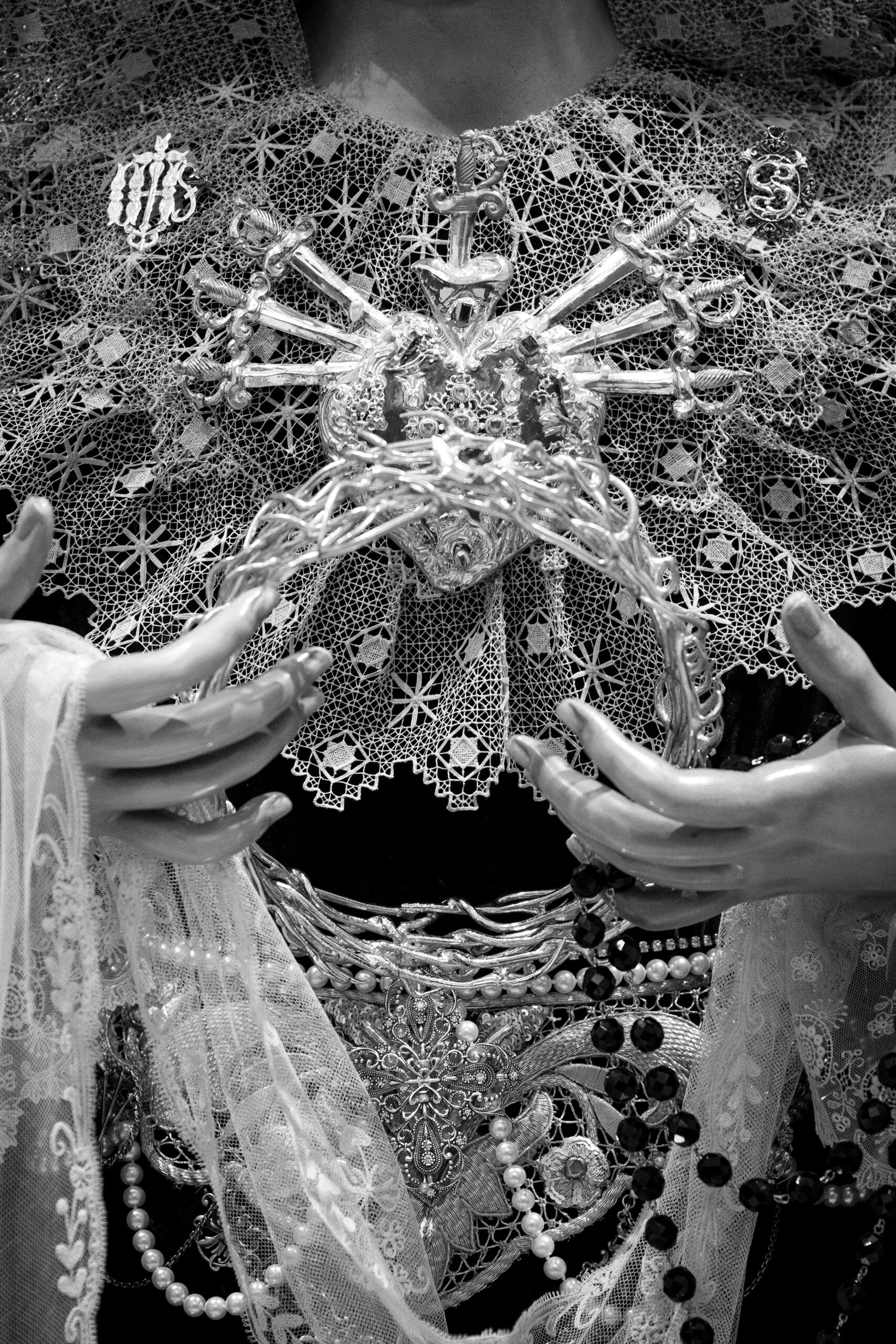
Photograph of the article: Jesús Cañete Fernández

