Franciscan Confraternity of Our Father Jesus the Risen and Our Lady of the Angels

Popular Name:
The Risen One
Founded:
Canonical Seat:
Iglesia Conventual de Madre de Dios de los RR.PP. Franciscanos
Imagery:
- Our Father Jesus the Risen (Francisco Javier López del Espino – 2025) – Throne of 26 santeros
- Our Lady of the Angels (Francisco Romero Zafra – 2001) – Throne of 28 santeros
Hermano Mayor:
Francisco Peñalver Moscoso
Processional Departure:
Easter Sunday – 12:30 pm
Number of Brothers:
100
Tunic of the Brothers:
The Governing Board and Youth Section wear suits.
Tunic of the Santeros:
White
The origins of this confraternity date back to 1978, when a group of young people from Lucena, encouraged by the priest Rafael Flores Morante, organised a procession of the Risen Christ setting out from San Juan Bautista. That moment marked the seed of a devotion that took shape in the founding of the confraternity in 1983, already based at the Franciscan church of Madre de Dios and under the leadership of its first Hermano Mayor, Francisco Javier Mellado Pino. In its early years, the confraternity used various borrowed images and thrones until it built up its own heritage. Devotion to Our Lady of the Angels was added in 1985 with an image by Niceto Mateo Porras, which was replaced in 2001 by the present carving by Romero Zafra. Since its foundation, the confraternity has maintained a sober, elegant style faithful to the Franciscan spirit, celebrating the Paschal Mystery with joy and fervour.
The image of Our Father Jesus the Risen is a work by the sculptor Francisco Javier López del Espino, created in 2025. Carved in royal cedar wood and polychromed in oil, it is a fully carved figure that replaces the earlier image by Manuel Luque Bonillo, which had in turn replaced the original image from Olot. The sculpture depicts Christ glorious and triumphant, standing on a rocky pedestal. He carries a richly decorated processional cross and wears a mantle in 24-carat gold leaf, gathered over his left shoulder, which accentuates the verticality and movement of the composition. The face of the Risen Christ shows a serene and majestic expression, with an uplifted gaze and a gesture of blessing in the right hand. The anatomy is treated in great detail, highlighting the strength and harmony of the glorious body. The image faithfully embodies the paschal message of hope, victory and new life, in keeping with the Franciscan spirit and the confraternity’s sober style.
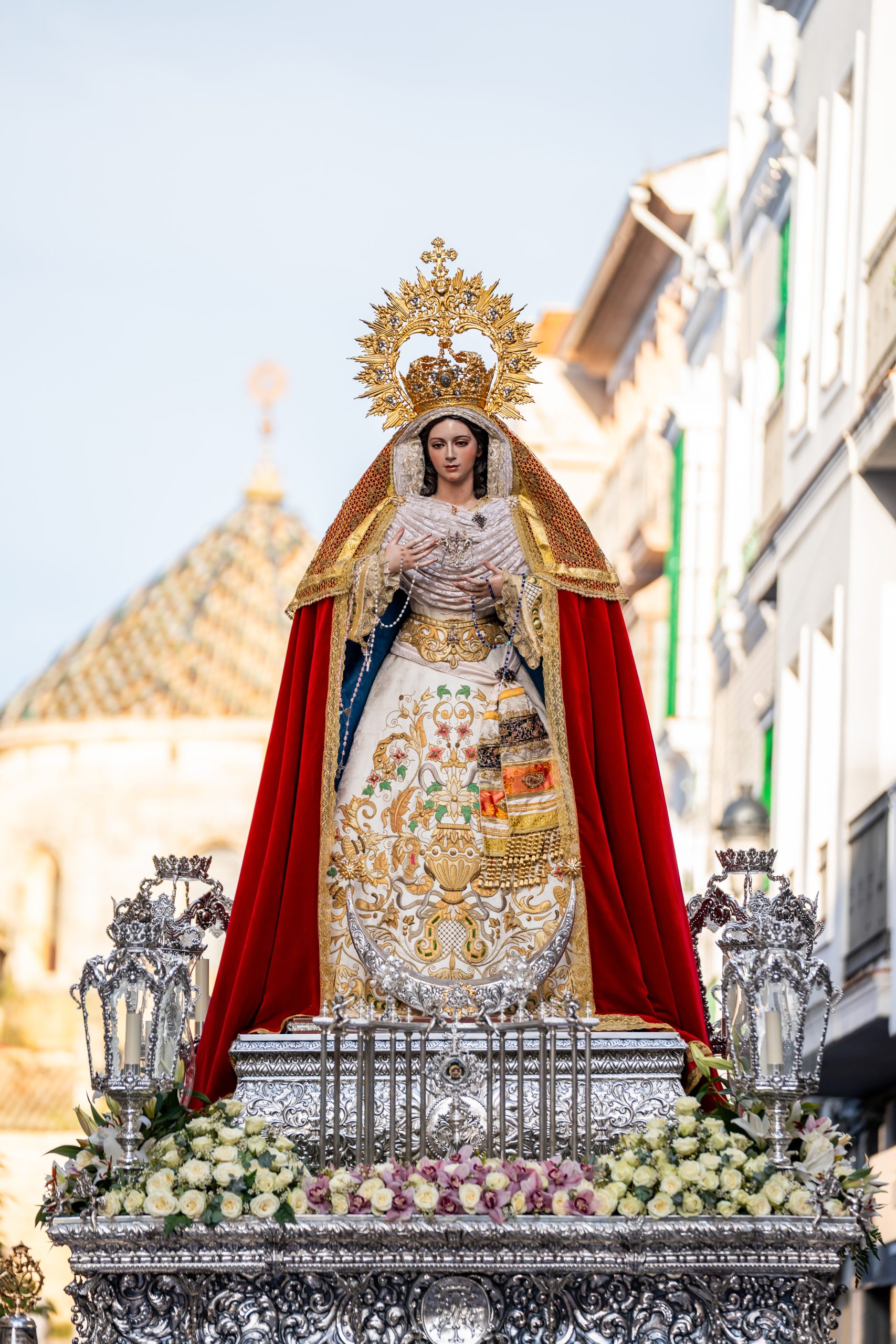
For her part, Our Lady of the Angels is a dressed image, with head and hands carved in cedar wood by the sculptor from Cabra Luis Peñalba Corpas in 1997, based on the earlier image by Niceto Mateo Porras (1985). It was completely renewed and blessed at the Convent of San Francisco, wearing new attire made by Francisco de Paula Ruiz Barranco — mantle, tunic and crown. Later, in 2001, it was replaced by the present glorious image carved by Francisco Romero Zafra, which was definitively incorporated into the confraternity.
Following a thorough restoration process, the processional throne of Our Father Jesus the Risen was unveiled again in 2024. It is a throne made entirely in silver metalwork, with finishes combining polished silver and aged silver, giving it an elegant, refined contrast. The base features embossed panels with scenes from the life of Christ and ornamental details of classical inspiration, notable for its angular mouldings and clean lines. On the central front there is a circular relief with the symbol of the Mystic Lamb, while small figures of angels in glorious poses rise at the corners. The image of the Lord stands on a pedestal lined in red, accompanied by four large lanterns, also in metalwork, made in the Lucena workshops of DECO-FRADE. These lanterns, with a faceted structure and topped with floral crestwork, reinforce the verticality of the ensemble and create a play of light around the figure of the Risen Christ. The overall style of the throne reflects a refined Baroque aesthetic, where solemnity and light combine with sobriety. The whole ensemble projects a glorious, triumphant and serene image, fully consistent with the paschal message proclaimed by the Brotherhood.
In 2025, the complete restoration of the processional throne of Our Lady of the Angels was presented; it now has a structure made entirely in embossed silver metalwork, with rich floral decoration and Franciscan motifs, in perfect harmony with the sober, glorious style of the confraternity. The base is finished with finely chiselled crestwork, and the sides feature panels with coats of arms and Marian symbolism, all framed by acanthus and foliage reliefs of clear Baroque inspiration. The central front shows a medallion with the emblem of the Franciscan Order. The image is accompanied by four metalwork lanterns in Imperial style, with an octagonal structure, floral finials and cut glass.
Instead of a canopy, the Virgin is presented beneath the celestial vault, highlighting her white brocade mantle with gold motifs and a rich silver crown. On the throne’s platform, floral arrangements in white, cream and burgundy tones are arranged in an elegant pyramidal display framing the Virgin in an attitude of prayer. The overall style of the throne departs from the traditional canopy concept, opting instead for a glorious, vertical and Marian presentation that reinforces its angelic and paschal character.

*Documentary Source: Notas para la historia de las cofradías lucentinas (Francisco López Salamanca – 2022), Official Programme of the Lucena Holy Week 2026, and documentation provided by the confraternity itself.
*Photographs: Jesús Ruiz Jiménez ‘Gitanito’ and Jesús Cañete Fernández.

