Brotherhood of Our Lady of Rocío of Lucena

Popular Name:
El Rocío
Foundation:
1972
Canonical Seat:
Iglesia Parroquial de Nuestra Señora del Carmen
Imagery:
- Simpecado of the Lucena Brotherhood (2007)
President:
Juan Luna García
(A Hermano/a Mayor de Camino is appointed each year)
Procession:
- Departure of the Lucena pilgrims for Almonte (Saturday before the pilgrimage weekend) – 10:00
- Pentecost Monday in Almonte (50 days after Easter Sunday)
Number of Members:
500
Distinctive Musical Accompaniment:
Piper (pitero) playing the pipe and tabor
Members' Attire:
Women usually wear a flamenco dress, long and fitted, adorned with ruffles, polka dots or bright colours. The outfit is completed with a small shawl (mantoncillo), a flower in the hair and eye-catching earrings. Around the neck they wear their brotherhood’s medal, hung on a cord, as a symbol of belonging and devotion to the Virgin.
Men wear the short Andalusian suit, made up of fitted trousers, a white shirt, a waistcoat and a short jacket. They sometimes wear a wide-brimmed hat and riding boots. Like the women, they wear their brotherhood’s medal around the neck, representing their faith and their commitment to the Rocío tradition.
Devotion to Our Lady of Rocío, universally known as the White Dove, has its roots in an old tradition linked to the finding of the image in the area known as La Rocina, in Almonte. According to tradition, it was the hunter Gregorio Medina who found the sacred carving hidden among the undergrowth, in the hollow of a tree, dressed in a white and green tunic and venerated at that time under the earlier title of Our Lady of the Remedies. That image, later venerated as Our Lady of las Rocinas, would in time become one of the great devotional symbols of Andalusia and of all Spain under the title of Our Lady of Rocío.
The Virgin was proclaimed Patroness of Almonte in the 17th century and canonically crowned on 8 June 1919, with the authorisation of Pope Benedict XV. Her pilgrimage, celebrated every Pentecost, is today one of the greatest expressions of popular religious devotion in the world.
In Lucena, Rocío devotion began to grow thanks to numerous residents and families who travelled individually to the village near Almonte. The decisive impetus came with the Golden Jubilee of the Coronation of Our Lady of Rocío, celebrated in May 1969, when a group trip was organised whose extraordinary reception sparked the wish to formally establish a Rocío brotherhood in the city.
With the support of D. Carlos Delgado Paniagua, parish priest of the Parroquia de Nuestra Señora del Carmen, the founding board was formed, made up of devotees such as Juan Lara, Manuel Arroyo, Emilio Marín, José Marín, Pablo Plaza, José López, Manuel Onieva, Juan Marín, Juan Bujalance, Juan Luis Reyes and Antonio Blancas, among others.
The Brotherhood of Our Lady of Rocío of Lucena was officially founded on 2 June 1970. Its statutes were approved on 17 March 1972 by the Bishop of Córdoba, Monsignor José María Cirarda Lachiondo, and it was canonically established in the Parroquia de Nuestra Señora del Carmen, the church with which it has maintained a close spiritual, pastoral and personal bond ever since.
That same year, the Mother Brotherhood of Almonte recognised the Lucena brotherhood as a filial member, granting it number 41 and giving it its first official presentation at the 1972 Pilgrimage. It was sponsored by the Rocío Brotherhood of Barcelona, which visited Lucena for the first time on 17 May 1972.
The Lucena brotherhood holds a prominent place within the Andalusian Rocío movement, being the first Rocío Brotherhood in the province of Córdoba. It later sponsored the Rocío Brotherhood of Córdoba in 1977 and that of Castillo de Locubín in 1983, contributing decisively to the spread of Rocío devotion in Eastern Andalusia.
The Brotherhood House in El Rocío
One of the brotherhood’s great heritage milestones was the acquisition, in 1980, of a plot of land in the village near Almonte to build what is now the Brotherhood House of Lucena. The first stone was laid during the October pilgrimage of 1985, and the house was definitively blessed in 1987 by D. José Ocaña Mesa, parish priest of the Carmen and spiritual advisor of the brotherhood. Since then, the Brotherhood House has been the home of the Lucena Rocío pilgrims in the village, a place of welcome, fellowship, prayer and brotherhood during the pilgrimages and the Pentecost Pilgrimage.
The Simpecado
The great spiritual symbol of the brotherhood is its Simpecado, a standard representing the Virgin’s permanent presence during the pilgrimage and the acts of worship. Over its history, the brotherhood has had several Simpecados. The first, made in Lucena for the 1972 presentation, was simple and small, featuring the image of the Virgin alongside the castle and the star, symbols of the city.
The second Simpecado, unveiled in 1973, was made of white satin embroidered in gold and presided over the brotherhood’s pilgrimages for decades. Of particular importance was the third Simpecado, blessed in 1995, designed by brother Antonio Budia Sabán and enriched with silverwork from the workshops of Juan Angulo Servián. Inspired by a Baroque altarpiece and the camarín of María Santísima de Araceli, it combined embroidery, silver and Marian and Christological symbolism in a composition of enormous artistic richness.
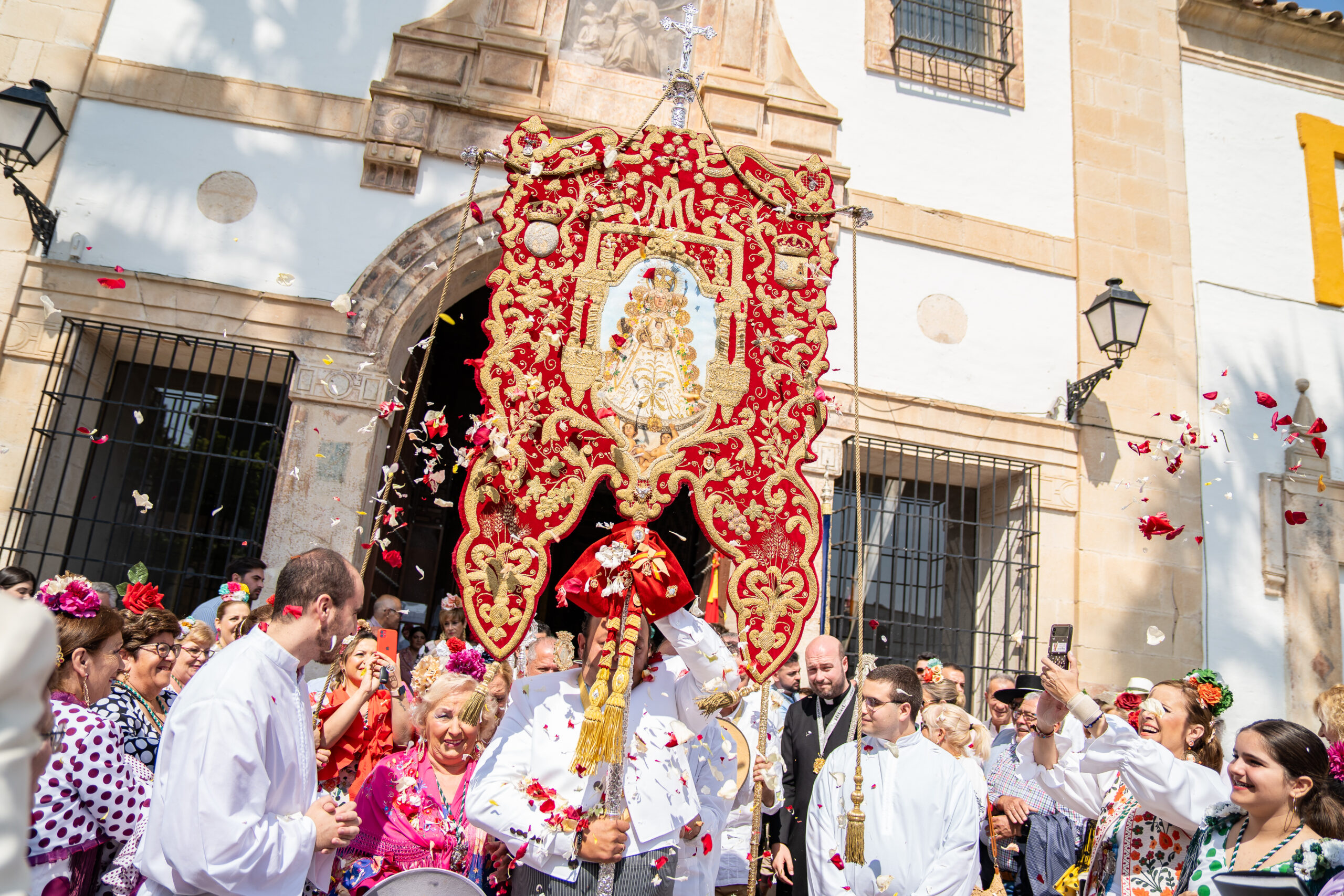
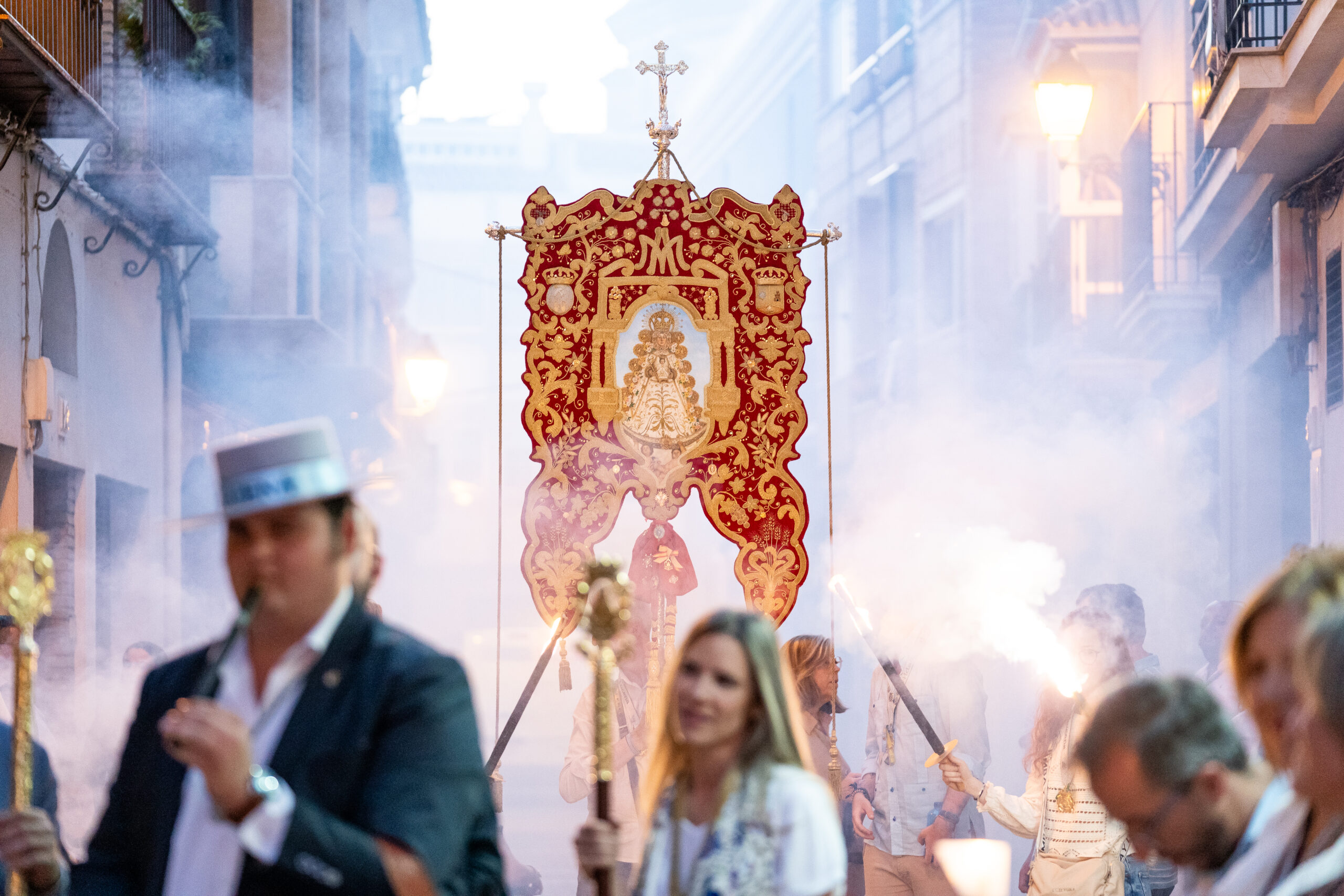
The current Simpecado was blessed on 23 June 2007 and made its first pilgrimage at Pentecost 2008. Embroidered in gold on red velvet, its design incorporates the coat of arms of Lucena and that of the Parroquia del Carmen, making it one of the brotherhood’s great devotional emblems.
The Simpecado processes on a cart drawn by mules. The brotherhood’s first cart, made of wood polychromed in white and gold, was designed by Manuel Arroyo Puech and unveiled in 1978. It was later replaced by the current silver cart, made in the Lucena workshops of Hermanos Gradit. During the pilgrimage, the Simpecado is never left alone. It is always accompanied by pilgrims fulfilling vows, walking behind it in silence, praying, or even barefoot, in one of the most profound expressions of Rocío spirituality.
The Brotherhood’s Medal
The brotherhood’s medal is another of its great symbols of identity. The earliest medals, popularly known as “de pandereta” (tambourine-style), featured the image of Our Lady of Rocío and a green and white cord. In 1977, brother Manuel Arroyo Puech designed the current medal, inspired by the coat of arms of Lucena and enriched with the image of Our Lady of Rocío and the city’s historic symbols: the castle, the star and the flower.
Worship, Social Action and Brotherhood Life
The Brotherhood of Our Lady of Rocío of Lucena maintains an intense spiritual, devotional and social life throughout the year, while also keeping close collaboration with the Parroquia de Nuestra Señora del Carmen and taking part in various charitable and fraternal aid initiatives. Every January it holds its General Assembly of Members, where the corporation’s key matters are discussed and the appointment of the Hermana or Hermano Mayor is ratified.
Of particular importance is the traditional Changing of the Medal, held after the feast of Candlemas. In this deeply symbolic act, the outgoing Hermana or Hermano Mayor hands the distinctive medal to whoever takes on the responsibility of representing the brotherhood during the new Rocío year. Two weeks after Easter, the preparatory devotions for Pentecost begin with the celebration of the Solemn Triduum, days of prayer that include the Rosary, the Eucharist and fraternal fellowship.
The Saturday culminates with the traditional Rocío Pregón, one of the most eagerly awaited events on the Lucena Rocío calendar, where the pregonero’s heartfelt words announce the imminent start of the pilgrimage. During the same event, the Pentecost poster is unveiled and the brotherhood’s Gold Medal is awarded. The day concludes with the traditional Brotherhood Dinner, reflecting the close-knit, welcoming and participatory character that defines the corporation.
The music also holds an essential place in the life of the brotherhood. The sounds of the Rocío choir, the pipe and the tabor accompany both the acts of worship and the pilgrimage, becoming an inseparable part of the spiritual and festive identity of the Lucena Rocío pilgrims. The brotherhood also maintains a strongly intergenerational character, in which whole families, young Rocío devotees and new pilgrims take an active part in passing on a devotion handed down from generation to generation, keeping the essence of Rocío alive in Lucena.
Pentecost and the Pilgrimage
The departure for the village is one of the most exciting moments of the year. After the Pilgrims’ Mass, the Simpecado’s cart leaves the Parroquia del Carmen and travels through the streets of Lucena amid cheers, flower petals, fireworks and the company of numerous faithful. From that moment, the true Rocío pilgrimage begins: days of fellowship, prayer and sacrifice in which the dust, the tiredness and the long days are transformed into a shared experience of faith.
The praying of the Angelus, the Salves recited as evening falls, the stops along the way and the fellowship among pilgrims turn the pilgrimage into a genuine spiritual and human experience. Arrival at the village of El Rocío and the official presentation before the feet of the Virgin represent one of the most defining moments for the brotherhood. During Pentecost, the Brotherhood House of Lucena becomes a permanent space of encounter and fellowship for the Lucena Rocío pilgrims.
Everything culminates in the early hours of Pentecost Monday, when, after the traditional leap over the grille, Our Lady of Rocío visits the Lucena Simpecado in one of the most emotional and fervent moments of the entire Pilgrimage.
A Deeply Rooted Devotion
The Brotherhood of Our Lady of Rocío of Lucena is today one of the most beloved and deeply rooted Glory brotherhoods in the city. Its history reflects the growth of a devotion handed down from generation to generation and deeply linked to Andalusian popular religiosity. Faith, fellowship, charity, tradition and pilgrimage come together every year around Our Lady of Rocío, making the brotherhood a true Rocío family that keeps alive in Lucena the spirit of Pentecost and love for the White Dove.
*Documentation provided by the confraternity itself.
*Photographs: Jesús Cañete Fernández.

