Confraternity of Our Father Jesus in His Triumphal Entry into Jerusalem

Popular Name:
La Pollinita
Foundation:
1928
Canonical Seat:
Iglesia Mayor Parroquial de San Mateo Apóstol
Imagery:
Our Father Jesus in His Entry into Jerusalem (Talleres de Olot – 1928) – Throne of 24 santeros
Hermano Mayor:
Francisco Escudero Ruiz
Procession Departure:
Palm Sunday – 5:45 pm
Number of Brothers:
100
Characteristic Musical Accompaniment:
It is accompanied by the Torralbo march
Tunic of the Brothers:
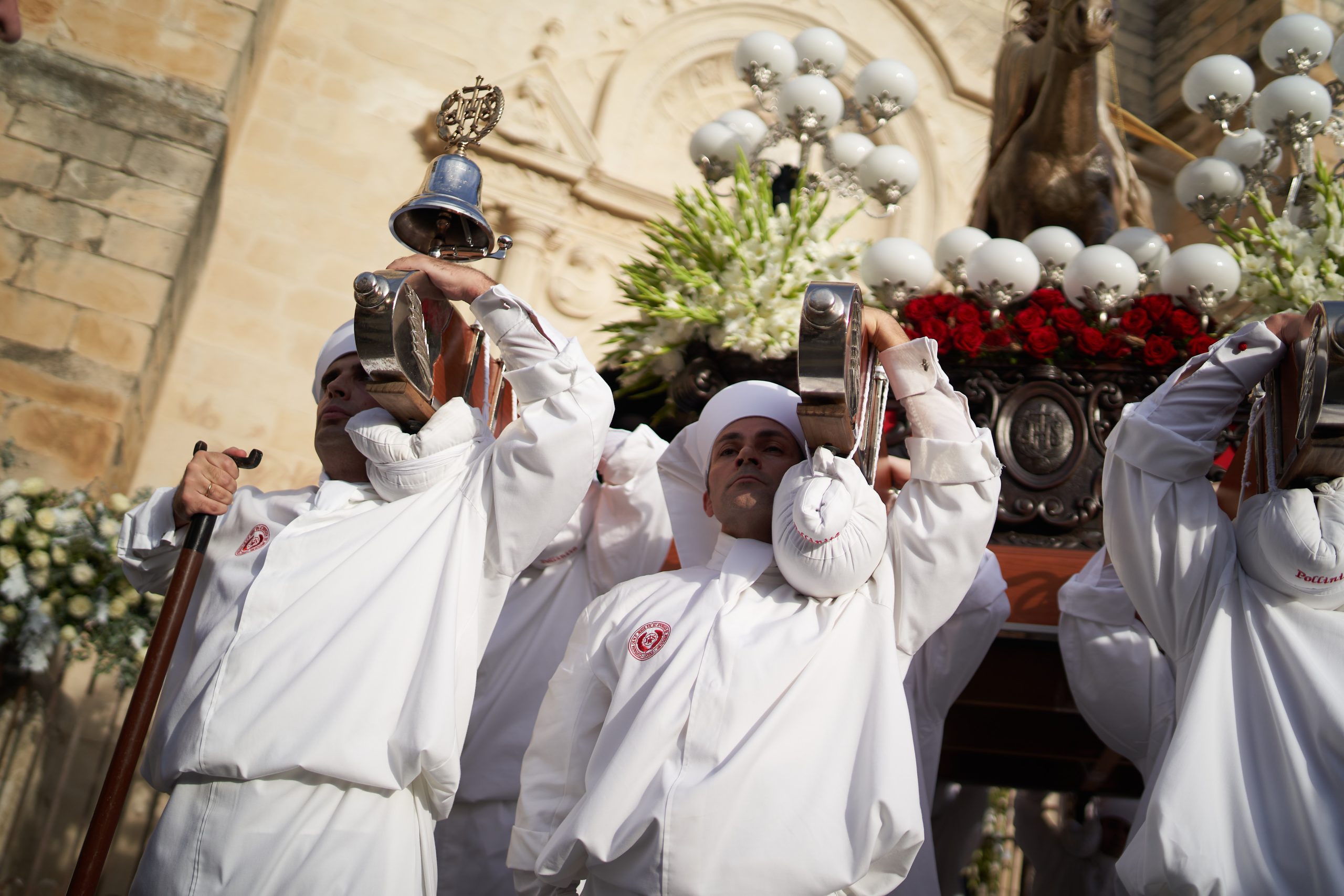
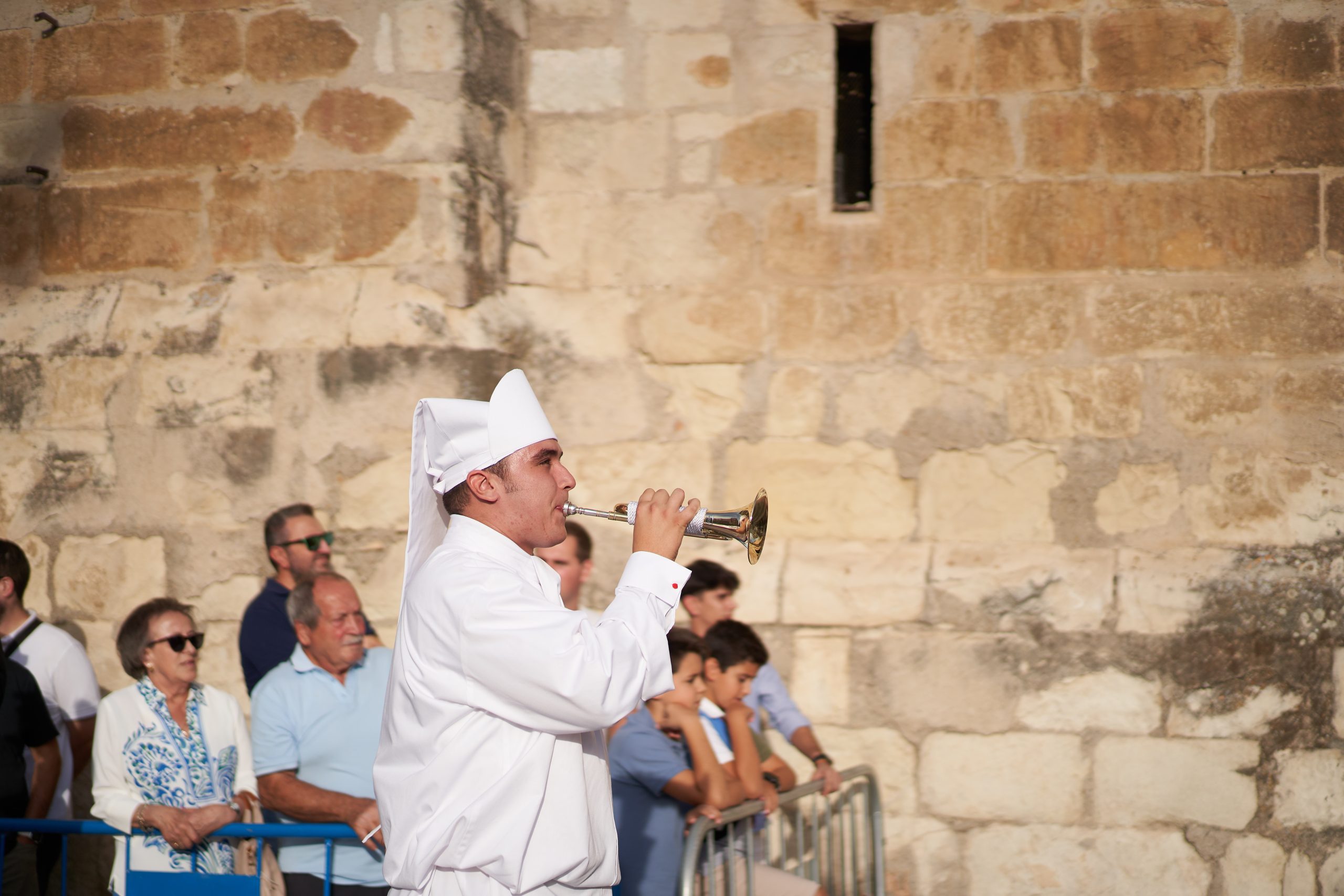
White with a hood of the same colour. Red cape, sash and buttons. The children are dressed as Hebrews, with their faces uncovered, wearing a capirote with a tassel.
Tunic of the santeros:
White with the confraternity’s coat of arms and a capirote of the same colour.
Established on 29 June 1928, the brotherhood’s fundamental purpose was to spread religion among young people. Its first governing board was made up of Cristóbal Escudero Bujalance, Hermano Mayor; Juan Palma Garzón, Deputy Hermano Mayor; Francisco Rodríguez Delgado, treasurer; Joaquín Galindo Cuadra, deputy treasurer; Francisco Evangelista Vera, secretary; and José Díaz Fernández de Villalta, deputy secretary. Board members: Miguel Roldán Pineda, Rafael Cuenca Escudero, Pedro Víbora del Pino and Francisco Mora Romero. Almoner brothers: Felipe Cañete Viso and Juan José Hoyos Sánchez.
The titular image was acquired from the Talleres de Olot (Gerona) by Cristóbal Escudero Bujalance, who paid its price of 800 pesetas. The carving is made of wood paste, and was later restored in 1993 and 1995 by Antonio Ortega Lozano. It depicts Jesus on a colt, carrying a palm branch in his left hand along with the gilded-cord halter, unveiled in 1995, while his right hand is raised in a gesture of blessing. The Lord wears on his head a gilded halo unveiled in 1928. The Christ’s throne, in Neo-Baroque style, is made of mahogany-coloured wood with carved ornamentation alluding to Palm Sunday, featuring Passion-related motifs and white opaline glass tulip lamp shades.
The first procession took place in 1929, with a team of bearers led by Ignacio Serrano Muñoz. From the following year, and until 1944, José María Ranchal Gómez held the position of team leader. By the middle of the century, it shared its titular status with Our Lady of Sorrows, of the Servite congregation, and the Christ of Mercy.
In 1968, for health reasons, the Hermano Mayor Francisco Escudero Bujalance handed over his position to Antonio Víbora Álvarez de Sotomayor. The brotherhood, which formalised its statutes in 2007, was a founding member of the Agrupación de Cofradías.
In 2014, Antonio Cañete Muñoz took charge of the confraternity. Except for the days around Palm Sunday, the image used to be moved to the Parroquia Mayor from the oratory of its founding Hermano Mayor, Cristóbal Escudero, until 2019, when it was placed in the Iglesia Mayor Parroquial de San Mateo Apóstol, where it currently occupies an altar at the foot of the Gospel-side nave.
It carries out its penitential procession accompanied by a large number of brothers carrying their blessed palm branches, with special participation from the youngest members. It is accompanied by the characteristic sound of the Lucena torralbo, one of the most distinctive and singular elements of the sound heritage of Lucena’s Holy Week. Its procession is organised through the historic figure of the cuadrillero, preserving a particular form of organisation unique to this Lucena tradition.

*Documentary Source: Notas para la historia de las cofradías lucentinas (Francisco López Salamanca – 2022), Official Programme of Lucena’s Holy Week 2026, and documentation provided by the confraternity itself.
*Photographs: Jesús Ruiz Jiménez ‘Gitanito’ and Rafael Fotografía.

