Royal Confraternity of Our Father Jesus of the Agony Praying in the Garden, Mary Most Holy of the Star and Saint Innocent the Martyr


Popular Name:
El Huerto
Foundation:
Canonical Seat:
Imagery:
- Our Father Jesus of the Agony Praying in the Garden (Luque Bonillo, M. – 1996) – Accompanied by three apostles, the work of Manuel Luque Bonillo in 2015, and an angel made by Luque Bonillo in 1997 – Throne of 28 santeros
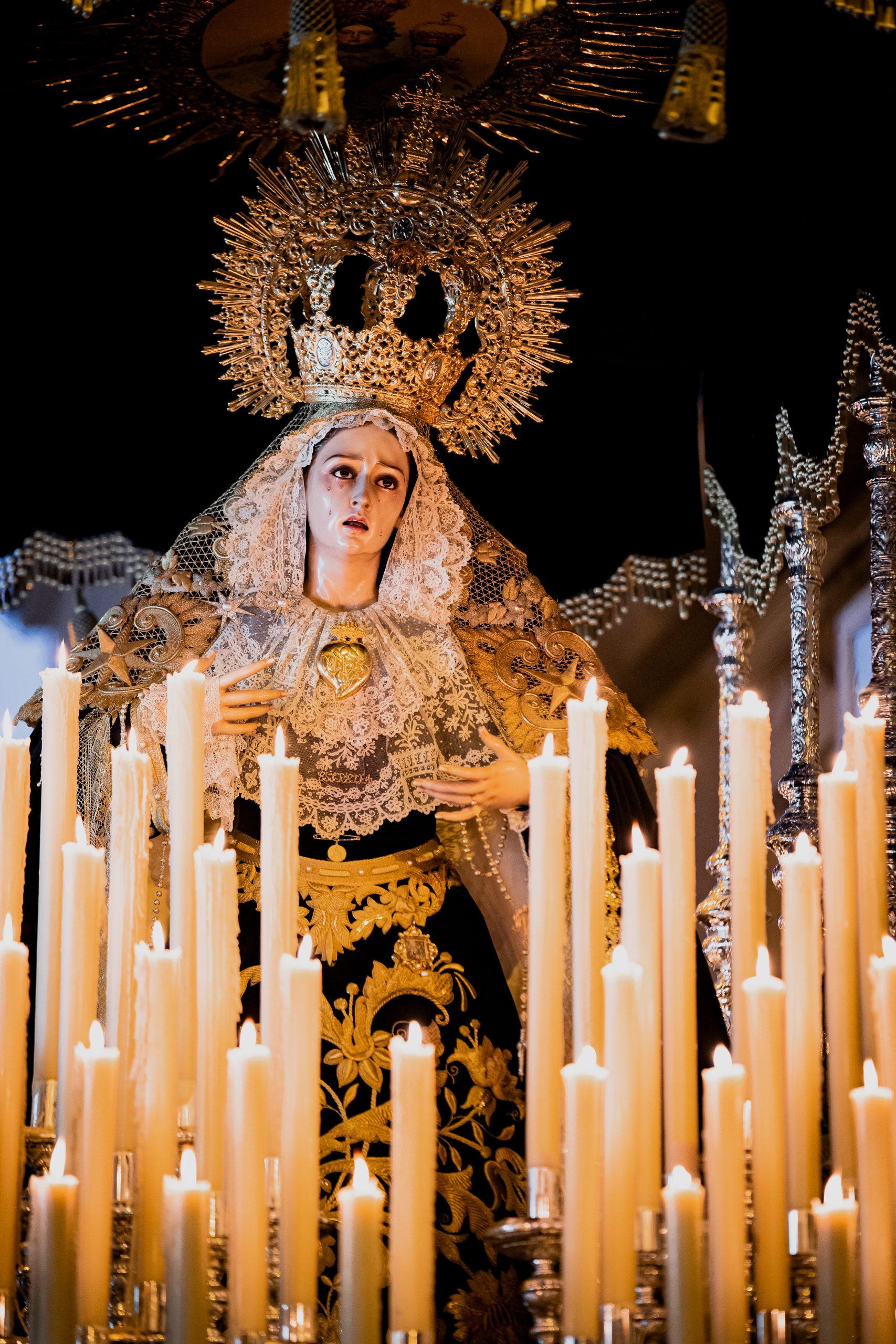
- Mary Most Holy of the Star (Luis Álvarez Duarte – 2000) – Throne of 28 santeros
Hermano Mayor:
Miguel Ángel Ramírez Jiménez
Procession Departure:
Palm Sunday – 7:45 pm
Number of Brothers:
402
Tunic of the Brothers:
Ivory with an olive-green hood and coat of arms embroidered in gold. The officers wear an ivory-coloured cape.
Tunic of the santeros:
Olive green with a gold cord (both images)
The Royal Confraternity of the Garden was established in the Parish Church of Santo Domingo de Guzmán in Lucena on 1 June 1990, thanks to a group of young people moved by devotion to the mystery of Jesus praying in the Garden. Initially, the titular image was a dressed carving from the first third of the 19th century, made by the Lucena-born sculptor Andrés Cordón, which was kept in the oratory of the Torres-Chacón family; this was the image with which the first penitential procession was held on Palm Sunday 1994, on a carved throne made by the Lucena-born artist Rafael Pérez González.
The relics of Saint Innocent the Martyr were received in the parish church of Santo Domingo in late 1992, coming from the oratory of the ancestral home of the Marquises of Campo de Aras. The confraternity adopted him as its patron saint and placed him on public veneration in its chapel, in an 18th-century Roman-style urn. The feast in his honour is celebrated on 22 September.
In 1996, Fray Gabriel de la Dolorosa Calvo Barrios blessed the present titular image of Our Father Jesus of the Agony Praying in the Garden, the work of the Cordoban sculptor Manuel Luque Bonillo. It is a carving of great expressiveness which in 2008 underwent, at the hands of its author, a process of anatomisation of the body and retouching of the flesh tones, also softening some of the more pronounced features of the face. The group is completed by the image of the comforting angel, also the work of Luque Bonillo, made in 1997 as a complete, polychrome carving, adjusted in proportion in 1999 and worked on again in 2014; the cross and chalice it carries are the work of the Juan Angulo workshops. Finally, in 2015 the secondary images of the apostles Peter, James and John were added to the mystery float, likewise made by the same sculptor, definitively enriching the Gospel scene of the Garden.
In the year 2000 the brotherhood was established as a public association of the Church by decree of the bishop, obtaining legal status and the approval of its statutes. On 27 February of that same year its Marian titular image, Mary Most Holy of the Star, was blessed, the work of the Seville sculptor Luis Álvarez Duarte. It is a candlestick-frame image, with carved head and hands, made in 1999. Among its most notable elements is the processional crown, made in the Juan Angulo workshops, as well as a valuable textile trousseau that includes a skirt and an over-mantle headpiece embroidered in gold thread at the workshops of the Cordoban embroiderer Antonio Villar Moreno, who is also responsible for dressing the image. On 24 November 2024, the image received as a donation a double-sided reliquary dagger, the work of the prestigious Cordoban jeweller and goldsmith Manuel Valera Pérez, designed in a Marian style and housing, set in the hollow of the heart on the centre of the reverse side, a theca containing an authentic relic from the Rock of the Agony in Jerusalem; this piece was blessed on 14 November 2024 by His Excellency and Most Reverend Mons. Bernardito Auza, Apostolic Nuncio of His Holiness the Pope in Spain.
During the celebration of the 25th anniversary of its foundation, in 2015, this brotherhood completed one of its most significant projects, its mystery float, with the addition of the three apostles (Peter, James and John) as secondary images, also the work of Manuel Luque Bonillo. Since 29 December 2021 this confraternity has held the title of Royal, granted by the Royal Household, which represented a great honour as well as a great responsibility for this corporation, as it continues to strengthen its prestige and its commitment to its brothers.
Over these thirty-five years of confraternal life, the Royal Confraternity of the Garden has experienced notable heritage, devotional and social development, playing an active part in Lucena’s Holy Week and enjoying deep roots among its large number of brothers, as well as in the neighbourhood of its parish.
The processional thrones of the Royal Confraternity are true works of art that enhance and highlight the presence of its sacred titular images. The throne of Our Father Jesus of the Agony Praying in the Garden, dated 2004, features a base structure made under the direction of Antonio Morillo Ruiz, while the canopy platform grew out of ideas from the brotherhood, given shape in a design by José Carlos Rubio Valverde; the figures of the major prophets are the work of Manuel Luque Bonillo and the painted cartouches are by Rafael Cervantes. With curved outlines, it is made of carved cedar wood, varnished in a walnut colour, with rich decoration of geometric and plant elements such as leaves, flowers and fruit. The second tier takes the form of an open cup, its carving combining foliage with bursts of flowers and fruit alongside figures of cherubs, with the carvings of the major prophets placed on pedestals at the corners. Small painted cartouches show the faces of Lucena images linked to four of the five Sorrowful Mysteries, with the titular image itself alluding to the remaining one, while the lighting is arranged by means of four six-branched tree-form candelabra at the corners and two five-light candlesticks at the sides.
For its part, the throne of Mary Most Holy of the Star was completed on 24 March 2002, the date on which the image processed for the first time. The base structure was made by Ángel Perfecto and the canopy frame comes from the workshop of Juan Angulo; the small allegorical images of the theological virtues are again the work of Manuel Luque Bonillo, the outer valances were embroidered by Antonio Villar Moreno and the canopy-ceiling oil painting is by Víctor Manuel Manjón-Cabeza Ortiz. The canopy frame, in neo-Baroque style, is made of chased silver-plated metal, with a rich variety of motifs, cartouches and niches designed to house the aforementioned allegorical images; the canopy is night-blue in colour, matching the mantle, with outer valances embroidered in appliqué and silk, the front valance featuring the scene of the Assumption of the Virgin into Heaven and the rear one the Coronation of the Blessed Virgin Mary.

*Documentary Source: Notas para la historia de las cofradías lucentinas (Francisco López Salamanca – 2022), Official Programme of Lucena’s Holy Week 2026, and documentation provided by the confraternity itself.
*Photographs: Jesús Ruiz Jiménez ‘Gitanito’ and Jesús Cañete Fernández.

