
Confraternity of Our Father Jesus of the Valley and Most Holy Mary of Bitter Sorrow

Popular Name:
The Valley
Foundation:
Canonical Seat:
Imagery:
- Our Father Jesus of the Valley (Granada School – 19th century) – Accompanied by the image of a Cyrenean, the work of Daniel Henares in 2025 – Throne of 26 santeros
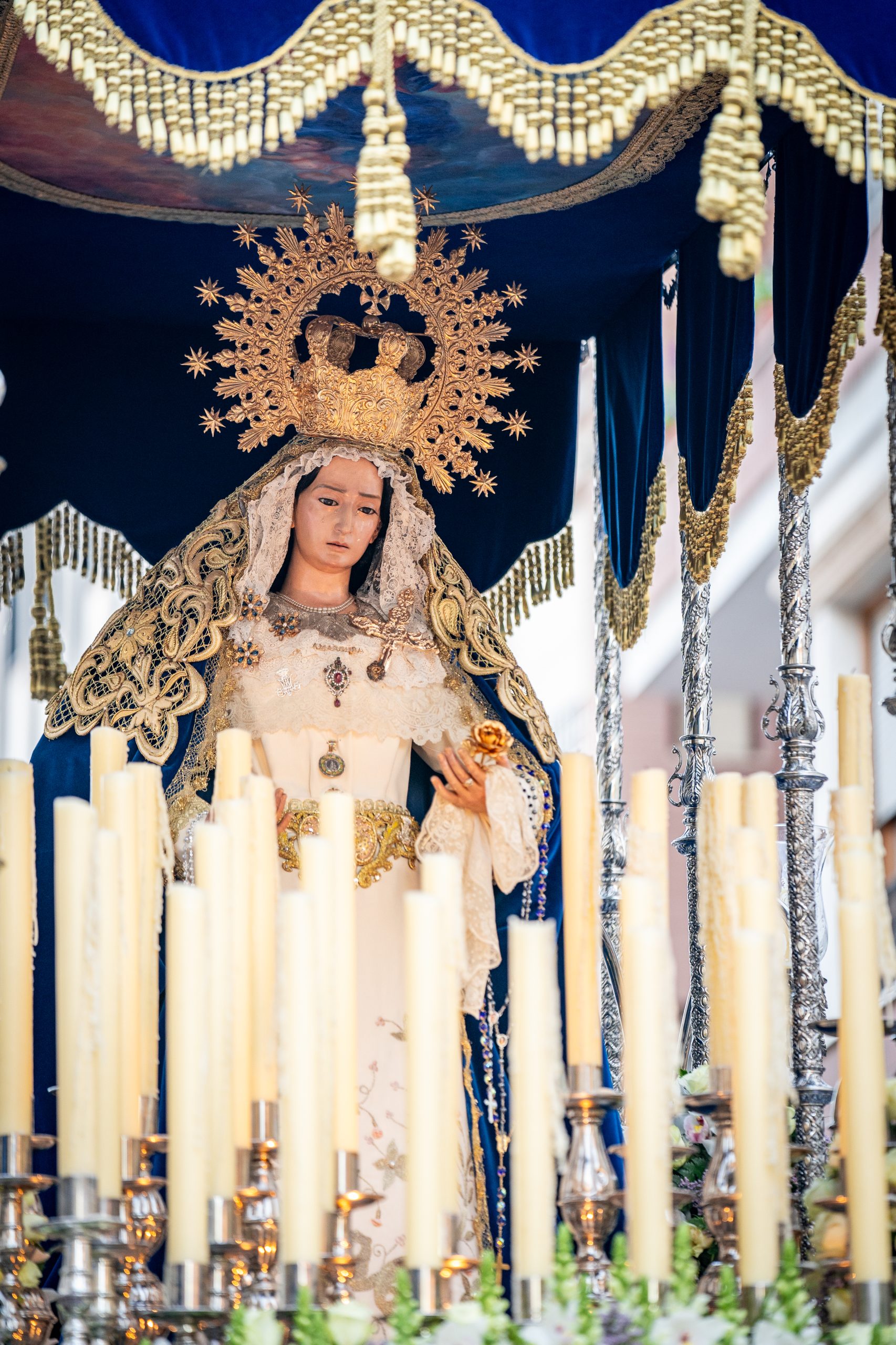
- Most Holy Mary of Bitter Sorrow (Granada School – 17th century) – Throne of 26 santeros
Hermano Mayor:
Antonio Rueda López
Procession Departure:
Holy Wednesday – 18:00 hours
Number of Brothers:
285
Tunic of the Brothers:
White, with purple mask and cord, and the officers wear a purple cape and sash.
Tunic of the Santeros:
White, with purple capirote and purple cord (Christ), and white, with blue capirote and cord (Virgin)
The Confraternity of Our Father Jesus of the Valley and Most Holy Mary of Bitter Sorrow was founded in 1986, driven by a group of friends, most of them vocational training students. They had the backing of the parish priest at the time, Fr. Jerónimo Durán Baena, and Prudencio Uzar, who was responsible for the former Valle convent.
The first general assembly was held on 13 July 1986, and the confraternity joined the Agrupación de Cofradías de Lucena on 19 September of the same year. Its first procession took place in the early hours of Holy Thursday 1987, and continued to be held then until 1990, when the confraternity moved its procession to the afternoon of Holy Wednesday. In 1988, the Confraternity added to its iconography the image of a Sorrowful Virgin under the title of Bitter Sorrow, donated by the Filipense Sisters. The following year, the image of Saint Veronica was added to the titular throne.
Our Father Jesus of the Valley is a dressed image with an anatomical body, articulated arms and natural hair. Of unknown authorship, in the style of the Granada School, its execution is dated to the 19th century. In 2018, the image underwent a major restoration involving the cleaning and restoration of the head, new hands, and the creation of a body, and it has since been a full-body carving.
It is processed on a throne made by the Lucena workshop Orfebres Gradit. It is in the neo-Baroque style and made of embossed metal plated with sterling silver, with a rectangular base with chamfered corners. With three tiers in height, it features cartouches and embossed mouldings with plant motifs, with the second tier notably bearing chiselled coats of arms referring to the brotherhood and to the National Police Corps. On the occasion of the Procesión Magna Pasionista held in 2025, the confraternity unveiled the image of the Cyrenean accompanying the Christ, the work of the sculptor José Daniel Henares.
Most Holy Mary of Bitter Sorrow is a candelero-type image with a carved head and hands, of anonymous authorship and dated to the 18th century. She was venerated as Our Lady of Sorrows in the church of that name founded by the Piarist community next to its school on Calle Ancha. She accompanied, together with Mary Magdalene, the Christ of the Blood. She also processed behind the Christ at the Column, under the title of Peace and Hope. In 2025 the restoration of the image was completed, carried out by the Lucena-born sculptor José Daniel Henares.
It is processed on a throne likewise made by the Lucena workshop Orfebres Gradit. It is in the neo-Baroque style and made of embossed metal plated with sterling silver, with a rectangular base with carved handles at the corners. With two tiers in height —canopy frame and base— it features embossed mouldings and cartouches with plant motifs. The central embossed medallions depicting scenes from the Way of the Cross relating to the brotherhood stand out. The original canopy poles combine embossed and Solomonic (twisted) shafts with foliage, while the canopy roof is topped with beautiful round-arched crestings.

*Documentary Source: Notas para la historia de las cofradías lucentinas (Francisco López Salamanca – 2022), Programa Oficial de la Semana Santa de Lucena 2026, and documentation provided by the confraternity itself.
*Photographs: Jesús Ruiz Jiménez ‘Gitanito’ and Jesús Cañete Fernández.

