Confraternity of the Holy Faith, Our Father Jesus at the Sacred Washing of the Feet and Our Father Jesus the Prisoner


Popular Name:
The Holy Faith
Founded:
Canonical Seat:
Sacred Imagery:
- Allegory of the Holy Faith (Andrés Cordón – 19th century) – Throne of 24 santeros
- Our Father Jesus at the Sacred Washing of the Feet (Attributed to Pedro de Mena Medrano – 17th century) – Throne of 28 santeros
- Our Father Jesus the Prisoner (Granada School – 17th century) – Throne of 24 santeros
Hermano Mayor:
José Luis Martos Onieva
Procession Date:
Holy Thursday – 6:30 pm
Number of Brothers:
215
Tunic of the Brothers:
White, with a hood of the same colour, a sash and cape of purple satin. The brothers carry a lantern instead of a candle.
Tunic of the Santeros:
White tunic and capirote (Holy Faith) and purple tunic and capirote (Washing of the Feet and Prisoner)
Founded in 1554, the Confraternity of the Holy True Cross is the oldest Passion confraternity of Holy Week in Lucena, having held its penitential procession on Holy Thursday since its earliest years, that is, since the second half of the 16th century. With a procession that included flagellants — known as hermanos de sangre (‘brothers of blood’) — and candle-bearing brothers, it is known for certain that in its earliest processions the brotherhood included a Crucified Christ and an image of the Virgin.
By the mid-17th century the procession had grown iconographically richer. Floats such as a Crucifixion between the Two Thieves, an Arrest of Christ, or the Sacred Washing of the Feet — not the one preserved today — set out from the chapel of the True Cross, along with an allegorical float, that of the Council, representing the Council of Trent. It is worth adding that in 1842 the allegory of the Holy Faith processed for the first time, the creation of its first cuadrillero, the physician Don Francisco Antonio Tenllado.
Given the brotherhood’s financial hardship, its assets having been seized under the ecclesiastical disentailment laws, the only solution was the involvement — almost always outside the governing board — of wealthy individuals able to cover the costs of the procession, who were known as cuadrilleros (lay patrons responsible for an image’s upkeep and procession).
The great autonomy granted to the cuadrilleros, whose repeated disregard for the governing boards’ decisions was evident, was one of the causes that eventually led to the disappearance of this ancient brotherhood. Furthermore, the poor condition of its small chapel on Calle Ancha, on the corner with Calle Veracruz, led the cuadrilleros to keep the images in their private homes, giving rise to false claims of ownership over them, a situation that persisted until quite recently.
Already in clear decline, this confraternity suffered a severe setback in 1917, when it officially ceased to be recognised as such and its processions were banned. Nevertheless, it still held its last chapter meeting on 17 March 1939, bringing to a close almost four hundred years of history. After the disappearance of the confraternity of the True Cross, most of its images passed into private homes, from where, at the expense of their respective cuadrilleros and not always continuously, they made their Holy Week processions.
After a long period of absence, a group of young people founded the present-day Confraternity of the Holy Faith in 1980, establishing itself in the Parish Church of Santiago and venerating the confraternity’s original titular image, the Allegory of the Holy Faith. Shortly afterwards, the corporation recovered another of the old confraternity’s images for Holy Week in Lucena: the mystery of the Sacred Washing of the Feet. They remained in that parish church until 1989, when they were moved to the Trinitarian Chapel of God the Father, until then closed to worship and in a poor state of repair. It was the confraternity itself that undertook the restoration of the building, restoring to worship one of the city’s architectural jewels, where it now has its canonical seat and from where it makes its penitential procession. In 1990 the image of Jesus the Prisoner was added, giving the confraternity the form in which it is known today.
The Chapel of God the Father was formerly named after the Holy Spirit, and had been, since 1624, the seat of the confraternity of the Most Holy Trinity. A general census of Lucena’s residents carried out in 1718 shows that the chapel was being rebuilt at that time.
It is likely that the confraternity’s financial difficulties made it necessary to accept private patronage to complete the works then underway. For this reason, the noble coats of arms of the patron, Don Pedro Bejarano Muñoz y Cisneros, were carved among the plasterwork of the dome’s pendentives — arms which, alongside those of Ahumada and Mendoza, also appear on the façade of an adjoining mansion connected to the church by a gallery.
A little later the patronage passed to the Bruna family, one of whose members, Don Andrés Tomás López de Bruna, married to Doña María Luisa de Ahumada y Villalón, the parents of Don Francisco de Bruna y Ahumada — known in Seville as “the lord of the Gran Poder” — became the true patron of the work. His absence and that of his family, from at least 1735 onward, suggests that this was the deadline for completing the works.
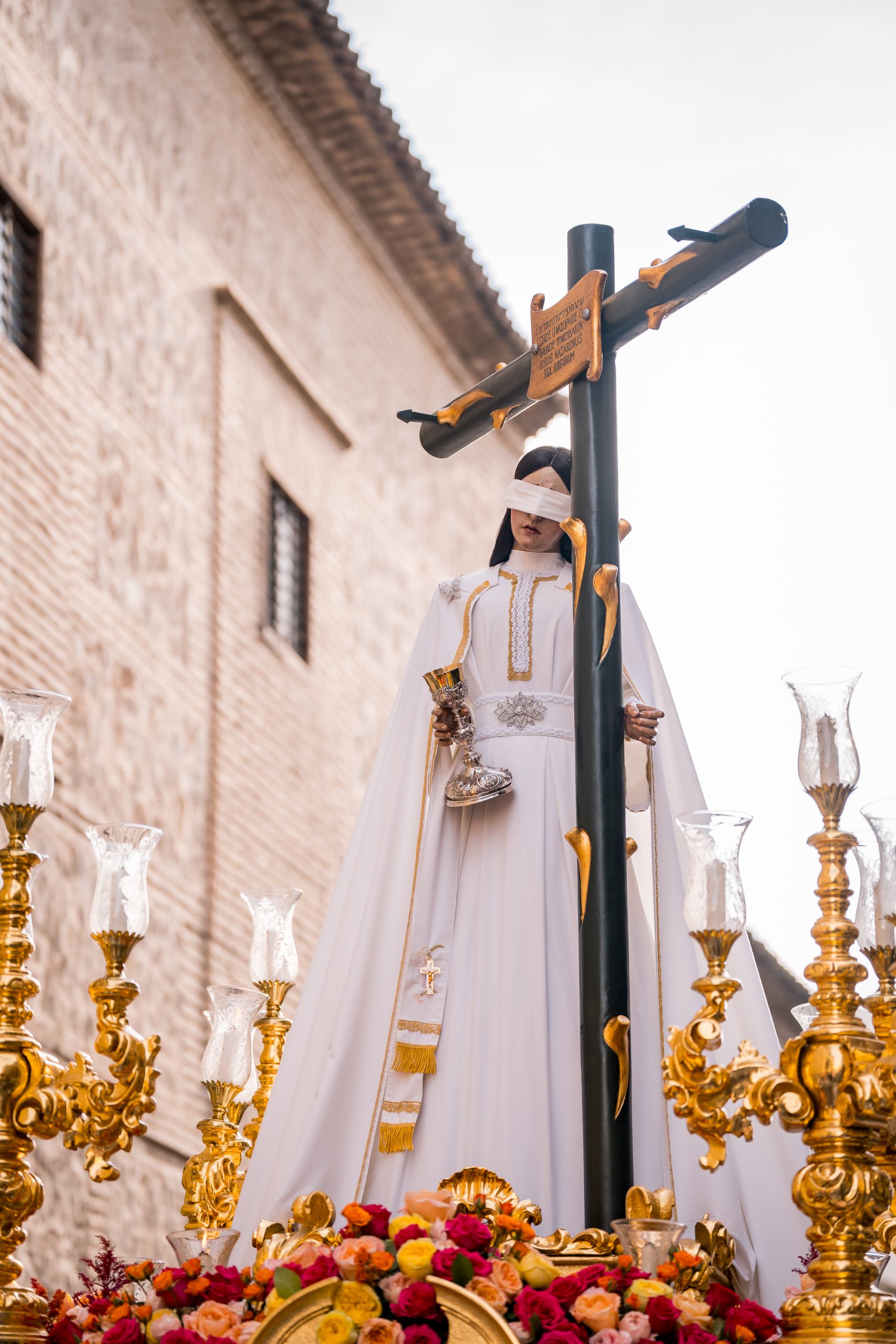
On 14 October 1843, the hermano mayor of the confraternity of Our Lady of Peace and the Holy True Cross recorded before its governing board that, the previous year, the allegory of Faith had processed in its Holy Thursday cortège, represented by a woman in white robes and blindfolded, who, set against a green cross with gilded knots, carries in her right hand a chalice, symbol of the Eucharist. The new float had been created by the physician Francisco Antonio Tenllado, who was for that reason appointed its cuadrillero.
From the original image, the green cross with gilded knots is preserved, made of cedar wood in 1673 by Pedro de Moraga, a sculptor from El Puerto de Santa María, and which was a titular image of the old confraternity. Faith is a 19th-century image attributed to the sculptor Andrés Cordón, replacing the one that processed originally. The current float is in the Neo-Baroque style, in carved and gilded wood. It comes from Málaga and was restored by the Priego-born artist Cristóbal Cubero, who delivered it for its unveiling in 1998. It incorporates four wind-guard candelabra in carved and gilt wood, and is carried by twenty-four santeros.
The sculptural group of the Sacred Washing of the Feet that we know today was a gift from one of the hermanos mayores of the old Confraternity of the True Cross, Luis de Guzmán y Soto, treasurer to the Duke of Medinaceli, who also donated the cedar cross that from then on opened the Holy Thursday procession and which today accompanies the allegory of the Holy Faith. Incorporated into the confraternity at the end of 1980, after decades of sporadic processions, it made its first procession in Holy Week 1981.
A work by the great sculptor from Granada Pedro de Mena y Medrano, though undocumented, it depicts the scene in the Upper Room in which Jesus, jug in hand and kneeling before Saint Peter, washes the apostle’s feet in a silver basin, the apostle seated in a Baroque gilded chair carved with papal symbols on the back. Especially notable is the impressive carving of Saint Peter’s head.
In 1985 the confraternity unveiled a magnificent Neo-Baroque throne, inspired by the old carrete-style throne so traditional in Holy Week in Lucena. Made by the Lucena silversmiths Angulo, it is chased in silver-plated and gilded metal with Passion and heraldic emblems, together with tree-shaped wind-guard candelabra in gilded metal with silver-plated acanthus-leaf finials. It is carried by twenty-eight santeros. Due to its size, leaving the chapel is very difficult, constrained by the narrowness of the chapel doorway.
Today, the image of Jesus wears a plain white velvet tunic, although it usually wears an embroidered tunic on purple velvet. The image of Saint Peter likewise wears a velvet tunic. The sculptural group recently underwent a complete restoration carried out by José Daniel Henares Paredes, an intervention that reinforced the attribution of the work to the aforementioned Pedro de Mena.
The image of Jesus the Prisoner was acquired by the old confraternity of Peace, in which it had had its own altar since 1700, in the city of Granada, and is attributed to the circle of José de Mora. It later processed from Calle San Pedro, where its oratory was located, and sporadically from the parish church of Santo Domingo. It depicts Jesus at his arrest in the garden of olives, abandoned by all his disciples.
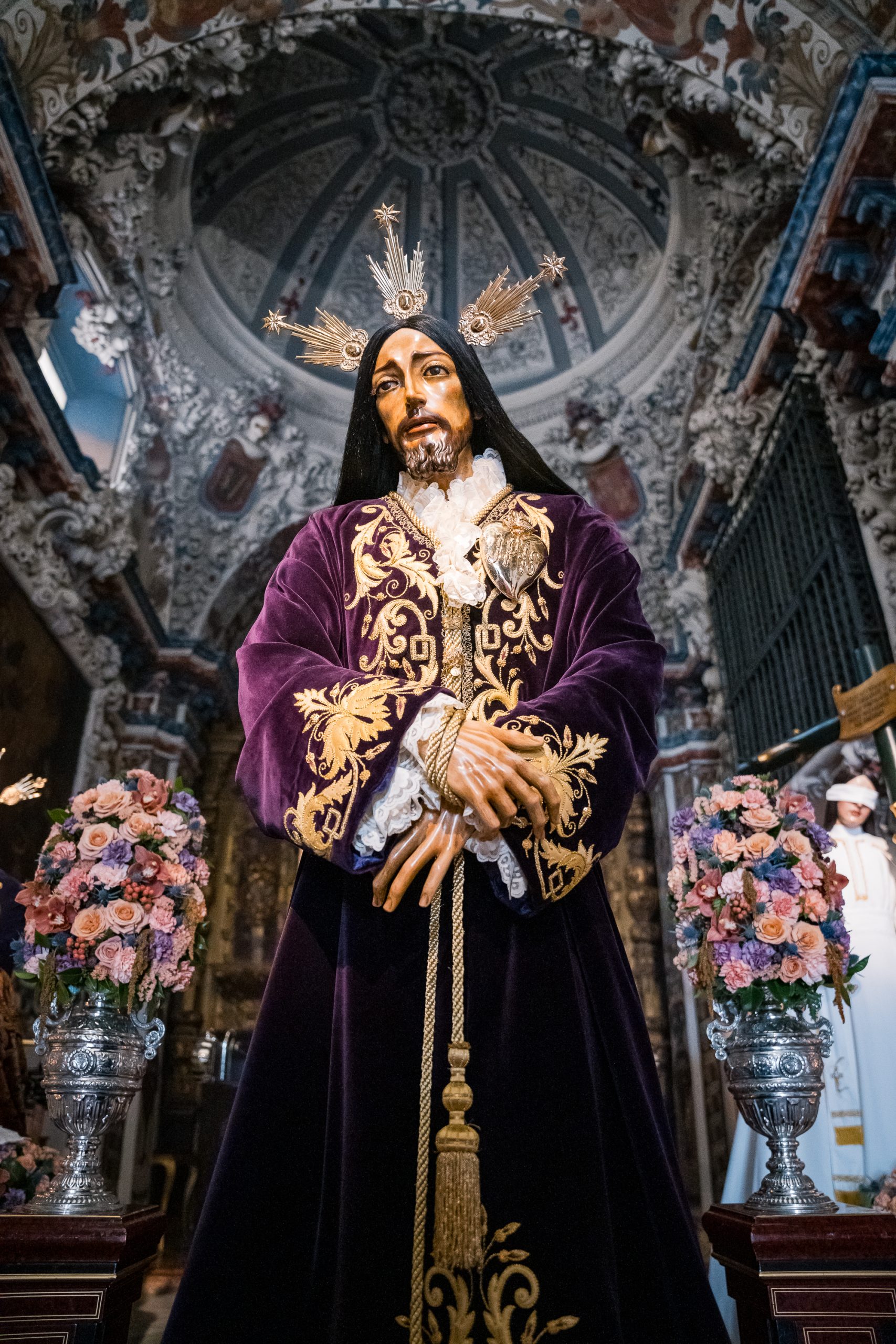
The Lord wears an embroidered tunic in purple, with gilded rays (potencias), a silver heart, and gilded cord bindings with tassels. Jesus the Prisoner processes on a chased metal throne in the Neo-Gothic style, made by the workshops of Juan Angulo in 2005, replacing an earlier one of the same style with cresting and Passion ornaments on purple velvet. The ensemble is lit by four lanterns in the same style and two side wind-guard candelabra belonging to the old throne. It is carried by twenty-four santeros.

*Documentary Source: Notas para la historia de las cofradías lucentinas (Francisco López Salamanca – 2022), Official Programme of the Semana Santa de Lucena 2026, and documentation provided by the confraternity itself.
*Photographs: Jesús Ruiz Jiménez ‘Gitanito’ and Jesús Cañete Fernández.

