Venerable Confraternity of Our Lady of the Dawn

Popular Name:
The Dawn
Foundation:
1717
Canonical Seat:
Ermita de Nuestra Señora de la Aurora
Imagery:
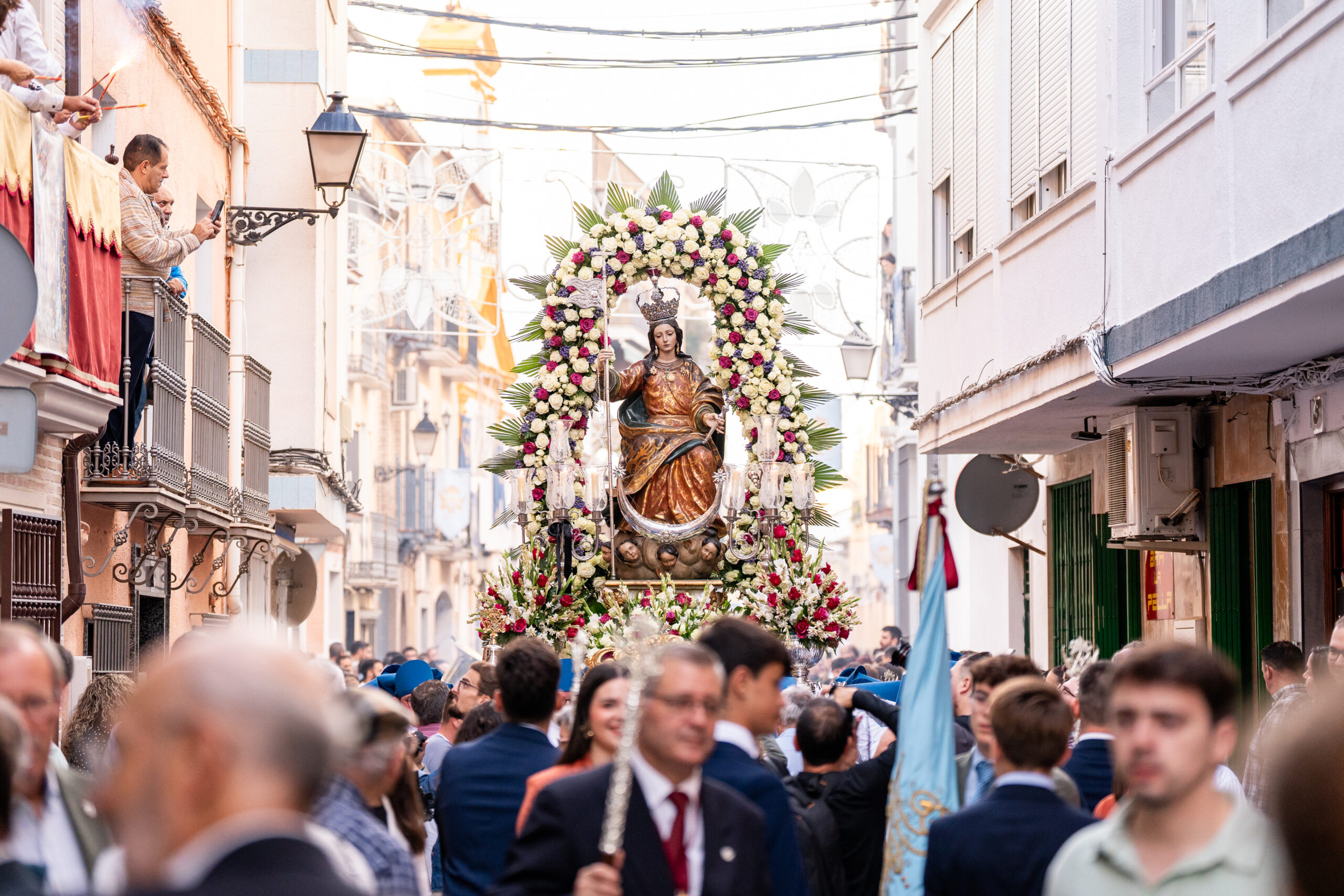
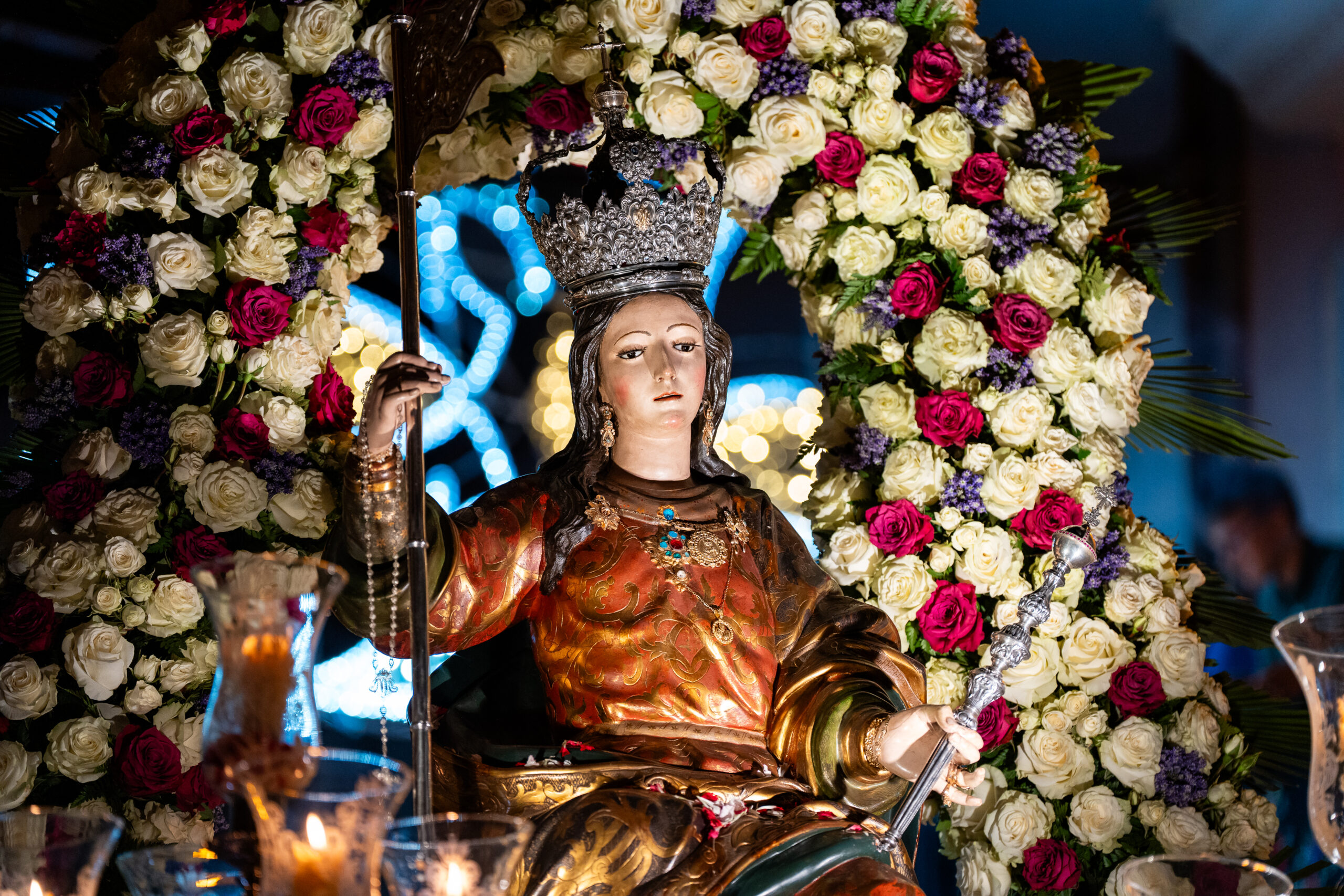
- Our Lady of the Dawn (Attributed to José de Medina, between 1756 and 1759) – Throne of 22 santeros
Hermano Mayor:
Pepe García Cruz
Procession:
Second Sunday of October
Number of Members:
320
Distinctive Musical Accompaniment:
Choir of the Campanilleros de la Aurora
Santeros' Tunic:
White, with the Confraternity’s emblem, blue capirote and maroon cord.
There is evidence that, in the final years of the 17th century, some worshippers from the neighbourhood centred on today’s Calle Abad Serrano, also known as Calle de la Aurora, would go out at night singing the Holy Rosary.
The image of its titular figure was venerated in a painting from the brush of the Lucena-born cleric and artist D. Leonardo Antonio de Castro Hurtado, placed in a niche on the wall of a house on Calle Catalina Marín, and which can be admired today in the hermitage, framed by a beautiful altarpiece on the left-hand side, the work of Francisco José Guerrero.
In those years, to distinguish her from Our Lady of the Rosary, who, among other names, was venerated under the nickname “la Dorada” in the nearby Dominican church of San Pedro Mártir, those devotees gave her the name Dawn.
An old local chronicler, D. Luis Próspero Villalba, states that in 1714 three noble gentlemen of this city arranged “to build and raise a hermitage and confraternity for this Sovereign Queen”. However, it seems that three years earlier, Pope Clement XI had already granted indulgences to all confraternity members of both sexes of the Venerable Brotherhood of Our Lady of the Dawn, canonically established and based in its hermitage in the city of Lucena. Construction began in the year 1714, and it was blessed with great solemnity, with a procession of the Blessed Sacrament from the major parish of San Mateo to the hermitage, at the end of November 1715.
The construction of the simple hermitage where the Virgin Mary is venerated under this beloved title is owed chiefly to the devotion and generosity of a Lucena-born priest, don José Arjona Hurtado, who built it at his own expense, endowing a chaplaincy so generously funded that the confraternity members, in gratitude, granted him the title of patron in 1725.
Towards the middle of the 18th century, the confraternity, and consequently the hermitage, experienced a period of great splendour. So much so that it was endowed with the magnificent altarpieces it now holds: the side altarpieces, the work of the aforementioned Francisco José Guerrero, and the main one, carved, along with the Virgin’s camarín, by the local sculptor and carver Pedro de Mena Gutiérrez. The image of Our Lady of the Dawn was commissioned from a renowned sculptor, most likely José de Medina, who was carrying out other work for Lucena around that time. In 2025, the image was restored by the artists Manuel Espejo Mármol and Miguel Sánchez Jiménez.
Its festivities are celebrated in October. Specifically, the second Sunday of that month sees the solemn service and the procession of the precious, beautiful and miraculous image of Our Lady of the Dawn. A distinctive feature is the arch of fresh flowers, used in place of a halo of rays, whose colours are renewed every year.
On the eve of the main day, Saturday evening, the Holy Rosary, the Salve and coplas are recited. This gives way at midnight to the greeting of the campanilleros for her name day, beginning a route through the city, visiting its different neighbourhoods as a form of notice or summons, just as had been done since the confraternity’s founding in centuries past. On the Monday following the Virgin’s name day, a novena begins in her honour, during which the campanilleros’ coplas are sung. On the third Sunday of October, the traditional Rosario de la Aurora takes place, along with the hand-kissing (besamanos) of this beautiful and venerated image of Our Lady.
The campanilleros are a group of male voices accompanied mainly by string instruments such as the violin, bandurria, lute and guitar, and of course by their characteristic hand bells. Originally, and even today though somewhat less clearly, their commendable task was to call the faithful to the Holy Rosary or the Virgin’s procession, always leading the procession, as recorded in this institution’s chapter minutes.
To the value of this devotion, to the jewel box that is the hermitage, and to the works of art it holds, must be added the marvel of a set of coplas, whose lyrics were written to be sung, adorned with the music of string instruments and hand bells, in honour of the Mother of God — coplas that originally served to summon the brothers to the processions, acting as their advance guard.
*Documentary Source: Notas para la historia de las cofradías lucentinas (Francisco López Salamanca – 2022) and documentation provided by the confraternity itself.
*Photographs: Jesús Cañete Fernández.

