Pious, Humble and Fervent Brotherhood and Confraternity of the Most Holy Christ of Love, Our Father Jesus of the Crucifixion and Most Holy Mary of Peace “Campanitas”


Popular Name:
Love and Peace
Foundation:
Canonical Seat:
Iglesia Mayor Parroquial de San Mateo Apóstol
Imagery:
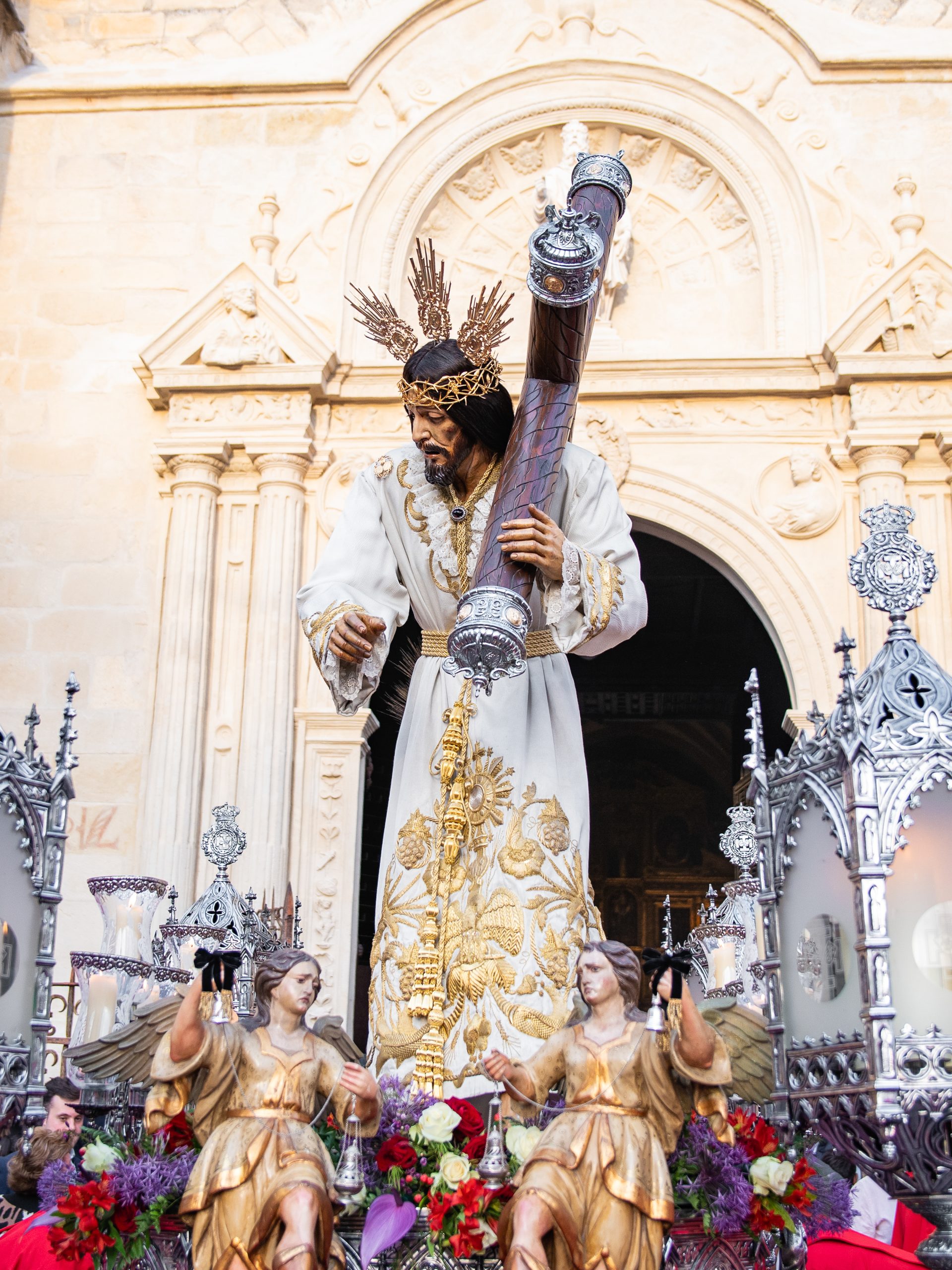
- Most Holy Christ of Love (Head by Alonso Cano, late 17th century, and body by Luis Tibao and Andrés Cordón, 1808) – Throne of 24 santeros
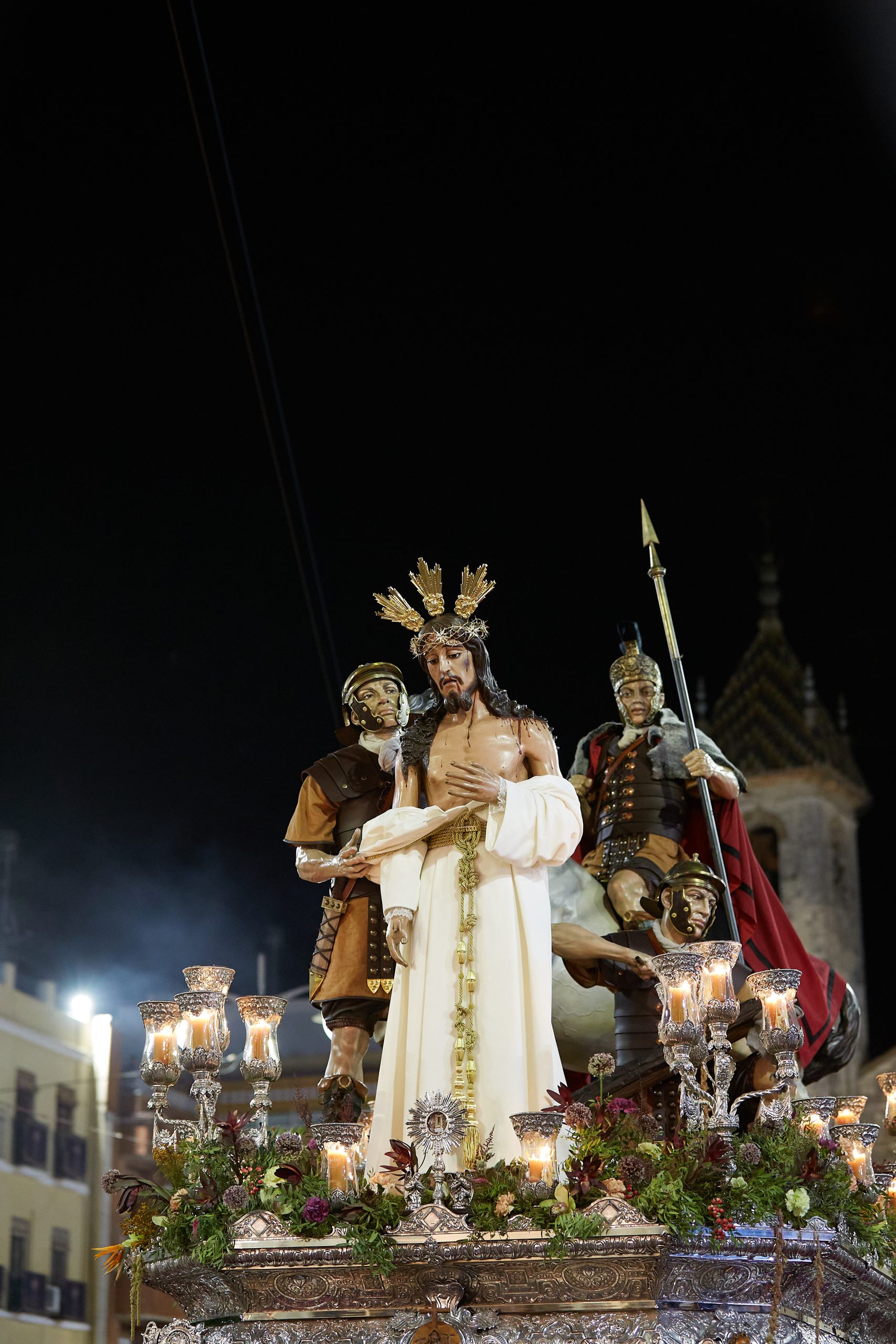
- Mystery of the Crucifixion (Pedro Muñoz de Toro – 19th century) – Accompanied by two Roman soldiers and a mounted centurion, the work of Francisco Javier López del Espino in 2024 – Throne of 28 santeros
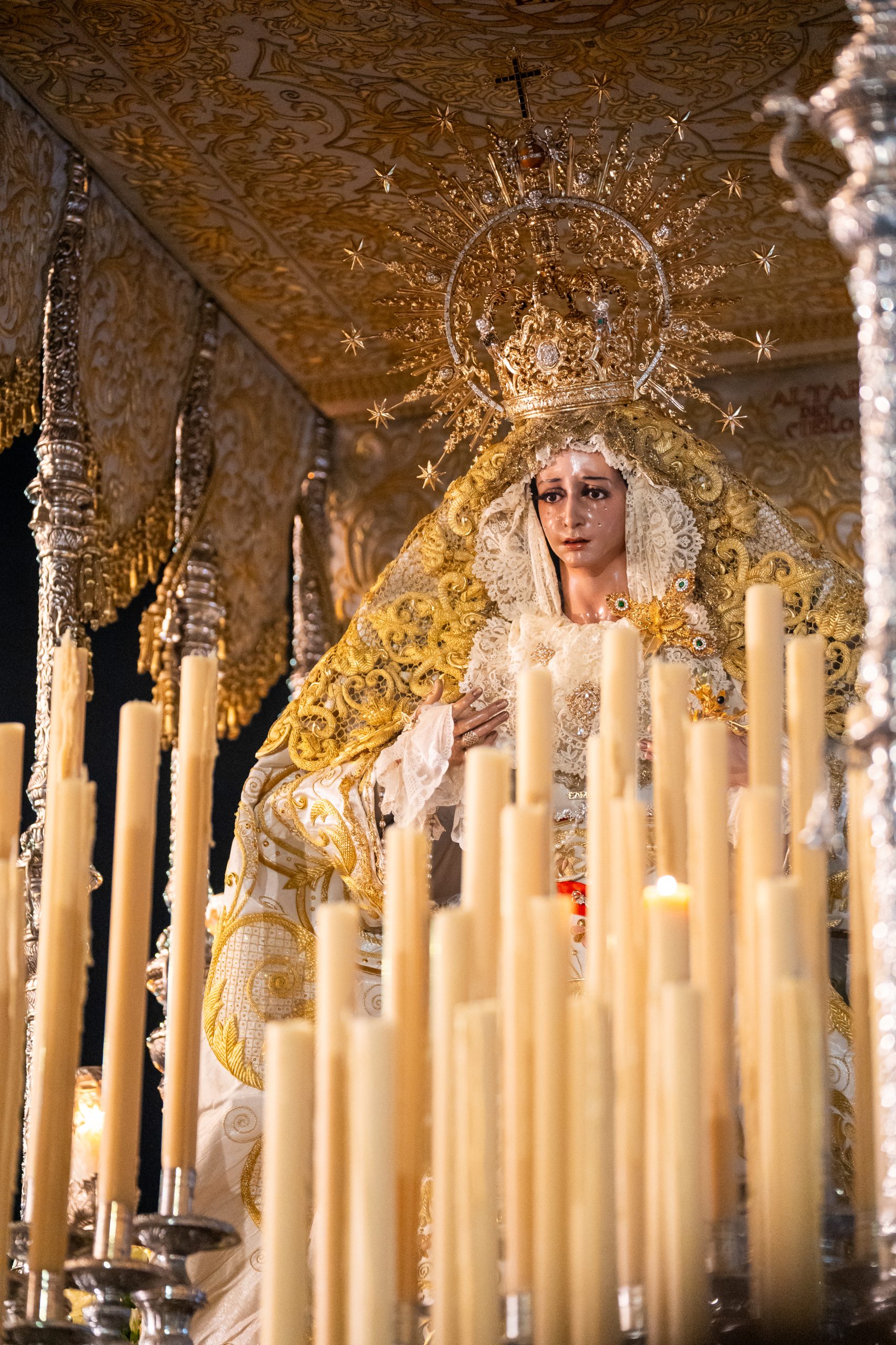
- Most Holy Mary of Peace, Campanitas (Juan Martínez Cerrillo – 1983) – Throne of 28 santeros
Hermano Mayor:
Francisco Caro Puertas
Procession Departure:
Holy Tuesday – 19:30 hours
Number of Brothers:
575
Tunic of the Brothers:
Red, with white mask and cord.
Tunic of the Santeros:
Red, with white capirote and cords (Love), cardinal red with white cord (Crucifixion), and white with red cord (Virgin)
The Pious, Humble and Fervent Brotherhood and Confraternity of the Most Holy Christ of Love, Our Father Jesus of the Crucifixion and Most Holy Mary of Peace “Campanitas” was founded in Lucena in 1969, with a markedly youthful character and closely linked to the Spanish Youth Organisation (O.J.E.). In its early years it was known as the Confraternity of the Youth, born from the enthusiasm and initiative of a group of young people from Lucena who drove the creation of a new brotherhood in the city. Don Juan Parejo Pineda was elected as its first Hermano Mayor.
The image chosen as titular was the Nazareno de San Mateo, venerated in the camarín of the parish’s main altarpiece, facing the Tabernacle. The choice reflected not only its notable artistic value, but also the profound devotional symbolism the image embodied for the youth of Lucena at the time.
The Most Holy Christ of Love displays a singular artistic richness, the result of different historical periods. The head was carved by Alonso Cano at the end of the 17th century, faithfully representing the Granada Baroque style, while the body was made in 1808 by the Lucena-born sculptors Luis Tibao and Andrés Cordón. This combination of Granada craftsmanship with local devotion produced a carving that soon became one of the icons of Holy Week in Lucena. On Holy Tuesday 1970, the Christ of Love processed through the streets of the city for the first time.
In 1973, the Brotherhood added the Mystery of the Crucifixion to the procession, although, due to the delicate state of conservation of the images, it processed only that year. It was not until 2014 that the tableau processed again on a permanent basis, and it has since remained one of the most significant scenes of Holy Tuesday in Lucena.
In 1983, the Brotherhood acquired the image of Most Holy Mary of Peace, the work of the Cordoban sculptor Martínez Cerrillo. Popularly known as the Virgen de las Campanitas (Our Lady of the Little Bells), her float is distinguished by the characteristic tinkling of small bells hung from the canopy poles, a symbol of promises fulfilled and a permanent remembrance of deceased brothers.
For its part, the Mystery of the Crucifixion, the work of the sculptor Pedro Muñoz de Toro y Borrego (1793-1872), depicts the moments before the crucifixion with profound artistic and iconographic value. After its sole procession in 1973, it was restored by Salvador Guzmán Moral and permanently recovered in 2014 as a key piece of the Brotherhood’s heritage.
With the aim of intensifying the drama of the scene, the Brotherhood undertook the renewal of the secondary figures. Under the leadership of José Luis Crespillo Guardeño, the new group, made by the sculptor Francisco Javier López del Espino, was unveiled on 15 March 2024, a date that providentially coincided with the feast of Saint Longinus, the Roman centurion who, according to tradition, pierced Christ’s side and recognised his divinity, exclaiming: “Truly this man was the Son of God” (Matthew 27:54).
The renewed scene incorporates three Roman figures of strong symbolism: Longinus, who deals the spear-thrust and regains his sight on contact with Christ’s blood, converting to the faith; Abenadar, tasked with stripping Jesus of his garments, who is transformed inwardly on witnessing his death; and Stephaton, who offers the sponge with wine and vinegar, boring into the cross with his gimlet.
These figures reinforce the visual narrative of the group, evoking the redemption and the eternal mystery of Calvary. The Lord’s crown is made up of thorns and thistles, symbols of sin and human suffering. According to Christian tradition, the thorns represent the burden of sin that Jesus takes on during the Passion, while the thistles allude to man’s fallen condition since Genesis. Interwoven upon his brow, both elements are transformed into signs of redemption, dignity and victory.
The throne of the Lord of the Crucifixion was made in 2014 by Orfebres Gradit, to a design by Javier Aguilar, constituting a true jewel of contemporary silverwork inspired by the Baroque and Romantic movements of the 18th and 19th centuries. The ornamentation combines geometric and plant motifs, with foliage and scallop shells delicately interwoven. In the resulting spaces there appear coffered panels and flowers, among them the fleur-de-lis, a symbol of royalty and spiritual purity. On the front and sides are oval cartouches with high reliefs by the sculptor Adrián Valverde, depicting key scenes from the Passion of Christ.
In the Mystery of the Crucifixion, every element of the throne transcends mere sculpture. The serpent, the skull and the dice do not symbolise defeat, but rather Christ’s victory. Stripped and humiliated, he appears as the Redeemer who overcomes sin and evil through his sacrifice on the cross, setting out on the path to salvation.
The skull, placed at the foot of the cross, recalls the finiteness of human life and heralds the possibility of a new existence through redemption, evoking Adam, whose fall is restored by the Redeemer’s sacrifice. The serpent, a traditional symbol of evil, is here transformed into an emblem of victory: where the fall began, redemption also begins. The dice allude to the soldiers’ casting of lots for Jesus’s tunic, reflecting human indifference to the divine sacrifice and silently narrating the tragedy of Calvary.
*Documentary Source: Notas para la historia de las cofradías lucentinas (Francisco López Salamanca – 2022), Programa Oficial de la Semana Santa de Lucena 2026, and documentation provided by the confraternity itself.
*Photographs: Jesús Ruiz Jiménez ‘Gitanito’, Rafael Fotografía and Jesús Cañete Fernández.

