Brotherhood and Confraternity of Nazarenes of Our Father Jesus of the Column and Our Lady of Peace and Hope

Popular Name:
Column and Hope
Founded:
Canonical Seat:
Sacred Imagery:
- Our Father Jesus of the Column (Pedro Roldán Onieva – 1675) – Accompanied by a soldier and a tormentor figure by Juan Manuel Miñarro, added in 2003 – Throne of 24 santeros
- Our Lady of Peace and Hope (Miguel Ángel González Jurado – 1992) – Throne of 28 santeros
Hermano Mayor:
Javier Sánchez Cruz
Procession Date:
Holy Thursday – 8:00 pm
Number of Brothers:
700
Distinctive Musical Accompaniment:
The Christ figure is accompanied by the Toque de Torralbo, a distinctive drum march.
Tunic of the Brothers:
White, with a hood and a burgundy red cape, with a red cross of Saint James and a green sash.
Tunic of the Santeros:
Cardinal red with a yellow cord (Christ) and white with the Marian monogram, green capirote and cord (Virgin)
The Confraternity of Our Father Jesus of the Column and Our Lady of Peace and Hope is the direct heir of the Venerable Archconfraternity of Our Lady of Peace, the Holy True Cross, Death and Prayer. After a period of decline, a group of Lucena confraternity members began organising the creation of the Confraternity of Our Father Jesus of the Column in early March 1923. On Palm Sunday of that year, the fledgling brotherhood held a procession with the image of the Lord to the Parish Church of San Mateo, where a solemn Miserere was celebrated, marking the corporation’s presentation. The procession was opened by the standard of the old True Cross confraternity. Over the following months, the process began to approve the confraternity’s rules, which was achieved in January 1924.
It was in 1954, under the leadership of Don José Gutiérrez Luque, that a Marian titular image was added to the Column confraternity, using for this purpose the titular image of the Confraternity of Peace and the True Cross, which came to be venerated under the title of Our Lady of Peace and Hope. This image, whose author is unknown and which has traditionally been dated to the second half of the 17th century, was later replaced by a Sorrowful Mother image kept in the Chapel of San Felipe de Neri — today’s Our Lady of Bitter Sorrow. After that, the brotherhood commissioned the sculptor and professor José Rivera García to make a new image in 1981. That image processed until 1991, when it was replaced by the current one.
The image of the Lord of the Column is a fully-carved polychrome sculpture, made of cedar wood and of life size. Its author was the sculptor Pedro Roldán, who carved it between 1674 and 1675, with the local painter Bernabé Jiménez de Illescas applying its flesh-tone finish on its arrival in Lucena. It was acquired from the sculptor by the Confraternity of Peace and the True Cross for 2,750 reales, with its polychroming costing a further 1,200 reales.
The image represents Christ in the sorrowful mystery of the Scourging, with his hands tied behind him against a low-shafted column, his right foot stepping forward. Notable features are the expressiveness of his face and the finely worked anatomy, covered only by a loincloth that reveals the Lord’s musculature and bone structure. It has undergone several interventions, the first in the months before Holy Week 1972, when Professor José Rivera carried out structural treatment and also worked on the face. Likewise, following an agreement at the Extraordinary General Assembly of Brothers held on 26 October 2022, Pedro Manzano Beltrán undertook a new structural restoration during the last months of 2022 and early 2023, with restoration of the flesh-tone finish left pending after Holy Week 2024.
From its arrival in Lucena, it was venerated in the now-vanished Chapel of Peace and the True Cross, and has been housed since the early 20th century in the Parish Church of Saint James the Apostle. After several locations within the church, it has for decades had its own altar at the head of the church, in the epistle-side nave.
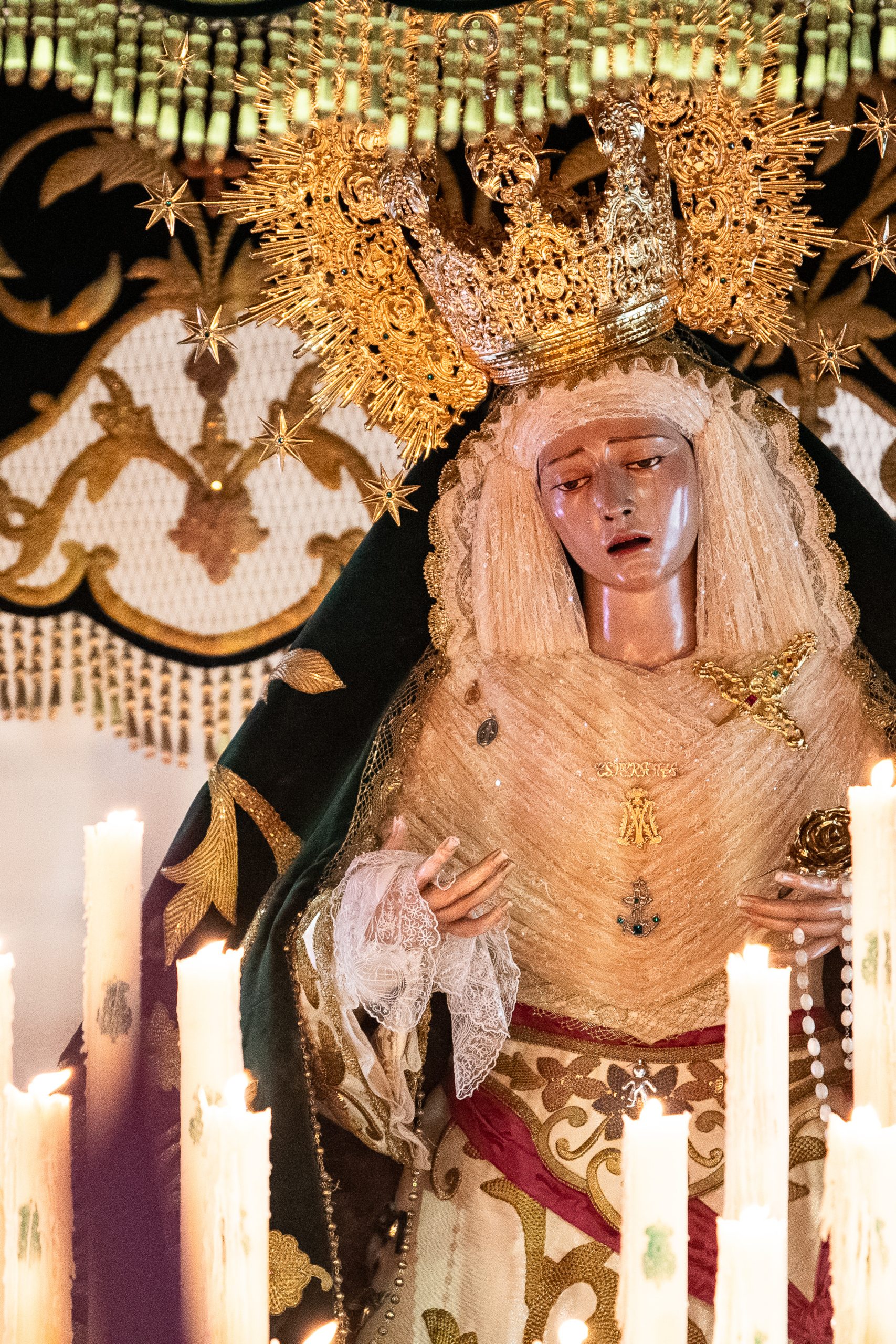
The current image of Our Lady of Peace and Hope is a candelero carving in polychrome wood made by the Córdoba sculptor Miguel Ángel González Jurado in 1992. It was later retouched by the sculptor himself, most notably in a remodelling carried out in 1994. The Virgin of Hope clearly follows the Astorga-school models found in the Virgin of the Presentation of the Seville Brotherhood of Calvary — attributed to Juan de Astorga — or in the Sorrowful Mother Esperanza de la Trinidad, a documented work by the same author, references that can also be seen in other images by González Jurado.
With a slightly olive skin tone, the Virgin delicately furrows her brow, showing a deep expression of sorrow in her dark eyes, from which three tears run down along the corners of her face. Especially notable are her reddish lips and delicate chin, though the carving’s main distinguishing feature is the gentle tilt of the head to the right. The image measures 165 centimetres in height.
This image has been venerated in the brotherhood’s chapel in the Parish Church of Santiago since 1 March 1992, the day on which the blessing ceremony took place, presided over by the parish priest of Santiago and spiritual director of the confraternity, Don Francisco Mesa López.
The processional platform used to carry the Lord of the Column every Holy Thursday is divided into two distinct tiers, both octagonal in plan with chamfered corners, made in silver-plated metal. It was crafted by the Casa Meneses workshop. The upper tier, unveiled in 1924, is adorned with gilded inlays alluding to the instruments of the Passion — the column, the cockerel, the crown of thorns, or Christ’s tomb — and served as the base platform until 1930, when the lower tier was added, forming the current configuration. This second tier incorporates plant motifs in the form of gilded inlays.
The platform that first processed in its complete form in 1930 had a set of candle-holders made up of four five-branch candelabra — one at each corner — and a further ten two-branch candelabra distributed across the front, rear and sides, in addition to the eight candle-bearing cherubs on the Christ’s original pedestal.
Today, the Christ’s throne has four nine-branch candelabra — one at each corner — and a further four three-branch candelabra placed on the sides. These pieces are currently being restored by the local workshop Paula Orfebres. In addition, a wooden pedestal covered in silver-plated metal serves to raise the figure of the Lord above the platform.
The base platform of the throne of Our Lady of Peace and Hope rests on a carrying frame with eight silver-plated metal caps decorated with the Marian monogram in gold. It was made in 1974 by the Angulo workshops of Lucena. It is in the Neo-Baroque style and was restored and re-silvered in 2002.
Standing out against the uniformity of the design are two gilt side cartouches bearing the Marian monogram and the confraternity’s coat of arms, as well as a central niche with a small effigy of the Lord of the Column. The ensemble is completed with pilasters topped by winged cherubs with a radiant halo, segmenting the composition. Both this niche, the small replica of the Lord, and the new silverwork on the corners were added in the 2002 remodelling. The base platform measures approximately 200 centimetres in width, 340 centimetres in length and 55 centimetres in height.
On Holy Thursday 2006 both the canopy roof and the complete set of canopy valances were unveiled. These are textile pieces outlined and embroidered in fine gold thread on green velvet and gold-thread mesh, the work of Antonio Muñoz Sánchez.
The mantle of Our Lady of Peace and Hope is a textile piece embroidered and outlined in fine gold on green velvet, with details in white and red silk thread. Information displayed at the Brotherhood’s House-Museum attributes its authorship to Antonio Muñoz Sánchez in 1998, although the first phase of its execution must have been earlier, as various audiovisual sources attest. According to the brother and official chronicler Luisfernando Palma Robles, it would have originally been made by Antonio Sánchez Pérez, a Lucena native settled in Écija and also the author of the blue mantle and canopy set of the Patroness of Lucena and her simpecado (processional standard), later enriched in 1998 by the aforementioned Muñoz Sánchez.
In the Neo-Baroque style, the mantle is made up of plant motifs radiating from a central axis, combined with dragon figures that take on a prominent role within the composition, culminating as the finial of some of the scrollwork.

*Documentary Source: Notas para la historia de las cofradías lucentinas (Francisco López Salamanca – 2022), Official Programme of the Semana Santa de Lucena 2026, and documentation provided by the confraternity itself.
*Photographs: Jesús Ruiz Jiménez ‘Gitanito’ and Jesús Cañete Fernández.

