Confraternity of Our Lady of Solitude

Popular Name:
The Solitude
Founded:
Canonical Seat:
Imagery:
Our Lady of Solitude (Luis Álvarez Duarte – 1988) – Throne of 26 santeros
Hermano Mayor:
Alfonso Gálvez Aranda
Processional Departure:
Holy Saturday – 8:30 pm
Number of Brothers:
845
Tunic of the Brothers:
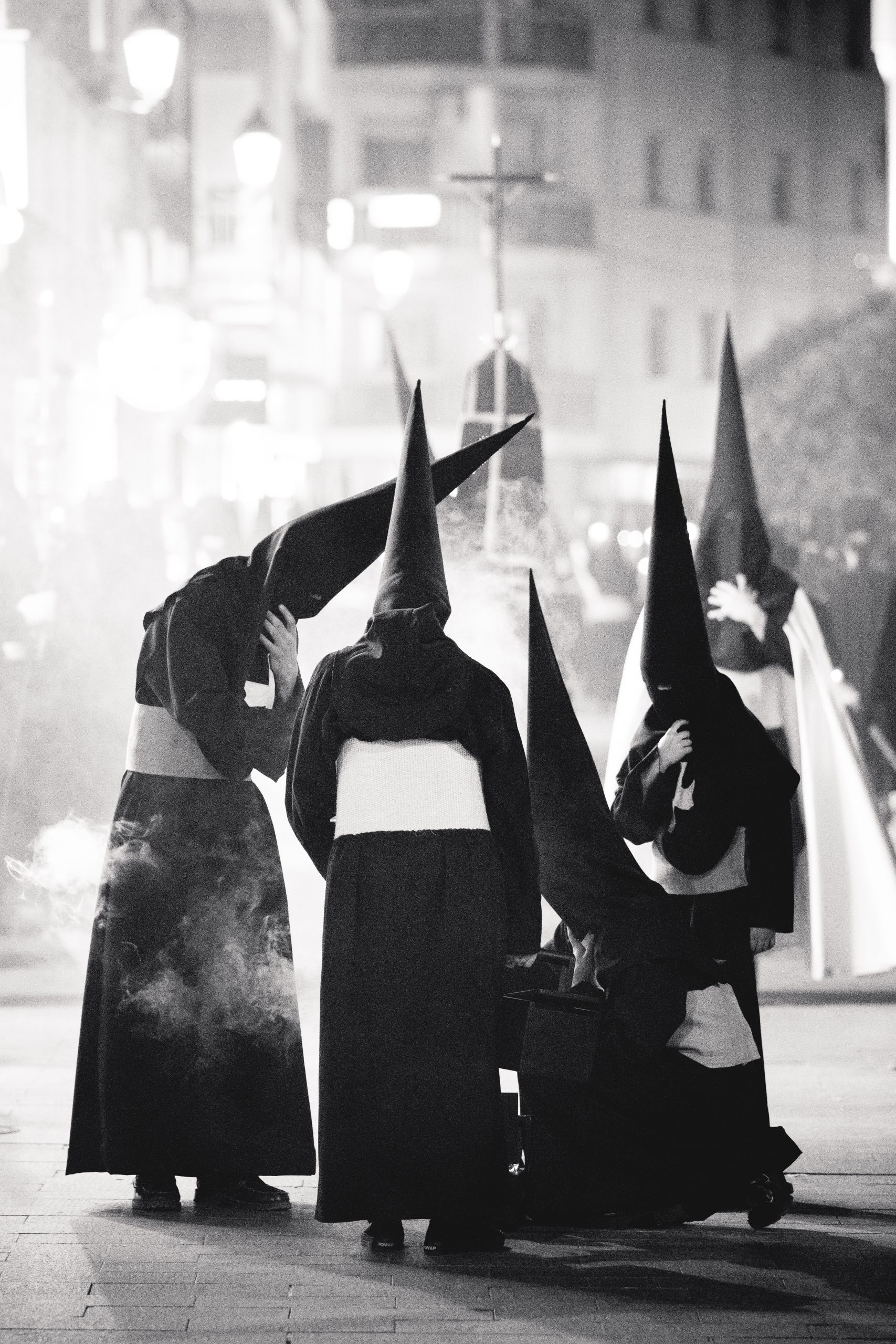
Black with an esparto-grass belt and a black hood also bearing the Maltese cross.
Tunic of the Santeros:
Black, with a capirote of the same colour.
This is the second Holy Week brotherhood founded in Lucena in the 16th century. The earliest dates recorded for this confraternity are 1564, its institution, and 14 May 1601, when its Constitutions were approved by Bishop Francisco Reinoso. The corporation retains the Marian-centred character present, to a greater or lesser degree depending on the period, in Lucena’s old Passion confraternities, except in the case of the Nazarene Archconfraternity. From its earliest years, it appears to have had a chapel in the church of Santiago, at the head of the Gospel-side nave, in its current location. This is shown by a municipal chapter record from 1652, which reflects the grant made by the vicar and priests of Lucena in favour of the decorative works then being carried out in this confraternity’s chapel.
In 1729, the chapel was extended with a camarín (niche shrine) for the Virgin. From 1764 onwards, the confraternity carried out further works, directed by Francisco Ramírez de Quero. In 1651 the confraternity acquired the image of the Recumbent Christ, which is today the oldest documented image held by any of Lucena’s Passion confraternities. This Recumbent Christ was blessed, following its restoration, on 15 September 1998. By 1730 the brotherhood already had the Holy Cross and Saint John, since both tunics were made that year for those who carried these emblems in the Good Friday procession.
A new image of Mary Magdalene was added in 1745. These images were still kept in the confraternity’s chapel in 1890. The flagellant penitents took part in the Good Friday procession dressed in white doublets and capirotes. At their head was the cuadrillero de azote (leader of the flagellants), who received a sum of money to reward the penitents and another of wine to tend their wounds.
The Confraternity of the Solitude held important acts of worship around Easter. Its main service took place on the morning of Easter Tuesday. It appears that in 1756 the corporation acquired a Risen Christ Child, which received special veneration during those Easter days.
As late as 1824 these Easter observances were still held, then known as the Glorious Sorrows, to distinguish them from the Novena of Sorrows, first mentioned in 1758. New constitutions were approved in 1860. In the second half of the 19th century its activity was reduced to internal acts of worship. In 1894, minutes recorded the corporation’s state of decline. It was not until January 1927 that it was revived, with Juan Córdoba Cabeza appointed as Hermano Mayor. The board decided to resume its procession that same year on Good Friday, after the Holy Burial procession, with a single throne, that of the Virgin.
From 1937 onwards, it moved to Saturday. In 1969, due to works at Santiago, it moved to the conventual church of Madres Angustias, returning to process from there in 1981. In 1996 it moved again to that conventual church because of works on the chapel, which would be blessed on 21 June 1998, following its restoration, as a sacramental chapel, by José Antonio Infantes Florido, Bishop Emeritus of Córdoba. In 1977 it marked the golden jubilee of the resumption of its procession with various events. On 20 February 1988, Valeriano Orden Palomino, vicar general, blessed the corporation’s new Marian image, made by the Seville sculptor Luis Álvarez Duarte.
In 2014, the Confraternity of Our Lady of Solitude celebrated the 450th anniversary of its founding, for which various commemorative events were held. As the conclusion of this special year, the Annual Gathering of Brotherhoods and Confraternities of the Solitude of Spain was held, culminating in an Extraordinary Procession.
The base of the processional throne was unveiled in 2017, made in hand-chased sterling silver at the Seville workshops of Villarreal. Its design is based on foliage motifs against a black velvet background, inspired by the previous throne, and each front panel bears a different votive cartouche of the brotherhood.
The canopy roof, unveiled in 2025, was made at the workshops of Jesús Rosado in Écija. It is embroidered in fine gold on black velvet, with a symmetrical, four-part design. Its central medallion reproduces the confraternity’s sceptre, with a small oil-painted medallion of Mary in Her Solitude and the Marian monogram. Embroidered in fine gold and applied over gold tissue, it follows the confraternity’s tradition of Isabeline-style embroidery.
The canopy roof also features new cresting made at the workshops of Orfebrería Angulo, based on the same design as the throne’s silver base. The technique used is repoussé and chased brass sheet, silver-plated with a protective vitrified finish.

*Documentary Source: Notas para la historia de las cofradías lucentinas (Francisco López Salamanca – 2022), Official Programme of the Lucena Holy Week 2026, and documentation provided by the confraternity itself.
*Photographs: Jesús Ruiz Jiménez ‘Gitanito’ and Jesús Cañete Fernández.

