Confraternity of Nazarenes of the Most Holy Christ of the Blood and Mary Most Holy of the Greatest Sorrow

Popular Name:
The Blood
Founded:
Canonical Seat::
Imagery:
- Most Holy Christ of the Blood (Anonymous carving of colonial origin – 16th century) – Throne of 28 santeros
- Mary Most Holy of the Greatest Sorrow (Antonio Castillo Lastrucci – 1959) – Throne of 28 santeros
Hermano Mayor:
Óscar Montilla Lavela
Procession Departure:
Holy Thursday – 9:00 pm
Number of Brothers:
450
Tunic of the Brothers:
White tunic and cape bearing the confraternity’s coat of arms, with a purple hood, buttons and cord.
Tunic of the Santeros:
White, with a purple capirote and cord (Christ), and white with a maroon capirote and cord (Virgin).
At the start of the summer of 1924, in a context of revival and growth of the confraternity movement in Lucena, the Confraternity of the Most Holy Christ of the Blood and Mary Most Holy of the Greatest Sorrow was established. This was a brotherhood of contemporary creation, but built on a much older devotional foundation: that of a Crucified Christ whose presence and worship in the city dates back several centuries and which, over time, went by different titles.
Although not documented with certainty, the Most Holy Christ of the Blood is believed to have arrived in Lucena from Spain’s new overseas colonies. We are dealing with an example that can be placed within the line of the so-called Tarascan Christs. The Doctor of Fine Arts Joaquín Jesús Sánchez Ruiz, in his catalogue of Cordovan crucifixes originating from New Spain, singles out this Christ of the Blood in particular. Everything suggests that its arrival in Lucena may have been linked to Luis de Velasco y Castilla, Viceroy of Mexico between 1595 and 1607.
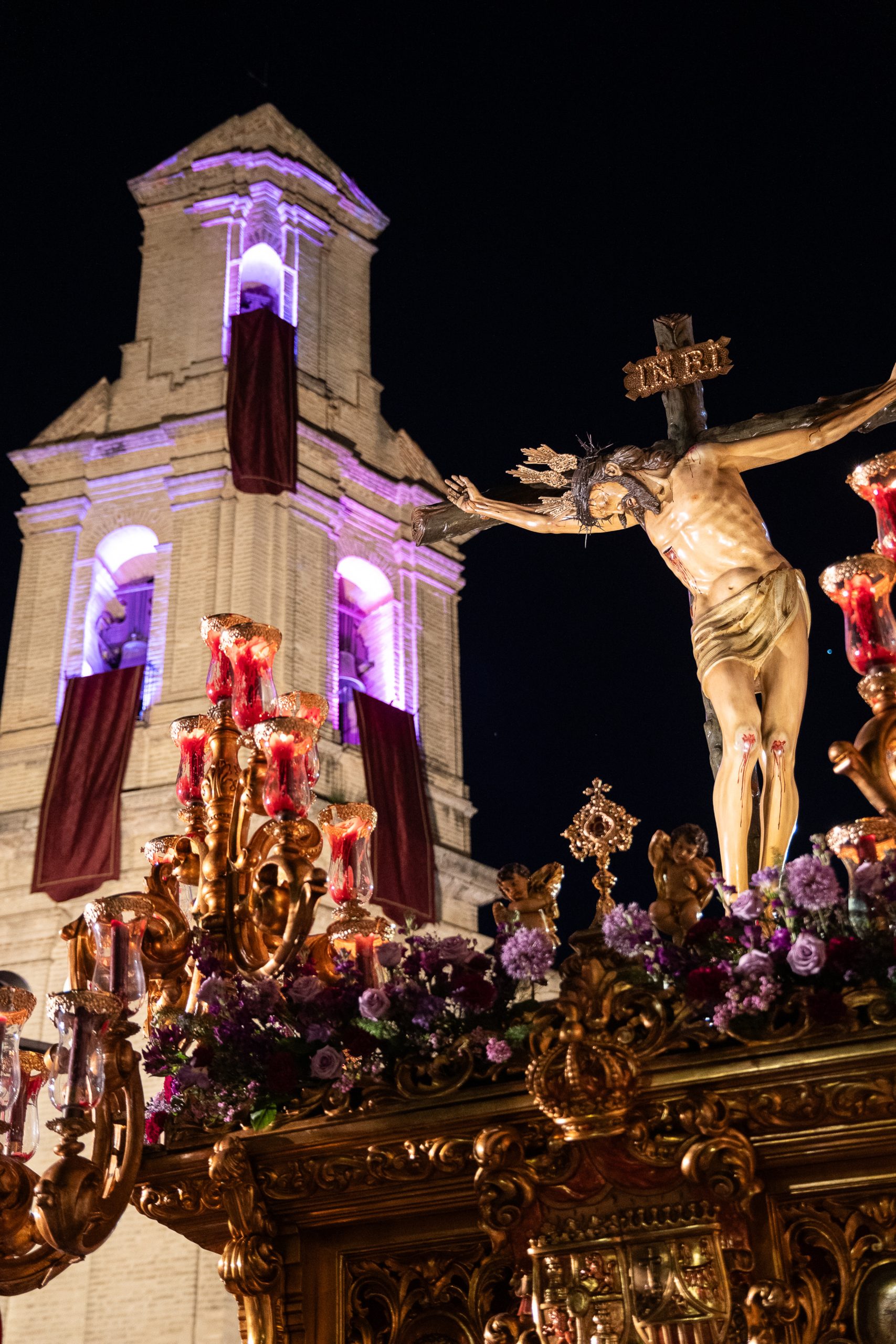
The image follows a Herculean canon, with powerful proportions and, at the same time, great elegance, despite the drama of the scene. The body twists in a dramatic pose; the head falls forward and turns to the right. The face, of majestic beauty, has hair arranged in locks as if dampened with the sweat and blood resulting from the sacrifice and the mistreatment suffered on the way to Calvary. The forked beard elongates the oval of the face and frames gentle, almond-shaped eyes that remain open, as though awaiting the compassionate gesture of someone coming to close them. The Crucified Christ is fixed in the Gothic manner, with three nails, on a tree-shaped cross.
According to a report issued in 1924 by Rafael Cabanes, the image’s restorer, the Christ figure had a hollow in its back closed by a small door, which was later sealed up. It would therefore have been a Cristo-Sagrario (a Christ figure with a hidden tabernacle). Oral tradition added a persistent legend: that this cavity had been used to transport gold from America and keep it hidden from possible pirate attacks.
In the early years of the 17th century, the image was venerated under the title of the Most Holy Christ of Humility within the confraternity of the Santo Cristo, probably established between 1608 and 1611. Long before that, it was known simply as the Santo Cristo (Holy Christ), a name that reflects the depth and antiquity of its veneration.
For centuries it was venerated in its own chapel at the church of San Pedro Mártir, until the building was declared unsafe in 1865. In the absence of an alternative site to sustain public devotion, it was moved to the private oratory of doña Concepción Jiménez Cuenca, at number 7 Calle del Agua. It later moved to the church of the Dominican convent, dedicated to San Francisco de Paula, which would in time be established as the parish of Santo Domingo de Guzmán, where it remains today.
Between 1897 and 1907, it processed on the afternoon of Holy Thursday under the insignia of the Archconfraternity of the Paz, evidence of the continuity of its worship during the final decades of the 19th century and the early 20th century.
Devotion to the image was already so intense that, in 1922, even before the founding of the new corporation was formalised, a solemn quinario (five-day devotion) was held in its honour. Finally, on 25 July 1924, the brotherhood was born, driven largely by the enthusiasm of a group of friends linked to the Círculo Mercantil (Merchants’ Circle). The first official act was a solemn Miserere, performed by the city’s musical chapel.
That same spirit of faith and charity marked its beginnings. On Holy Thursday, in accordance with the founding rules, the brothers prepared and served meals to twelve people in need, a number that would increase over the years. The brotherhood’s own members acted as waiters and kitchen assistants, with the voluntary help of friends who took on the cooking duties.
The first procession took place on 9 April 1925, Holy Thursday. The Christ figure began by processing as a paso de misterio (tableau throne), forming the scene of Calvary together with the Virgin and Mary Magdalene. The Virgin is today’s Mary Most Holy of Bitter Sorrow, who processes on Holy Wednesday with the confraternity of Our Father Jesus of the Valley. Mary Magdalene corresponds to today’s Santa Fe, who processes on Holy Thursday ahead of the Passion scenes of the Sacred Procession.
To carry the Crucified Christ, a throne was purchased from the Málaga archconfraternity of the Most Holy Christ of the Blood. The arrival of the throne in Lucena was fixed in popular memory through accounts of tremendous force. It is remembered how the Hermano Mayor returned from the transfer with his shirt bloodied and stuck to his skin from the effort, to the point that it had to be cut off to treat his wounds. That throne was later remodelled and shortened, further reinforcing its presence.
It was not until 1959 that the image of Mary Most Holy of the Greatest Sorrow arrived in Lucena, the work of the Seville sculptor Antonio Castillo Lastrucci. There is a particularly significant anecdote surrounding its acquisition. The then Hermano Mayor, Pedro Angulo Solís, on a business trip to Seville, was deeply struck by a Dolorosa displayed in a shop window in the city centre. On his return, he gathered the governing board, showed them the photograph, and its purchase was agreed. However, the image had already been commissioned by a confraternity from Huelva.
The situation changed when it became known that the sculptor’s grandmother was named Araceli. On learning this detail, the sculptor not only released the image, but also considerably lowered the price. The Dolorosa was blessed on 1 March 1959 before a crowd of the faithful, becoming a co-titular of the brotherhood that same month.
It is particularly moving that her first set of vestments was made by Carmen Castillo, a professional seamstress and devotee of the Virgin, who lived at number 1 Calle Huertas. She hand-made the mantle, the tunic and the sleeves. For her, in her own words, it was a special grace granted by the Lady. It was also the last work she carried out before her death.
In its early years, Mary Most Holy of the Greatest Sorrow processed at the feet of the Christ and, later, on the same throne. Over time, she came to process on her own throne, a burgundy canopy throne with gold embroidery. She first processed under canopy on Holy Thursday 1967.
In the late 1980s, the confraternity experienced a period of notable growth. Until the late 1990s, the procession of nazarenos grew so large that it came to be organised into two distinct processions: lighting the way of the Christ marched nazarenos in white tunic and cape with a purple capirote, cord and buttons; behind the Virgin, another procession in the same tunic and cape, but with a burgundy capirote, cord and buttons.
As time passed and new confraternities emerged, the number of brothers declined. Today, the procession is made with a purple hood and buttons, while Mary Most Holy of the Greatest Sorrow is accompanied mainly by women dressed in mantilla.
In 1974, the confraternity celebrated its golden jubilee of foundation with extraordinary events, including a procession of both thrones in the month of September. In 1999, the 75th anniversary of its founding was commemorated with numerous religious and cultural events.
At a plenary session held on 23 May 1995, the Municipal Corporation agreed that the small square next to the parish of Santo Domingo would be named Plaza del Cristo de la Sangre (Christ of the Blood Square), with its administrative boundaries defined to avoid changes to street numbering.
Since 1986, the confraternity has held an internal Stations of the Cross on the night of Holy Wednesday within the church, moving the processional thrones from the transept to the point of departure. On 9 October 1998, the Capilla Sacramental (Sacramental Chapel) was blessed at Santo Domingo, the new location for the titular images.
The brotherhood has published an internal newsletter since 1995. For years it had an old Casa Hermandad (Brotherhood House) located in a basement at the Maristas school, and its headquarters is now located on Calle Cabrillana, blessed in 2006 by Juan José Asenjo Peregrina, then Bishop of Córdoba.
In musical terms, the Most Holy Christ of the Blood has the march Por las calles de Lucena (1986), by Fernando Chicano Muñoz, and Santísimo Cristo de la Sangre, by Primitivo Buendía. Mary Most Holy of the Greatest Sorrow has the march Mayor Dolor, also by Primitivo Buendía, as well as Dolorosa (1999), by Fernando Chicano Muñoz.
The image of Mary Most Holy of the Greatest Sorrow was restored in the 1990s by the sculptor Luis Álvarez Duarte due to its delicate state of conservation, an intervention after which the dark complexion that today characterises the Dolorosa was accentuated.
In 2009 the fiftieth anniversary of its blessing was celebrated with a septenario (seven-day devotion) preached by priests of the diocese of Córdoba, a lecture series under the theme “In Defence of the Family and of Life”, and the unveiling of a new crown in the Antequera style, in gilded silver, as well as a tunic embroidered in beige tones.

*Documentary Source: Notas para la historia de las cofradías lucentinas (Francisco López Salamanca – 2022), Official Programme of the Lucena Holy Week 2026, and documentation provided by the confraternity itself.
*Photographs: Jesús Ruiz Jiménez ‘Gitanito’ and Jesús Cañete Fernández.

