
Confraternity of the Most Holy Christ of the Humiliation and Our Lady of Sorrows

Popular Name:
The Servites
Foundation:
1975
Canonical Seat:
Iglesia Mayor Parroquial de San Mateo Apóstol
Imagery:
- Most Holy Christ of the Humiliation (Pedro Muñoz de Toro – 19th century) Accompanied by two Roman soldiers, the work of Ventura Gómez at the end of the 20th century – Throne of 24 santeros
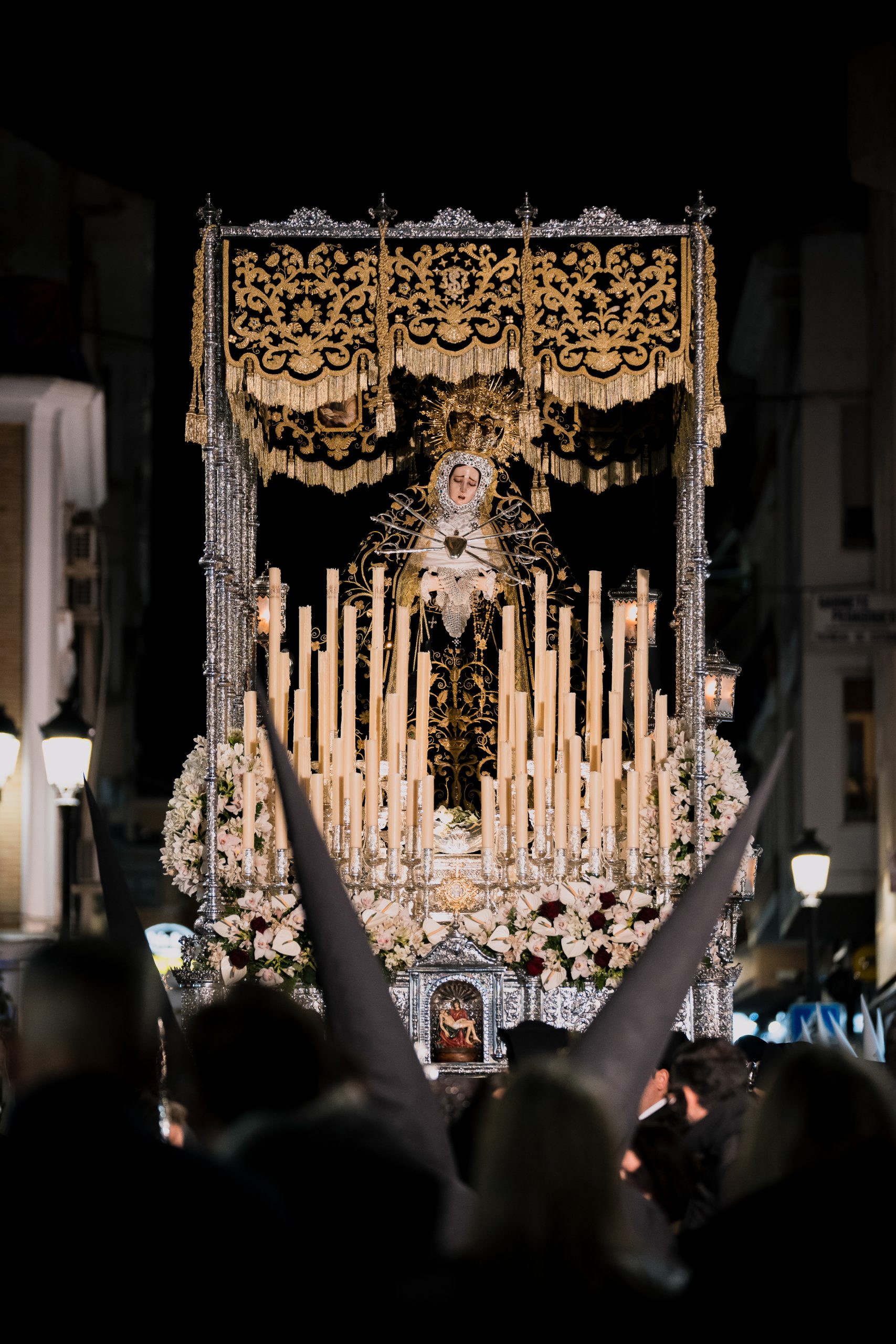
- Our Lady of Sorrows Servites (Anonymous carving – 1772) – Throne of 26 santeros
Hermano Mayor:
Francisco Jesús Bergillos Bujalance
Procession Departure:
Holy Tuesday – 19:00 hours
Number of Brothers:
300
Tunic of the Brothers:
Black tunic and mask with the emblem embroidered in gold on it, and a maroon sash. The officers wear the black scapular of the Servite order.
Tunic of the Santeros:
Maroon, with black cord and maroon capirote (Christ), and black with capirote of the same colour and gold cord (Virgin)
This brotherhood originates from the merger of two historic institutions: the now-defunct Servite Congregation of Our Lady of Sorrows and the Confraternity of the Most Holy Christ of the Humiliation, a union that gave rise to the present-day corporation.
In 1724 a congregation under the title of Slaves of Our Lady of Anguish was founded in the hermitage of Nuestra Señora de la O. Five years later, in 1729, the institution was renamed the Congregation of the Servants of the Sweet Name of Mary of Sorrows. From 1737 onward, the congregation suffered a significant loss of members, many of whom joined the Congregation of Christian Doctrine. Given this situation, and due to the reduced number of members, in 1744 it was agreed to request admission into the Servite Order, obtaining the corresponding licence in 1746.
Already in the second half of the 18th century, the institution began to regain strength. In 1760, owing to space problems at the hermitage of Nuestra Señora de la O, the congregation moved to the hermitage of the Cristo del Valle, located on Calle Corralás, where no other confraternity was based at the time. Later, in 1787, the Servites moved their headquarters to the conventual church of the Victoria, belonging to San Francisco de Paula, today the parish of Santo Domingo. This stay was brief, since in June 1788 the definitive move took place to the Parish of San Mateo, the brotherhood’s current canonical seat.
In 1790 the altarpiece was completed, which has presided over the image of Our Lady of Sorrows ever since. During the 18th and 19th centuries, the Lucena Servites held a solemn septenario (seven-day novena) every year, culminating in the main feast on Friday of Sorrows, while on Palm Sunday the procession with the image of the Virgin took place. However, in the second half of the 19th century the congregation entered a period of decline that brought it close to disappearing altogether.
Throughout the first half of the 20th century, the tradition of the Palm Sunday procession was maintained, accompanying the image of Our Father Jesus in His Triumphal Entry into Jerusalem, although intermittently. In 1970 and 1971 the brotherhood took part in the procession of the parish of San Mateo on Holy Tuesday. Following an attempt to merge with the Confraternity of the Most Holy Christ of Health and Mercy in 1971, a governing board of its own was formed in 1973.
For its part, the Most Holy Christ of the Humiliation, formerly known as the Cristo del Mayor Dolor (Christ of the Greatest Sorrow) for following the iconographic model of the carving existing in Antequera, became part of the Confraternity of the True Cross and Peace from 1885, at the request of its owner, María del Carmen Pascual y Jiménez. In 1945 it processed with this confraternity and, in the following two years, it did so with the Franciscan Confraternity of the Passion on the afternoon of Palm Sunday, appearing in the programmes as Our Father Jesus after the Flagellation.
In 1973 the Confraternity of the Most Holy Christ of the Humiliation was founded at the Parish of San Mateo, with this image as its titular, which at that time was kept at the home of the Quintero family, on Calle Quintana. That same year it made its first procession on the night of Holy Monday. Two years later, in 1975, the definitive merger of both institutions based at San Mateo took place, giving rise to the present-day Confraternity of the Most Holy Christ of the Humiliation and Our Lady of Sorrows (Servites), and fixing its penitential station on Holy Tuesday.
The image of the Most Holy Christ of the Humiliation represents the moment when Jesus, after being scourged at the column, is released from it and falls to the ground to gather up his garments. This is an uncommon iconographic scene, with few examples found throughout Andalusia. The carving is the work of the Lucena-born sculptor Pedro Muñoz de Toro, made in the first half of the 19th century. The tableau is completed by two Roman centurions, made by the sculptor Ventura Gómez Rodríguez in 2004, which replaced earlier figures of lesser artistic quality.
Its processional throne was acquired in 1973 from the Angulo workshops. It is made of silvered, embossed metal, with gilded details of cherub angels and medallions with Passion motifs on its four sides. On the occasion of the confraternity’s fiftieth founding anniversary, in 2025 it underwent a thorough restoration, which included the repair and redesign of numerous elements, as well as gilding the entire ensemble in fine gold. The candlesticks that had previously completed the throne were replaced with new ones in neo-Baroque design, made up of a carved square base from which arms inspired by the cornucopia emerge, topped with clusters of fruit embracing the glass wind-guards. The set, made up of six pieces of different sizes, has likewise been gilded. This work was carried out at the workshops of Orfebres Gradit, under the artistic direction of Antonio Budia Sabán, and has been funded almost entirely through donations from a large number of brothers.
For its part, Most Holy Mary of Sorrows Servites is a dressed candelero-type image, somewhat smaller than life-size. It was made in 1772 at the request of the governing board of the Servite congregation. In 1788 it was enthroned in the main niche of the altarpiece it presides over today. Its authorship has been attributed to the Levantine sculptor based in Seville, Blas Molner, although also to the Frenchman Miguel Verdiguier and to the artist Mateo de Medina.

*Documentary Source: Notas para la historia de las cofradías lucentinas (Francisco López Salamanca – 2022), Programa Oficial de la Semana Santa de Lucena 2026, and documentation provided by the confraternity itself.
*Photographs: Jesús Ruiz Jiménez ‘Gitanito’ and Jesús Cañete Fernández.

