Venerable and Illustrious Archconfraternity of the Blessed Sacrament (not affiliated)

Popular Name:
El Corpus
Foundation:
1520
Canonical Seat:
Major Parish Church of Saint Matthew the Apostle
Imagery:
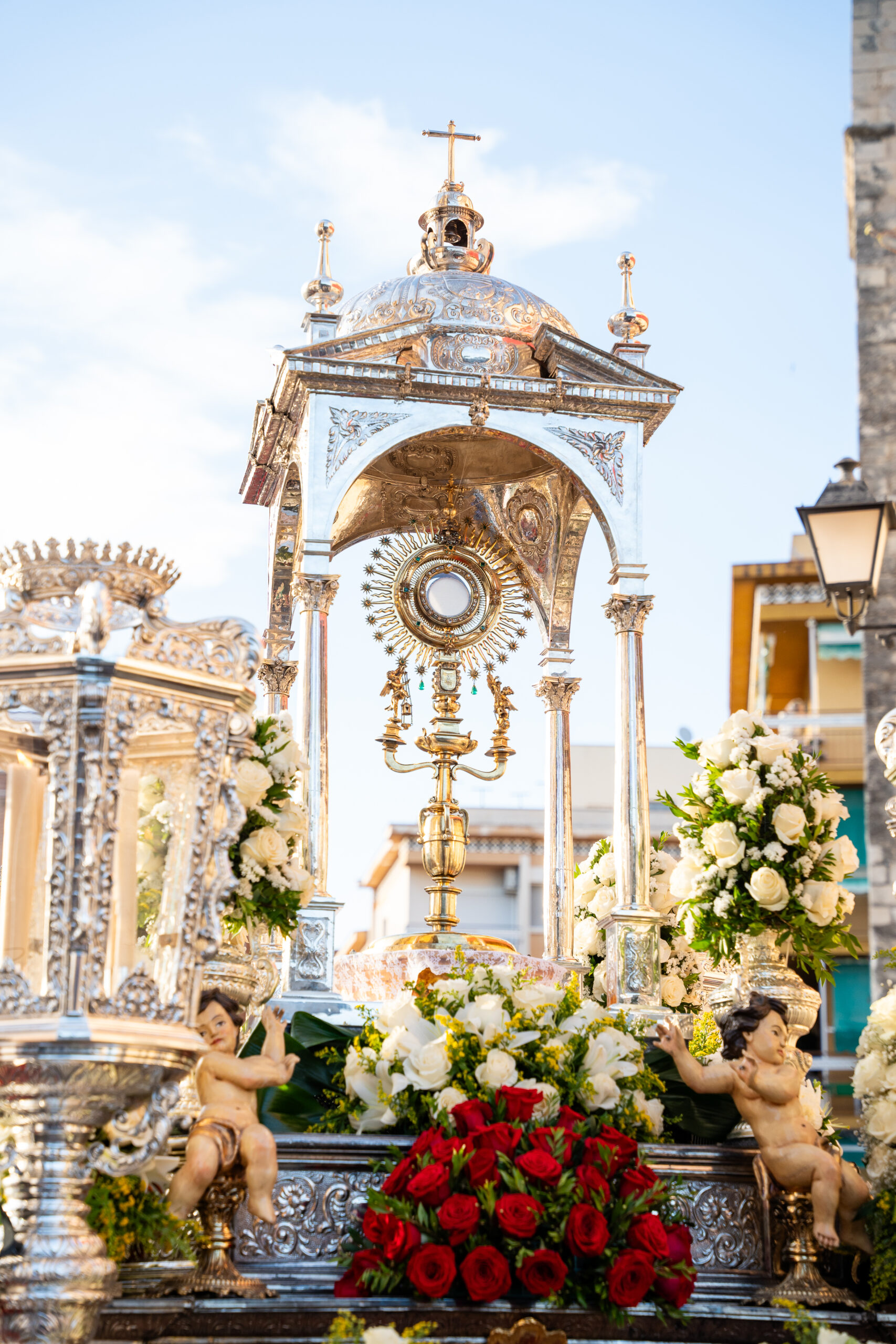
Monstrance that holds the Blessed Sacrament (the processional float moves on a portable altar mounted on wheels)
Hermano Mayor:
Gonzalo Angulo Vigo
Procession Departure:
The Sunday closest to Corpus Christi Thursday
Number of Brothers:
270
The Venerable and Illustrious Archconfraternity of the Blessed Sacrament is possibly the oldest brotherhood in Lucena and one of the oldest sacramental corporations in Andalusia.
Although its official approval took place on 3 January 1598 by the Bishop of Córdoba D. Francisco Reinoso y Baeza, promoted at the initiative of Teresa Enríquez, historically known as “the madwoman of the Sacrament”, documentary references confirm the existence of a sacramental brotherhood in Lucena as early as 3 August 1520, which makes it an institution of extraordinary antiquity within Andalusian popular religiosity.
The archconfraternity even predates the Minerva of the Dominicans of Rome, to which it was aggregated on 18 November 1759 by grant of Pope Clement XIII. Over the centuries, the corporation played a fundamental role in the city’s eucharistic worship, promoting adoration of the Blessed Sacrament and enhancing the liturgical celebrations linked to the Eucharist in the parish of Saint Matthew.
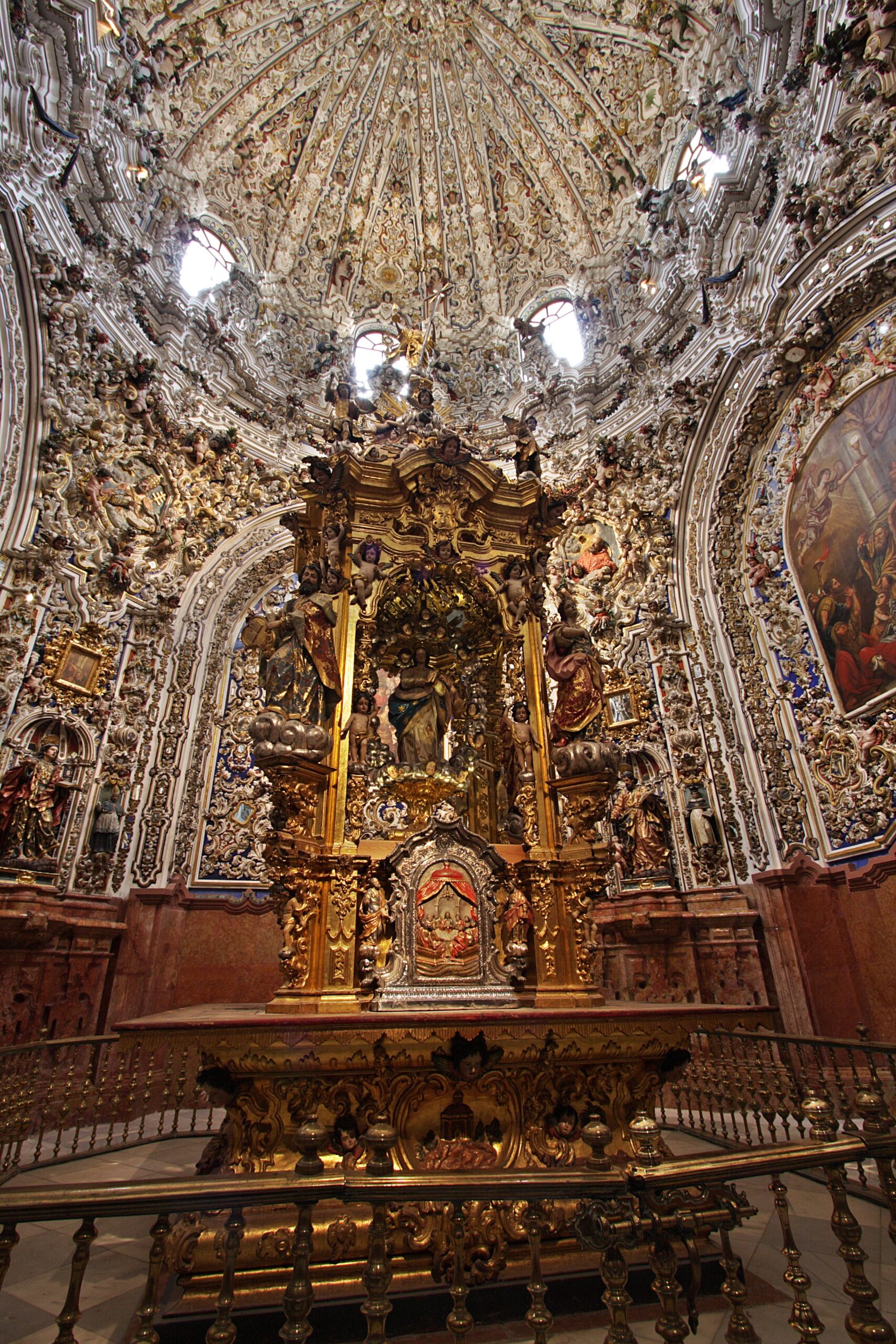
One of the great heritage milestones of the brotherhood took place in 1772, when the monumental Sagrario Chapel was built, annexed to the epistle side of the nave of Saint Matthew’s. Conceived under the design of Leonardo Antonio de Castro, some of the most outstanding artists of the period took part in its construction.
The result was one of the most outstanding architectural works of Andalusian Baroque and, without doubt, one of Lucena’s great heritage treasures. With a circular floor plan and a tall drum, this chapel represents the highest expression of Lucena’s Baroque style, within the so-called florígero (floral) style, characterized by ornamental exuberance and decorative richness.
As a singular historical privilege, Pope Leo XIII granted the archconfraternity a special bull allowing the Blessed Sacrament’s procession to take place after the ringing of vespers, an exceptional circumstance within the eucharistic celebrations of the time.
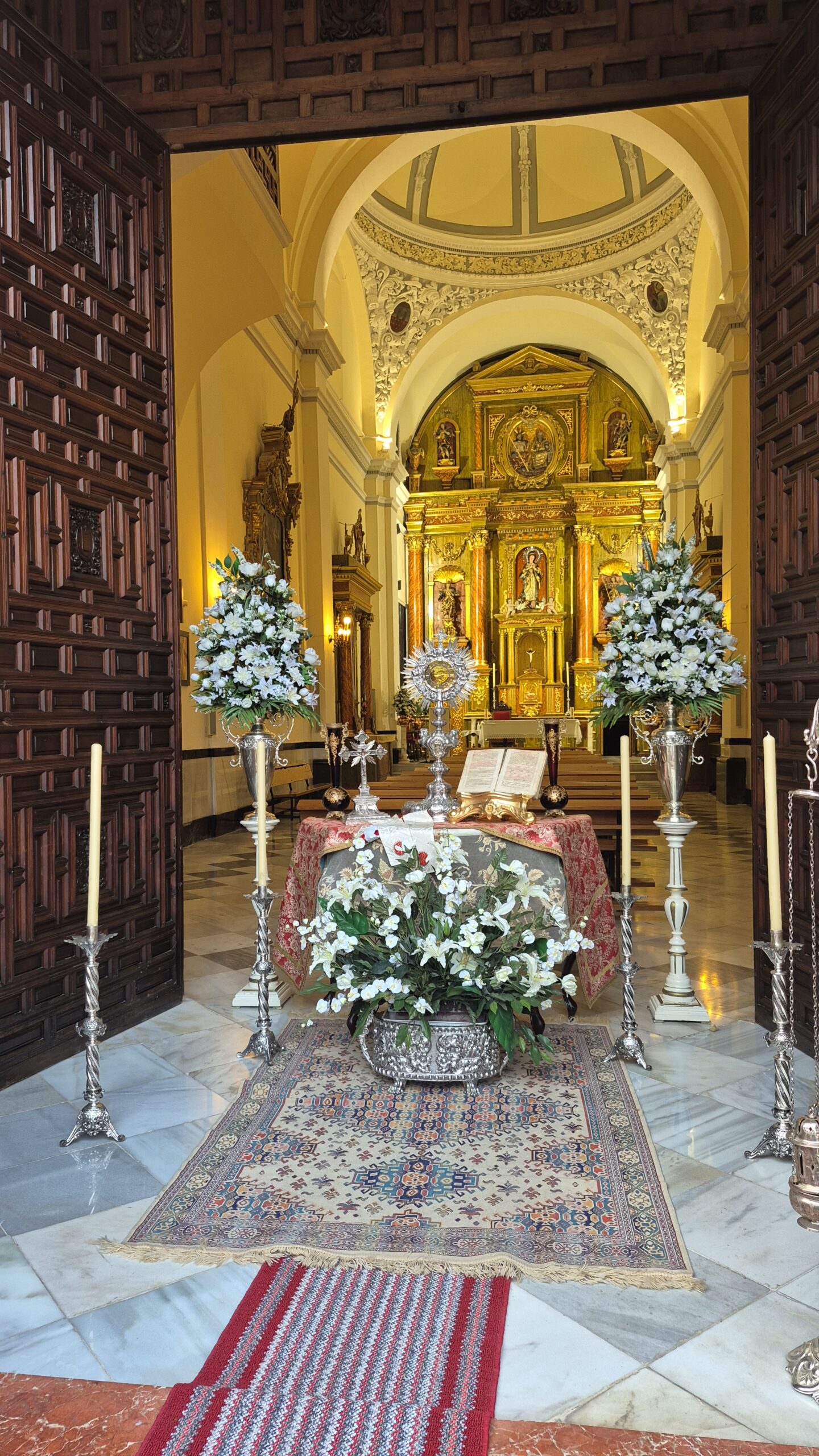
As for its heritage, the archconfraternity preserves an important collection of liturgical and eucharistic items, notably the neoclassical aedicule with monstrance, a mounted portable altar, various historical furnishings used for the worship and adoration of the Blessed Sacrament, as well as different pieces traditionally used in the parish of Saint Matthew.
However, much of its historical heritage disappeared or was sold off during the process of the Disentailment (Desamortización), which profoundly affected numerous Spanish religious corporations and confraternities during the 19th century.
The Corpus Christi procession today continues to maintain much of its solemnity and popular roots. In it, the boys and girls who received the sacrament of First Communion that same year traditionally take part, together with their catechists, accompanying the Blessed Sacrament along its processional route through the streets of the city. Also joining are the parish and conventual clergy of the city. Likewise, as it is an official procession, the Agrupación de Cofradías and representatives of all the Passion and Glory confraternities of Lucena take part.
Likewise, numerous churches, façades and private houses put up ephemeral altars to honor the passing of the monstrance, while the streets are adorned with colorful carpets of salt, aromatic plants and ornamental elements, turning the feast of Corpus Christi into one of the most beautiful and distinctive expressions of Lucena’s popular religiosity.
*Documentary source: documentation provided by the confraternity itself.
*Photographs: Jesús Cañete Fernández and the archive of the Agrupación de Cofradías de Lucena.

