
Author: Luisfernando Palma Robles, official chronicler of Lucena
(Adapted and updated from my book Pedro Muñoz de Toro y el drama pasionista lucentino (Pedro Muñoz de Toro and the Passion plays of Lucena). Foreword by Víctor J. Ramos Muñoz de Toro. Lucena: Gestoría Aras, 2022, pp. 93-103)
In the case of Lucena, the most distinctive ritual expressions of its traditional religious observances form part of the rich intangible heritage embodied in the ‘Santería’.
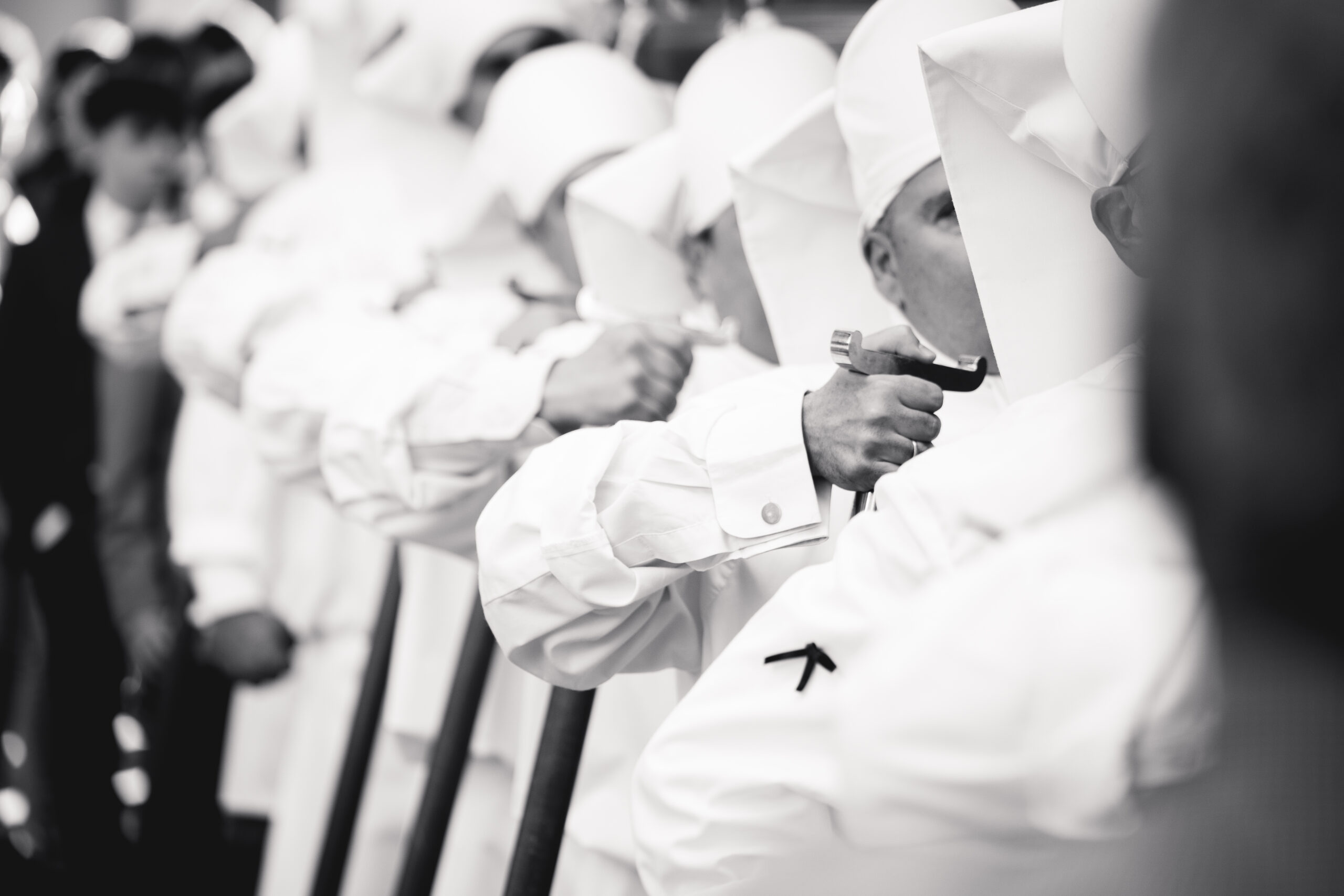
Lucena is one of the Andalusian towns where the singular way in which the processional images are carried is of paramount importance. This way of carrying the processional images is known by a verb turned into a noun: the ‘santear’, from which an entire rich and complex ritual tradition known as ‘santería’ has developed. In this section, I present a miscellaneous overview of this ritual, which is so uniquely characteristic of Lucena.
1.- Santería: Ritual and dramatic tradition
The ‘santería’ is today a group-based temporary male ritual (the ‘santeros’, who form the ‘cuadrilla’), selected and led by one of their number (the ‘manijero’), whose purpose is to carry the processional thrones on their shoulders in the distinctive manner known as ‘el santear’1. ‘Santería’ as we know it today is the result of an evolutionary process that began in the first half of the 19th century and was already well established by the 1920s, although, as is only to be expected in the case of an anthropological phenomenon, it remains an ongoing process. As an anthropological phenomenon, it has continued ―and continues― to evolve.
Indeed, this group-based ritual ―currently an exclusively male one― provides an important means of overcoming the individualistic isolation that characterises contemporary society. The barriers to personalised relationships imposed by the hierarchical structure of society disappear in the associative ritual in question through the participation of the individuals who make up the association, which, in addition to its explicit purpose —in this case, carrying the processional thrones on their shoulders— also functions as a setting for sociability and as a point of reference for collective identity. The participants in the ritual emphasise their individuality just because they feel part of «a collective ‘we’» in which the «I» transcended2, both in the meetings of the association and on the day of the procession, carrying the processional throne on their shoulders.
In the procession, the attire of the ‘santeros’, the movement of the processional throne and the positions they occupy around it are also fundamental elements of the ‘santería’ ritual, in which the drum plays a central role.
The practice of ‘santear’ is governed by aesthetic rules, some relating to the posture of the ‘santero’ (individual rules) and others to the movement of the group, which seeks to adapt itself to the processional image or iconographic scene being carried, with the rhythmic accompaniment of the drums. From this arise the basic styles, or ‘pasos’ which, for purely choreograpic purpouses, can be divided into two groups: dynamic and static.
Among the former are the style of Jesus the Nazarene, which seeks to convey the impression that the image is walking under the burden of the cross; that of Our Lord bound to the Column, which, through a characteristic ‘botao’ , aims to portray Christ’s physical response to the scourging He endures; and that of the Holy Burial, known also as ‘coleao’, intended to evoke the progress of a funeral carriage.
The basic styles that may be described as static are two in number: that of the dead crucified Christs, sometimes known as ‘maseteao’ and at other times as ‘asentao’, characterised by very little movement, as though care were being taken not to disturb the Lord in the sleep of death; and that of the sorrowful Virgins, with its slow, solemn swaying, reflecting the tenderness and reverence due to a grieving mother.
These dramatic conventions should not be regarded as inflexible. Each ‘manijero’ agrees with his ‘cuadrilla’ on the particular characteristics that the ‘paso’ should display during the procession.
2.- Bullfighting and ‘santería’
The collective imagination of the people of Lucena has long associated ‘santería’ with bullfighting. Throughout its history, Lucena has maintained a close association with bullfighting, which at times even served as a source of public revenue. I shall give just one example from the late 18th century, the period in which Pedro Muñoz de Toro was born:
It was resolved that, with regard to the remaining bullfight of the four that His Majesty had been pleased to grant to this town, so that the proceeds might be used for the repair of the Town Hall, the public fountains and other public works owing to the lack of municipal funds, and since that need still persisted, and given that the proceeds from the most recent bullfight had been used to restore the ‘Fuente Nueva’ and were being applied to the repair of the fountain in the ‘plaza del Coso’ as well as the Town Hall (…) the final bullfight should be held, consisting of twenty-four bulls divided over two days so that none of the meat should go to waste3.
On Easter Sunday in 1922, Lucena’s bullring was officially inaugurated. It has since disappeared and was located opposite the Our Lady of Araceli district. During the 1920s, Spanish society was deeply immersed in the culture of bullfighting. In Lucena, however, one local bullfighter inspired particular admiration: Francisco López Parejo (Parejito). In 1920, the famous rivalry that had defined Spanish bullfighting between José Gómez Ortega («Gallito» or «Joselito») and Juan Belmonte came to an abrupt end with the fatal goring that claimed the life of the former. Together, they stood at the very heart of what is known as the Golden Age of Bullfighting. The entire bullfighting world ―and, one might even say, Spanish society as a whole— were around this legendary pairing. It remains, without doubt, the most famous rivalry in the history of the bullfighting and the one that most deeply divided public opinion in Spain, where, although it may sound like an exaggeration, people were said to be either «gallistas» (supporters of Gallito) or «belmontistas» (supporters of Belmonte). It was during these years that the form of ‘santería’ we know today began to take shape, following the natural course of its historical evolution. Its development has been shaped —and continues to be shaped, often unconsciously— by a wide range of influences: agricultural practices, trades associated with bronze and wood, religious traditions and, naturally, the world of bullfighting. Anything that is born and develops within a community inevitably reflects its spirit and the everyday occupations of its people.
The santero’s attire —combining elements of traditional rural dress with the habit of a member of a brotherhood— also includes ceremonial features that closely parallel those associated with the bullfighter. The sash, belt, tunic, neckerchief and ‘capirote’ are all put on according to a precise ritual through which the ‘santero’ undergoes a profound transformation: leaving behind the everyday self to become a central figure in Lucena’s Passion drama. This transformation may be regarded as mythical, since the experience of myth is clearly distinct from that of everyday life.
Before making their way to the church for the procession, the ‘santeros’ gather at the ‘manijero’s’ home. There, the ‘paseíllo’ begins, traditionally performed with the cushion tucked beneath the arm ―a gesture that may well be a reminiscense of the bullfighter’s ‘capote de paseo’. The ‘paseíllo’ follows the arena (‘ruedo’) formed by our streets and squares, accompanied by the rhythm of drums (recalling the ‘pasodoble’ that traditionally marks the opening of a bullfight).
Once inside the church, the cushion is fastened into place. Does this act ―so often carried out by someone whom the ‘santero’ trusts implicitly― not evoke the bullfighting ritual of ‘atar los machos’, performed by the matador’s ‘mozo de espadas’ before entering the ring?
It is common, once the procession has ended, for the ‘manijero’ to hand over the bell —the symbol of his authority— to the person who will lead the ‘cuadrilla’ the following year. I see in this ritual moment a clear echo of the bullfighter’s ‘alternativa’.
Likewise, when a veteran ‘santero’ decides that he will no longer practise his ‘santear’, he has the appendix of his ‘capirote’ cut off by a respected member of the community, much as a bullfighter has his ‘coleta’ cut upon retirement. In this case, there is no mere resemblance or echo: it is a direct borrowing from the traditions of bullfighting.
The tradition of presenting cigars to the ‘santeros’ arose as a mark of recognition for a job well done, much as it does in the world of bullfighting. Many other influences from the bullfighting tradition can also be found in ‘santería’. Attentive readers will discover some of them for themselves4.
3.- The term ‘santero’ and other names in use
The term «santero», in its distinctively Lucena sense, does not appear in the written press until 1906. It can be read: «With the exception of the expulsion of a ‘santero’ by the owner of a throne, prompted by the fact that the expelled ‘santero’ had abandoned his precious burden in order to indulge in drink , and, upon returning to his place, sought to make amends for his misconduct by singing a ‘saeta’, nothing occurred that warranted severe censure»5.
As can be seen, the excerpt hightlights the expression «indulge in drink» (‘empinar el codo’) and the term «saeta». As for the former, it requires no further comment. What is striking, however, is that the author of the article chose to emphasise the latter. To the best of my knowledge, this is the earliest recorded appearance of the term in the Lucena press.
Shortly beforehand, when referring to this distinctive sound associated with Holy Week, the same publication had described it, in the plural, as «cantares clásicos»6.
Because of its interest, I reproduce below a text dating from the middle of the first quarter of the 20th century, which offers a portrait of the figure of the ‘santero’:
Broad-shouldered and proud, with a calm gaze, a sundarkened, clean-shaven face, lean, powerfully built, and walking with measured confidence; dressed in the short purple tunic of a brotherhood memberof Jesus, with the raised peakof his long ‘capirote’ folded back so that it falls in rippling folds down his back; his waist bound by a sturdy leather belt, grasping in his triumphant right hand a long ‘jorquilla’, resembling a modern Hercules; from the straw-coloured cords of his habit hang large ring-shaped breads, placed there by the affectionate hand of a graceful young woman as a token of admiration, while the broad breast of his tunic is crammed with cigars . Thus, with more than a hint of swagger, the unmistakable ‘santero’ of our processions may be seen during these days.
He bustles through the streets and squares; he engages in animated debate among circles of friends and admirers about the weight of his ‘insignia’, whether the ‘manijero’ possesses the qualities required to command those steel-muscled ‘santeros’, whether, in lifting the image entry by strength alone, this or that corner was dented , whether, during that lightning-fast half-turn or steep descent, those of at the rear draggedthe ‘paso’, and over countless other incidents. All of this takes place amid generous libations of golden Pedro Jiménez wine until, warmed by the drink, they become filled with poetic inspiration and break into rhythmical saetas , exchanging them from one group to another.
They are a sight to behold beneath the immensely heavy processional throne, their sturdy shoulders pressed into the almohadillas (shoulder cushions). With their rhythmic stride and swaying movement, they draw murmurs of admiration from the inteligentes who await them at every point along the procession route, ready to act as critics and, where it is deserved, to applaud the grace, skill and bearing of those powerfully built young men, whose greatest satisfaction lies in these displays —innocent in themselves— of the strength of their iron arms.
This is a figure that has remained vividly etched in our imagination since childhood. In those distant days, when we saw them with their faces adorned by ‘boca e jacha sideburns and their long trailing ‘capirotes’, we likened them to the legendary chisperos of old, with their hanging plaits. Just as they carried the jorquilla tucked under one arm, one could equally imagine them bearing a sharp knife or a trabuco naranjero, ready to defend the beloved homeland with courage against any foreign invaders who might dare set foot upon its sacred soil.7.
In 1916, three years later, we find further evidence in the local press that, when referring to the ‘santeros’, the term was printed in italics. Once again, the reports dwell on what were regarded as the excesses associated with them:
(…) And, since we are speaking of processions, it is worth recalling the favourable impression made upon the public last year by the attempt to enforce rather stricter order in some of them and to curb certain excesses on the part of the ‘santeros’, which produce such an unfortunate effect during ceremonies of so solemn and religious character8.
This excerpt, together with the two previous ones (1906 and 1913), belongs to the first quarter of the 20th century, the period during which santería began to take shape and become established in the form and manner in which it is known today.
In the 1941 statutes of the Archconfraternity of Jesus the Nazarene, the expression «Personnel» appears, used as a synonym for the body of all its workers. In the case of these statutes, those workers —almost certainly agricultural labourers— temporarily exchanged their work in the fields for the task of carrying the processional images. In the records of the Brotherhood of the True Cross and Peace (Veracruz y Paz), the following expressions appear throughout the 19th century to refer to these individuals: «those who carry the insignias», «those who bring out the insignias», «those who perform duties during the procession», «the ‘insignieros’», «those who carry the sacred images»,9 and «the assistants to the cuadrilleros». The latter figure often came to assume the principal —if not the sole— responsibility for ensuring the participation of each image in the procession, appointing the ‘manijero’ and meeting the expenses associated with both the procession itself and the ‘santería’. Today, in those brotherhoods where this position still exists, these responsibilities have been considerably reduced, reflecting the greater involvement of the governing board in the organisation and management of the procession.
The following are some observations on the use of the adjetive «santeril». There are several reasons why this adjective cannot properly be applied to the case of the Lucena ‘santero’. In the Gramática descriptiva de la Lengua Española (Descriptive Grammar of the Spanish Language (1999), following Anthony Gooch, it is stated that the suffix -il is particularly common in words associated with women (such as «femenil», «mujeril», and «matronil») and with humble or manual occupations (such as «carpinteril», «cocineril», and «porteril»). This is, in itself, a neutral observation. However, as Gooch also points out, the suffix -il, much like -esco, frequently carries pejorative connotations, as in «libresco» or «solteril». The Grammar likewise invites comparison between «señorial» and «señoril»,10. When discussing porteril, Moliner gives as an example the expression «chismes porteriles» (porter’s gossip)11, in which the adjective serves only to reinforce the pejorative connotation already inherent in the noun «chismes» (“gossip”). Gutiérrez Cuadrado also notes Cervantes’ preference for the suffix -il, which he frequently employed with a humorous effect12(of cachondeo).
Like -il, the suffix -ero is used in the formation of both nouns and adjectives. According to the Diccionario de la Real Academia Española (Dictionary of the Royal Spanish Academy), it carries the following meanings and uses. As a noun, it denotes an occupation, trade, profession, or position. Significantly, the ‘Dictionary’ illustrates this meaning with a term («jornalero», day labourer) whose occupational origin is strikingly close to that of santero in the context under discussion.
When used adjectivally, -ero denotes moral character or qualities13—that is, ethical and, it may be added, aesthetic values. Hence expressions such as «postura santera» (a santero-like bearing) and «palabra santera» (a santero’s word), which run parallel to familiar expressions such as «postura torera», «valor torero», and «vergüenza torera». The ethical nuance that the Real Academia Española (Royal Spanish Academy) attributes to the suffix -ero in the formation of adjectives is, in itself, sufficient to justify its application in the case of the adjective derived from the homonymous noun «santero».
4.-The ‘santero’ and his social evolution
In 1768, the Servite Congregation began holding a Palm Sunday procession with its titular image. This procession of Our Lady of Sorrows lacked the traditional elements characteristic of the town’s brotherhoods and confraternities. The platform proved too heavy for the few men carrying it. Consequently, during Lent in 1797 it was decided «to obtain six or eight new tunics and hoods, and for these brethren to carry the Sovereign Image» Does this suggest an increase in the number of bearers?
There are references to an earlier platform with its ‘parihuelas’ (carrying frame). In January 1776, the Servite Superior observed that, given the considerable weight of the new image —which would become even heavier once mounted on the platform and parihuelas— it seemed impossible that, even if many members of the Congregation were assembled, they would be able to carry the image without excessive effort in the Palm Sunday procession that had been held annually since 1768. Brother Antonio Rafael de Mora offered to provide six or eight sturdy men from among his own servants to carry the Holy Image. He undertook to supply them with suitable tunics and to pay them a small gratuity. Thus emerged the figure of the ‘cuadrillero’ within the former Servite Congregation.
Until well into the 20th century, membership of the governing bodies of the brotherhoods was largely reserved for the social elite and the town’s ruling classes, whereas ‘santeros’ were, for the most part, drawn from the working classes. A particularly telling illustration of the situation can be found in the conservative press of 1937:
The ‘cuadrillas’ of ‘señoritos’ should, as they always have, leave the place to those good working men, for as long as they retain such devotion and aspirations, there remains a bond that unites them to religion and to the established order. If those rich men also feel the desire to carry the sacred images, they may become ‘cuadrilleros’, for that role too affectionate respect that, in this town, traditionally distinguished the relationship between day labourers and their employers14.
Lucena’s ‘santería’, while remaining firmly rooted in its authentic tradition, has also undergone a process of semantic redefinition. There existed a model in which a ‘cuadrillero’ —a landowner or a professional of relatively high social standing— delegated to a trusted subordinate, the ‘manijero’, the task of assembling a ‘cuadrilla’ of ‘santeros’, made up of men accustomed to the demanding physical labour of their everyday work. In this way, these expressions of traditional religiosity clearly reflected a social model in which the roles of its members were rigidly defined and hierarchically ordered. The leaders of the brotherhoods and confraternities belonged to the upper social strata, whereas the members of the ‘cuadrillas’ were drawn from the lower levels of society. It may be said that the social structure operated along two distinct horizontal tiers: an upper tier, occupied by the ‘cuadrilleros’, and a lower tier, formed by the ‘cuadrillas’ of ‘santeros’.
As the 20th century progressed, this horizontal structure gradually gave way to a more vertical model,15 to the extent that the roles of ‘cuadrillero’, ‘manijero’, and ‘santero’ underwent a process of redefinition. The ‘cuadrillero’ gradually ceased to be identified exclusively with the local landowner or señorito; the ‘manijero’ became increasingly dissociated from the role of foreman, overseer, or similar position; and the ‘santero’ was no longer closely associated with men whose occupations involved strenuous physical labour. This horizontal division has gradually faded away, while the ‘cuadrillas’ have come to adopt, from a social perspective, a vertical structure in which participation in ‘santería’ is no longer determined by an individual’s position in society. Within this single vertical framework, each participant generally finds his place at a level that is not exclusively conditioned by social status. As a result, ‘santería’ has evolved into an interclass ritual. Nevertheless, there are instances in which ‘santería’ —and even membership of a brotherhood or confraternity itself— has been used as a means of social advancement.
From the 1960s onwards, Lucena, like the rest of Andalusia, experienced a decline in social, political, and ideological polarisation. As a result, those social groups which had traditionally regarded the sacred images, the brotherhoods, and Holy Week itself as symbols, associations, and celebrations belonging exclusively to the religious sphere, and as markers of the dominant social classes, gradually came to recognise that, although they are unquestionably rooted in religion, they are also «points of collective identification, not necessarily linked to oligarchic or conservative sectors»16. The groups that make up Lucena’s brotherhoods, confraternities and ‘santería’ provide a valuable framework for analysing the interaction between the symbolic level (what one is as a ‘cofrade’ or ‘santero’) and the real level (what one is in everyday life), together with the socio-economic implications arising from this relationship17.
5.- ‘Santería’ and the intangible cultural heritage
In March 2025, the Regional Ministry of Culture and Sport (Consejería de Cultura y Deporte) initiated the procedure to register the ‘Santería’ of Lucena in the General Catalogue of the Historical Heritage of Andalusia (Catálogo General del Patrimonio Histórico Andaluz, CGPHA) as an Asset of Cultural Interest (Bien de Interés Cultural, BIC), under the classification of an Activity of Ethnological Interest.
The Project for the Atlas of the Intangible Heritage of Andalusia (Atlas del Patrimonio Inmaterial de Andalucía, Subbética Cordobesa), prepared by María del Rosario Ortiz Amores (2009), to which I contributed as an informant, records that the phenomenon of Santería has been documented extensively and in considerable detail in Lucena since the first decade of the 20th century.
I have defined ‘Santería’ —a definition adopted in the section on related heritage assets under code 1701011 for the Romería de Bajada de la Virgen de Araceli in the Atlas of the Intangible Heritage of Andalusia— as a system of temporary association involving individuals, to date exclusively men (‘santeros’), whose principal purpose is to carry procession thrones on their shoulders in the distinctive manner known as «santear». Santería clearly encompasses the activity of ‘santear’ (the active verb), an action that falls within the realm of the performing arts, since there are different aesthetic ways of carrying procession thrones. In Lucena these styles are known as «pasos», and they make a dramatic contribution to the visual staging of the sacred images borne on the santeros’ shoulders. The act of ‘santear’ is therefore governed by a set of rules that ensure the solemnity of the occasion and uphold the fundamental principles of this dramatic representation.
‘Santería’, taken as a whole, constitutes a ritual that can be clearly classified and recognised as an expression of intangible cultural heritage. UNESCO defines intangible cultural heritage as comprising the practices, representations, expressions, knowledge, and skills that communities recognise as part of their cultural heritage, together with the instruments, objects, artefacts, and cultural spaces associated with them.
The ritual of ‘Santería’ fully embodies all the elements identified by UNESCO (2003) as constituting intangible cultural heritage. ‘Santería’ encompasses artistic and traditional representations and expressions that have been transmitted from generation to generation. It is a ritual that is continually recreated by the community or group in response to its physical surroundings and shared emotional experience. At the same time, its various manifestations give expression to the group’s own identity and continuity, while presenting itself to the spectator as something both distinctive and emblematic of that identity.
Indeed, ‘Santería’, as an element of intangible cultural heritage, possesses a clearly defined identity, a distinctive set of characteristics that sets it apart from other traditions pursuing similar purposes. Two further concepts derive from this notion of identity. The first is the identifying function, which enables us to recognise something or someone, but in isolation. Identifying is the national identity card: it belongs to an individual regardless of the environment in which that person exists. Identity-related, by contrast, refers to what enables us to recognise something or someone by virtue of their belonging to a particular community or group.
‘Santería’ possesses a strong identity-forming value. Throughout its history, it has become an important context for the affirmation and reproduction of collective identities, that is, of the elements that define and sustain a shared sense of identity. It is precisely in order to preserve this identity-forming value that Santería must be safeguarded by the public authorities responsible for the protection of cultural heritage —in this case, intangible cultural heritage. This is without prejudice to the fact that, as a living tradition, Santería should continue to evolve naturally in those aspects that are not fundamental to its essential character.
6.-Ritual commensality
The principal internal setting of ‘santería’ is found in the juntas de santeros, ritual gatherings held before the procession, where collective ritual commensality takes place and where a distinctive form of communication is employed through the so-called saeta borrachuna.
Another aspect of ‘santería’ that has undergone a process of reinterpretation is what has been termed ritual commensality. This has been a feature of expressions of traditional popular religiosity for centuries, as is readily demonstrated by the well-known prohibitions issued by the ecclesiastical authorities, in which prelate sternly condemned the excessive eating and drinking indulged in by those taking part in religious processions.
On 11th March 1785, the Vicar of Lucena, Juan Martínez de Gálvez, received a communication from the Diocese of Córdoba in which the Vicar General, José Antonio Garnica, stated:
that he had been informed of the complete ineffectiveness of the repeated injunctions issued by the bishops of the diocese regarding the sinful and scandalous excesses incurred in that town [Lucena]
which take place during the days of Holy Week on the occasion of the processions, providing ample opportunity for carousal and banqueting, from which drunkenness and disorder arise [quebrantamiento] of fasting, which we must prevent by adopting the most appropriate measures to put an end to such grievously sinful practices. We therefore order the Vicar to summon before him the quadrilleros of the aforementioned brotherhoods and to inform them that they are not to hold banquets or, under any pretext whatsoever, provide such refrescos to any class of persons during the days of Holy Week on the occasion of the processions, under penalty of removal from office for those who contravene this order, together with any further sanctions that we may see fit to impose, which shall be enforced as soon as we receive notice of any breach of this most salutary decree. [Disponiendo asimismo dicho vicario] se lea y publique este nuestro Despacho en la iglesia mayor de la expresada ciudad [lo que efectuó el Domingo de Ramos, 20 de marzo] so that all may be duly informed, and so that those who infringe these orders may incur the punishment warranted by their disobedience18.
As can be seen from this decree issued by the Diocese, terms that are highly characteristic of Holy Week in Lucena, such as ‘cuadrillero’, ‘gasto’, and ‘refresco’, were already in use. Today, the latter two survive in the vocabulary of ‘santería’, although they have virtually disappeared from everyday language in the sense of a festive gathering centred on food and drink.
The aforementioned ritual commensality associated with the ‘juntas de santeros’ unfolds in three stages: first, with the coffee shared as a pause during the ‘paseíllo’; second, with the ‘refresco’ at the conclusion of the procession; and finally, with the ‘gasto’, the gathering that marks the end of each ‘santería’ as a temporary association.
Ritual commensality is an intrinsic element of the local Passion celebrations. This concern on the part of the ecclesiastical authorities regarding ritual commensality during Holy Week was by no means new, as is explicitly acknowledged in the decree just discussed. It can already be found in the measures enacted by Bishop Siuri and in his edict of 1718. There it is stated that Holy Week is a time of «mortification and penance» and that it «is often profaned by the meals and refreshments provided by the stewards of the Brotherhoods»19.
Ritual commensality also appears in the records preserved in the account books of Lucena’s historic Passion brotherhoods. By way of example, the Brotherhood of Our Lady of Solitude (Cofradía de la Soledad) treated its members, at the conclusion of the Easter Tuesday celebration in the 18th century, to mistela —a drink prepared with water, sugar, cinnamon, spirits, and sandalwood— together with hot chocolate, sponge cakes, and ring-shaped biscuits.
In 1824, on Holy Tuesday, at the height of the absolutist fervour, the Town Council issued a public proclamation stating:
From the moment this proclamation is published, all tavern keepers and women in charge of liquor stalls shall close their premises, both by day and by night, until Easter Tuesday, and shall not be permitted to sell drinks or spirits to any person. Anyone contravening this order shall be committed to the Royal Prison and fined ten ducats, to be applied in the customary manner.
Wine producers and growers with wine cellars, together with distillers of spirits and other liquors, are likewise forbidden to allow gatherings of local residents or visitors in their premises for the purpose of serving wine or spirits by the ‘cuartilla’, ‘jarrillo’, or ‘medios’. Anyone contravening this prohibition shall incur the penalties laid down in the preceding article.
The owners or leasees of inns shall not permit muleteers, itinerant traders, or other visitors lodging there to consume wine or spirits in the manner described above, failing which they shall be punished with the utmost severity.
The Catholic community of this town are exhorted to conduct themselves during the processions and the visitation of the Stations with the utmost devotion, and on no account to depart from the decorum and propriety befitting such sacred observances.
The ‘Alguacil Mayor’ (chief constable or high bailiff), the ordinary constables, the senior and junior rural wardens, and all other officers of justice shall ensure, for their own part, compliance with the preceding articles, as the public cause and general welfare of this community depend upon it20.
This proclamation, which provides an insight into the repressive climate of the period, refers to gatherings at which wine and other alcoholic beverages were consumed during Holy Week. The only thing this proclamation stops short of doing is forbidding people to sing to one another.
Ritual commensality is, therefore, a constant feature of Holy Week in Lucena. And the drink, in no small quantity. Let us not seek to rewrite history or deceive ourselves. In anthropology, concealing elements of a culture —whether contemporary or historical— has a name: cultural castration. And this is precisely what happens, for example, when, in disregard of the historical record, we avoid using the expression saeta borrachuna.
Footnotes:
1 Palma Robles, Luisfernando. «La Santería y otras manifestaciones del patrimonio inmaterial de la Semana Santa de Lucena (Córdoba)». In Campos Fernández de Sevilla, Javier (coord.). Patrimonio inmaterial de la cultura cristiana. San Lorenzo del Escorial: Instituto Escurialense de Investigaciones Históricas y Artísticas, 2013, p. 571.
2 Moreno Navarro, Isidoro. «La vitalidad actual de la Semana Santa andaluza: modernidad y rituales festivos religiosos populares». Demófilo. Fundación Machado (Sevilla) 23 (1997), pp, 188 y 189.
3 Archivo Histórico Municipal de Lucena, Actas capitulares, 1783-7-21.
4 Palma Robles, Luisfernando. «Notas taurinas sobre la santería». Entrevarales (Lucena) 3 (1993), pp. 4 y 5.
5 X. «Las procesiones». La Voz de Lucena 153 (1906), p 1.
6 Anonymous. «Noticias». El Adalid Lucentino 16 (1904), s/p.
7 Anonymous. «En las procesiones de Semana Santa. Boceto de un tipo». Revista Aracelitana (Lucena) 65 (1913), pp. 36 y 37.
8 Anonymous «Crónica local. Las procesiones de Semana Santa». Revista Aracelitana (Lucena) 170 (1916), s/p.
9 Actas de la Archicofradía de la Veracruz y Paz de Lucena (Reproduction), 1885-3-8.
10Bosque, Ignacio / Demonte, Violeta (dirs.). Gramática descriptiva de la Lengua Española. Real Academia Española. Volume III. Madrid: Espasa, 1999, p. 4.675.
11 Moliner; María. Diccionario de uso del Español. Volume II. 2nd edition. Madrid: Ed. Gredos, 1998, p. 741.
12 Gutiérrez Cuadrado, Juan. «La lengua del Quijote; rasgos generales». In Rico, Francisco (dir.). Edición del Instituto Cervantes de Don Quijote de la Mancha. Appended volume. Barcelona: Galaxia Gutenberg / Círculo de Lectores, 2004, p. 848.
13 Real Academia Española. Diccionario de la Lengua Española (DRAE). 23rd edition. Tercentenary edition. Madrid: Espasa, 2014, p.919.
14 Ideales. Lucena. 65 (1937), s/p.
15 It should be borne in mind that these are the same concepts of horizontality and verticality employed by Professor Moreno Navarro in his seminal work on the Andalusian brotherhoods and confraternities with regard to the integration of their members. S. Moreno Navarro, Isidoro. Las Hermandades Andaluzas Una aproximación desde la Antropología. 2nd upgraded edition. Universidad de Sevilla, 1999, p. 49.
16 Moreno Navarro, Isidoro. “La Semana Santa en la cultura andaluza”. In Moreno Navarro, Isidoro (coord.) Artes y Artesanías de la Semana Santa Andaluza.1. La Semana Santa como Patrimonio Cultural de Andalucía. Seville: Ed. Tartesso, 2006, pp. 24 and 25.
17 Plata García, Fuensanta. «La conservación del patrimonio etnológico de la Semana Santa de Lucena». In Palma Robles, Luisfernando (coord.). Conservación del patrimonio cofradiero. Lucena: Excmo. Ayuntamiento, 1987, p. 51.
18 Archivo Parroquial de San Mateo de Lucena. Disposiciones y visitas pastorales. 1785.
19 Cf. Palma Robles, Luisfernando. «Las disposiciones del obispo Siuri y la Semana Santa de Lucena». Alto Guadalquivir (Córdoba) (1995), p. 102.
20Archivo Histórico Municipal de Lucena, Actas capitulares, 1824-4-13.
Photograph of the article: Jesús Cañete Fernández

